
Football stadiums stand as monuments to the world’s most popular sport. In 2026, capacities continue to evolve through renovations, new builds, and multi-purpose adaptations. Rankings focus primarily on permanent seating capacity for association football (soccer) venues, including those that regularly host national teams or major clubs, while noting multi-use sites where relevant. Figures draw from official and widely reported data as of mid-2026 and can shift slightly with ongoing works.
Biggest Football Stadium in the World
The largest football stadiums reflect national ambition, club prestige, and historical significance. From North Korea’s vast multi-purpose arena to Europe’s iconic club grounds and Africa’s modern national venues, size often correlates with passionate support and major tournament hosting. Capacity rankings prioritize seated spectators for safety and modern standards. Multi-sport venues appear when they frequently stage football. By 2026, projects like Camp Nou’s expansion highlight how infrastructure keeps pace with growing global audiences.
Criteria for Ranking the Biggest Stadiums
Rankings rely on official permanent seating capacity rather than temporary or standing-only figures. Venues must primarily or regularly host association football matches. Multi-purpose stadiums (athletics, other sports, or events) qualify if football is a significant use. All-seater conversions and renovations update older numbers. Data comes from governing bodies, stadium operators, and reliable compilations. Exact figures can vary slightly by configuration for international matches versus domestic games.
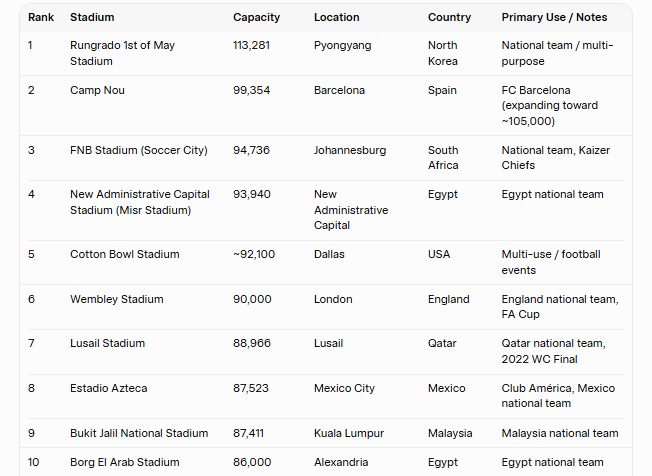
Top 50 Soccer Stadiums of the World (by Capacity)
| Rank | Stadium | Capacity | Location | Country | Primary Use / Notes |
|---|---|---|---|---|---|
| 1 | Rungrado 1st of May Stadium | 113,281 | Pyongyang | North Korea | National team / multi-purpose |
| 2 | Camp Nou | 99,354 | Barcelona | Spain | FC Barcelona (expanding toward ~105,000) |
| 3 | FNB Stadium (Soccer City) | 94,736 | Johannesburg | South Africa | National team, Kaizer Chiefs |
| 4 | New Administrative Capital Stadium (Misr Stadium) | 93,940 | New Administrative Capital | Egypt | Egypt national team |
| 5 | Cotton Bowl Stadium | ~92,100 | Dallas | USA | Multi-use / football events |
| 6 | Wembley Stadium | 90,000 | London | England | England national team, FA Cup |
| 7 | Lusail Stadium | 88,966 | Lusail | Qatar | Qatar national team, 2022 WC Final |
| 8 | Estadio Azteca | 87,523 | Mexico City | Mexico | Club América, Mexico national team |
| 9 | Bukit Jalil National Stadium | 87,411 | Kuala Lumpur | Malaysia | Malaysia national team |
| 10 | Borg El Arab Stadium | 86,000 | Alexandria | Egypt | Egypt national team |
| 11 | Estadio Más Monumental | 85,018 | Buenos Aires | Argentina | River Plate, Argentina national team |
| 12 | Salt Lake Stadium | 85,000 | Kolkata | India | India national team, local clubs |
| 13 | Stadium Australia | 83,500 | Sydney | Australia | Multi-use / Socceroos |
| 14 | Estadio Santiago Bernabéu | 83,186 | Madrid | Spain | Real Madrid |
| 15 | Croke Park | 82,300 | Dublin | Ireland | Gaelic games / occasional football |
| 16 | Jakarta International Stadium | 82,000 | Jakarta | Indonesia | National team / Persija |
| 17 | Signal Iduna Park | 81,365 | Dortmund | Germany | Borussia Dortmund |
| 18 | Stade de France | 81,338 | Saint-Denis | France | France national team |
| 19 | Luzhniki Stadium | 81,000 | Moscow | Russia | National / major events |
| 20 | Shah Alam Stadium | 80,372 | Shah Alam | Malaysia | Selangor / national |
| 21 | Estadio Monumental | 80,093 | Lima | Peru | Universitario |
| 22 | Stadio Giuseppe Meazza (San Siro) | 80,018 | Milan | Italy | AC Milan / Inter |
| 23 | Guangdong Olympic Stadium | 80,012 | Guangzhou | China | Multi-use |
| 24 | Hangzhou Olympic Sports Expo Centre | 80,000 | Hangzhou | China | Multi-use |
| 25 | Stade des Martyrs | 80,000 | Kinshasa | DR Congo | National team |
| 26 | Beijing National Stadium | 80,000 | Beijing | China | Multi-use |
| 27 | Maracanã | 78,838 | Rio de Janeiro | Brazil | Flamengo, Fluminense etc. |
| 28 | Azadi Stadium | 78,116 | Tehran | Iran | National team, Esteghlal, Persepolis |
| 29 | Gelora Bung Karno Stadium | 77,193 | Jakarta | Indonesia | National team |
| 30 | Atatürk Olympic Stadium | 76,092 | Istanbul | Turkey | National / major events |
| 31 | Old Trafford | ~74,000–76,000 | Manchester | England | Manchester United |
| 32 | Tangier Grand Stadium | ~75,500 | Tangier | Morocco | National team |
| 33 | Allianz Arena | 75,024 | Munich | Germany | Bayern Munich |
| 34 | Naghsh-e Jahan Stadium | 75,000 | Isfahan | Iran | Sepahan |
| 35 | Bank of America Stadium | ~74,867 | Charlotte | USA | Multi-use / Charlotte FC |
| 36 | Principality Stadium | 74,500 | Cardiff | Wales | Rugby / football |
| 37 | Olympiastadion Berlin | 74,475 | Berlin | Germany | Hertha BSC / events |
| 38 | Cairo International Stadium | 74,100 | Cairo | Egypt | Al Ahly, Zamalek, national |
| 39 | Estádio Nacional Mané Garrincha | 72,788 | Brasília | Brazil | National / local |
| 40 | Stadio Olimpico | 72,698 | Rome | Italy | Roma, Lazio |
| 41 | Nissan Stadium | 72,327 | Yokohama | Japan | Yokohama F. Marinos |
| 42 | Shanghai Stadium | 72,000 | Shanghai | China | Shanghai Shenhua |
| 43 | Mercedes-Benz Stadium | ~71,000 | Atlanta | USA | Atlanta United |
| 44 | Riyadh Air Metropolitano | ~70,692 | Madrid | Spain | Atlético Madrid |
| 45 | Olympic National Sports Complex | 70,050 | Kyiv | Ukraine | Dynamo Kyiv / national |
| 46 | Nou Mestalla (or similar large Spanish) | ~70,000 | Valencia area | Spain | Various |
| 47 | Estadio La Cartuja | 70,000 | Seville | Spain | Events / national |
| 48 | Seoul Olympic Stadium | 69,950 | Seoul | South Korea | Multi-use |
| 49 | Baku Olympic Stadium | 69,870 | Baku | Azerbaijan | National team |
| 50 | Olympic Stadium (Athens) | 69,618 | Athens | Greece | National team |
Note: Capacities are approximate/current as of available 2026 data and may vary by match configuration. Some multi-use venues (e.g., US college or athletics grounds) appear only if football is regularly hosted. Camp Nou figures reflect ongoing renovation status.
Detailed Look at the Biggest Football Stadium in the World
Rungrado 1st of May Stadium remains the capacity leader. Opened in 1989 on an island in Pyongyang, its distinctive scalloped roof and vast scale serve national team matches alongside mass games and athletics. Modern estimates after seating upgrades place it near 113,000–114,000. Access and international use remain limited, adding to its unique status among global football venues.
Camp Nou holds the European crown. Home to FC Barcelona since 1957, the stadium is undergoing the Espai Barça redevelopment. Target capacity after full completion approaches or exceeds 105,000. Even at current listed figures near 99,000, it consistently ranks among the world’s elite club grounds and hosts major European nights.
FNB Stadium (Soccer City) in Johannesburg is Africa’s standout. Its calabash-inspired design hosted the 2010 World Cup final. With nearly 95,000 seats it serves the South African national team and Kaizer Chiefs while carrying deep historical resonance from post-apartheid events.
Notable European Giants
Wembley Stadium in London seats 90,000 and serves as the spiritual home of English football. It stages FA Cup finals, England internationals, and major finals. The modern arch design replaced the old Twin Towers venue. Santiago Bernabéu in Madrid, after extensive renovation, offers over 83,000 seats with advanced technology including a retractable roof and pitch. Signal Iduna Park in Dortmund is renowned for its “Yellow Wall” standing terrace atmosphere alongside high capacity. Stade de France and Luzhniki Stadium round out major national venues that have hosted World Cup and Champions League finals.
Major Stadiums in the Americas
Estadio Azteca in Mexico City holds historic distinction as a multiple World Cup final host (1970 and 1986) and a 2026 World Cup venue. Its high altitude adds challenge for visiting teams. Estadio Más Monumental in Buenos Aires is River Plate’s fortress and Argentina’s largest after expansions. Maracanã in Rio remains an iconic Brazilian venue despite capacity reductions from its original massive figures. Several US stadiums appear due to multi-use configurations that accommodate soccer alongside American football or other events.
African and Asian Powerhouses
Egypt features strongly with the New Administrative Capital Stadium and Borg El Arab. Lusail Stadium in Qatar hosted the 2022 World Cup final and remains a modern landmark. Bukit Jalil and other Southeast Asian national stadiums demonstrate the region’s growing infrastructure. Iranian venues such as Azadi Stadium regularly fill for domestic and international matches. Chinese Olympic-era stadiums provide large multi-purpose capacity across several cities.
Emerging and Renovated Venues in 2026
Ongoing projects continue to reshape the ranking. Camp Nou’s completion will push European club capacity higher. Moroccan venues linked to future World Cup hosting plans show ambition for larger capacities. Renovations at places like the Bernabéu and Monumental emphasize comfort, technology, and year-round usability beyond pure football. Newer builds prioritize sustainability, accessibility, and mixed-use potential after major tournaments.
Factors Influencing Stadium Size and Design
Large capacities support high average attendances in passionate football cultures. National prestige and tournament bids drive government investment. Club ownership models influence commercial features such as hospitality and entertainment spaces. Safety regulations, all-seater requirements in many competitions, and sightline standards often reduce theoretical maximums from earlier eras. Climate control, retractable roofs, and hybrid pitches have become standard in modern mega-stadiums.
The Future of Football Stadiums Beyond 2026
Expect further growth in capacity at selected elite venues alongside smarter, more sustainable designs. Modular or expandable seating may appear. Fan experience technology, environmental considerations, and multi-event flexibility will shape new projects. While pure size remains impressive, the best stadiums will balance scale with atmosphere, accessibility, and long-term community value. The 2030 World Cup cycle and club infrastructure races will likely produce the next generation of record holders.