
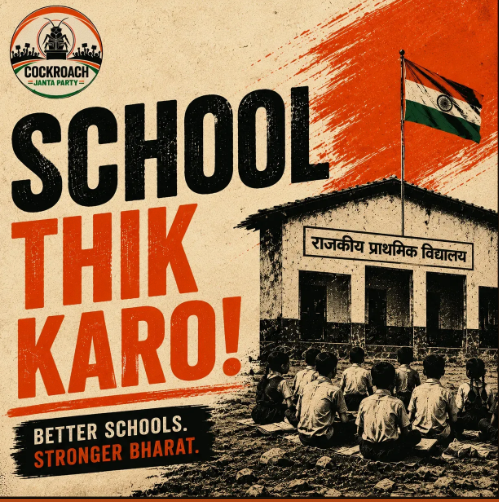
School Thik Karo Campaign can be envisioned as a community-driven initiative to improve the condition of rural government schools across India. A school is not just a building; it is the foundation on which children develop knowledge, confidence, skills and aspirations. However, many rural schools continue to face challenges related to classrooms, toilets, drinking water, electricity, furniture, libraries, digital facilities, playgrounds and regular maintenance.
The objective of a School Thik Karo Campaign should therefore be broader than simply repairing old buildings. It should focus on creating safe, clean, functional, inclusive and learning-friendly government schools. This can be achieved through a combination of government schemes, local administration, School Management Committees (SMCs), Gram Panchayats, CSR support, NGOs, alumni and community participation.
The Government of India’s Samagra Shiksha framework already provides support for strengthening government schools, including additional classrooms, drinking water, toilets, ramps, electrification, libraries, laboratories, furniture and other infrastructure.
What Is the School Thik Karo Campaign?
The School Thik Karo Campaign can be designed as a structured programme to identify problems in rural government schools and solve them through local participation and convergence of available government resources.
Instead of treating every school in the same way, the campaign should begin with a school-by-school assessment. For example, one school may need a new toilet, another may require classroom repairs, while another may have adequate infrastructure but need teaching-learning materials and digital resources.
The campaign can follow a simple principle:
Identify → Prioritise → Fund → Repair → Monitor → Maintain
This approach can help ensure that money and resources are directed towards the most urgent needs rather than being spent on cosmetic improvements alone.
Why Rural Government Schools Need Attention
Rural government schools play an important role in providing affordable education to children from farming families, low-income households and remote communities. For many children, the nearest government school may be the only realistic option for regular education.
Infrastructure problems can affect attendance, safety, dignity and the overall learning environment. A damaged classroom, inadequate toilet facilities, lack of drinking water or absence of electricity can make it difficult for children and teachers to use the school effectively.
The solution is not necessarily to construct expensive new buildings everywhere. In many cases, repairing existing infrastructure, ensuring regular maintenance and improving basic facilities can produce significant results.
Major Areas to Fix Under the School Thik Karo Campaign
1. Repair Damaged School Buildings
The first priority should be structural safety. Schools should be inspected for damaged roofs, cracked walls, broken doors and windows, unsafe floors and other hazards.
A basic school audit should identify:
- Damaged classrooms
- Roof leakage
- Cracked walls
- Broken doors and windows
- Unsafe electrical wiring
- Damaged boundary walls
- Waterlogging around buildings
- Unsafe staircases
- Broken classroom flooring
Major structural problems should be referred to the competent engineering or education authorities rather than being handled through informal repairs.
2. Make Toilets Functional and Clean
Having a toilet on the school premises is not enough. It must be functional, clean, accessible and regularly maintained.
Schools should ideally have separate facilities for boys and girls, adequate water supply and arrangements for cleanliness. Facilities should also consider children with disabilities.
Samagra Shiksha includes support for separate toilets for boys, girls and Children with Special Needs, along with other accessibility measures.
Under the campaign, every school can maintain a simple monthly toilet checklist covering:
| Checkpoint | Status |
|---|---|
| Toilet functional | Yes/No |
| Water available | Yes/No |
| Doors and locks working | Yes/No |
| Cleaning done regularly | Yes/No |
| Girls’ toilet usable | Yes/No |
| Handwashing facility | Yes/No |
| Accessibility for children with disabilities | Yes/No |
3. Ensure Safe Drinking Water
Every child should have access to safe drinking water during school hours.
The campaign can work with the Gram Panchayat and relevant departments to address:
- Non-functional hand pumps
- Broken taps
- Water storage problems
- Contaminated water sources
- Lack of drinking-water points
- Inadequate water during summer
- Poor maintenance of tanks and pipelines
Where technically and financially appropriate, schools can also explore rainwater harvesting and other sustainable water solutions.
4. Provide Electricity and Lighting
Electricity is increasingly important for both teaching and administration. Classrooms should have safe wiring, functional fans and adequate lighting.
Schools can be assessed for:
- Electricity connection
- Functional lights
- Functional fans
- Safe wiring
- Switchboards
- Backup power where required
- Solar solutions where grid supply is unreliable
Samagra Shiksha specifically includes electrification and solar-panel-related infrastructure among supported interventions.
5. Repair Classrooms and Provide Furniture
A child should not have to study in an unsafe or uncomfortable classroom.
The campaign should identify schools where students are sitting on damaged furniture or where classrooms lack basic teaching infrastructure.
Priority items can include:
- Student desks and benches
- Teacher tables and chairs
- Blackboard/whiteboard
- Storage cupboards
- Classroom lighting
- Fans
- Curtains or suitable ventilation
- Floor and wall repairs
- Safe doors and windows
Furniture procurement should be based on actual student strength and classroom requirements.
6. Build Better Libraries
A rural government school does not need an expensive library building to encourage reading.
A reading corner or classroom library can be created with:
- Age-appropriate storybooks
- Hindi and regional-language books
- English reading material
- Children’s newspapers
- Science books
- General knowledge books
- Maps and educational charts
- Reference material
The objective should be to make books accessible to children rather than keeping them locked in cupboards.
Samagra Shiksha provides for library-related interventions as part of school-quality improvement.
7. Improve Digital Education Facilities
Digital education can help rural students access high-quality learning resources, but technology should be introduced according to actual school requirements.
Possible interventions include:
- Smart TV/projector
- Computer systems
- Internet connectivity
- Digital learning content
- Educational videos
- Offline digital resources
- Basic computer literacy
- Teacher training
Schools should first ensure electricity and reliable basic infrastructure before spending heavily on advanced technology.
The government’s Samagra Shiksha framework also includes ICT projects, hardware/software support and digital resources.
8. Create Safe Playgrounds
Physical activity is an important part of children’s development.
The School Thik Karo Campaign can identify schools that have unused or poorly maintained land and convert suitable areas into basic playgrounds.
Depending on available space, schools can provide facilities for:
- Football
- Volleyball
- Kabaddi
- Kho-kho
- Cricket
- Athletics
- Indoor games
Samagra Shiksha provides for sports equipment and physical education support for government schools, with grant amounts linked to school level and applicable norms.
9. Improve Boundary Walls and School Safety
A school should provide a secure environment for children.
The campaign can prioritise:
- Boundary-wall repairs
- Safe gates
- Removal of dangerous structures
- Proper classroom exits
- Safe electrical systems
- Adequate lighting
- Prevention of open drains near school areas
- Safe access roads
Safety improvements should be based on a professional inspection wherever structural risks are involved.
10. Make Schools Disability-Friendly
Rural schools should be accessible to children with disabilities.
Important facilities include:
- Ramps
- Handrails
- Accessible toilets
- Appropriate classroom access
- Suitable teaching-learning materials
- Support for children with special needs
Samagra Shiksha explicitly provides infrastructure and student-oriented support for Children with Special Needs.
How to Run the School Thik Karo Campaign
Step 1: Select Schools
Begin with a cluster of villages rather than attempting to repair hundreds of schools simultaneously.
For example:
Phase 1: 10 schools
Phase 2: 25 schools
Phase 3: 100 schools
Phase 4: District-wide expansion
Starting with a smaller group makes monitoring easier and allows the campaign to demonstrate measurable results.
Step 2: Conduct a School Audit
A team consisting of teachers, parents, SMC members, Panchayat representatives, engineers and volunteers can conduct a basic infrastructure audit.
Each school should receive a score for:
| Area | Suggested Priority |
|---|---|
| Building safety | Very High |
| Drinking water | Very High |
| Toilets | Very High |
| Electricity | High |
| Furniture | High |
| Accessibility | High |
| Library | Medium |
| Digital facilities | Medium |
| Playground | Medium |
| Beautification | Low |
Safety and basic functionality should always come before beautification.
Step 3: Prepare a School Repair Plan
After the audit, prepare a school-specific plan.
For example:
School A: Repair two classrooms + toilet repair + drinking water
School B: Furniture + electricity + library
School C: Boundary wall + ramp + playground
School D: Roof repair + toilets + digital classroom
This prevents unnecessary spending and ensures that every rupee addresses an identified requirement.
Step 4: Use Government Schemes First
One of the most important principles of the campaign should be:
“Use government resources first, community resources for gaps.”
Samagra Shiksha supports states and Union Territories in strengthening existing government schools based on infrastructure gaps identified through education data and state proposals. Its interventions cover classrooms, drinking water, toilets, ramps, electrification, laboratories and other facilities.
The campaign can therefore help communities understand:
- What the school requires
- Which department is responsible
- Which government scheme may cover the requirement
- What documentation is needed
- How to monitor implementation
Step 5: Involve the Gram Panchayat
The Gram Panchayat can play an important role in local school improvement.
It can help coordinate issues relating to:
- Cleanliness
- Water
- Sanitation
- Local infrastructure
- Drainage
- School surroundings
- Community participation
- Local maintenance
Regular meetings involving the school head, SMC and Panchayat can help resolve small problems before they become expensive repairs.
Step 6: Strengthen School Management Committees
The SMC should not exist merely as a formal committee.
Parents and community representatives can participate in:
- School inspections
- Attendance monitoring
- Infrastructure audits
- Cleanliness drives
- Parent meetings
- Local fundraising
- Monitoring repair work
- Feedback from students
Samagra Shiksha also includes capacity-building support for SMCs/SMDCs and PTAs.
Step 7: Bring CSR and NGOs into the Campaign
Companies, NGOs and philanthropic organisations can support schools where government funding does not immediately cover a requirement.
Possible CSR/NGO projects include:
- Libraries
- Science laboratories
- Computer labs
- Sports equipment
- Drinking-water systems
- Girls’ hygiene facilities
- School furniture
- Digital classrooms
- Teacher-support programmes
However, external organisations should coordinate with the school and relevant authorities rather than independently changing school infrastructure.
Step 8: Adopt a School
The campaign can introduce a “Adopt a School for Improvement” model.
An organisation, alumni group, NGO or group of citizens can support one school for a defined period.
For example:
12-Month School Improvement Plan
| Month | Activity |
|---|---|
| 1 | Infrastructure audit |
| 2 | Priority plan |
| 3–4 | Basic repairs |
| 5 | Toilet and water improvement |
| 6 | Furniture |
| 7 | Library |
| 8 | Digital resources |
| 9 | Playground |
| 10 | Teacher/community activities |
| 11 | Review |
| 12 | Impact assessment |
The model should focus on sustainable improvement rather than a one-time donation.
How Much Can a School Improvement Campaign Cost?
The cost will vary substantially depending on the school’s condition, size, location and whether work involves structural construction.
A campaign can divide expenses into three categories:
| Category | Examples |
|---|---|
| Basic | Cleaning, painting, minor repairs, classroom materials |
| Moderate | Toilets, furniture, electrical work, water facilities |
| Major | Building repairs, additional classrooms, boundary walls, laboratories |
Instead of announcing a single universal cost, each school should have an independently prepared estimate based on its requirements and applicable government rates.
Create a Transparent School Improvement Dashboard
Transparency can make the campaign more credible.
For every participating school, publish:
- School name
- Number of students
- Number of teachers
- Existing facilities
- Problems identified
- Estimated cost
- Funding source
- Work completed
- Work pending
- Before-and-after photographs
- Date of inspection
A public dashboard can allow parents and donors to see exactly what has been achieved.
School Thik Karo Campaign: Suggested 10-Point Checklist
Every participating school can be assessed using the following checklist:
- Building is structurally safe
- Classrooms are usable
- Adequate furniture is available
- Drinking water is available
- Toilets are functional and clean
- Electricity and lighting are functional
- School is accessible to children with disabilities
- Library/reading resources are available
- Sports facilities/equipment are available
- Regular maintenance and monitoring system exists
Focus on Learning, Not Only Buildings
A major mistake would be to make School Thik Karo only a construction campaign.
A school can have a beautiful building and still produce poor learning outcomes if children do not receive adequate academic support.
Therefore, the campaign should also focus on:
Foundational Literacy and Numeracy
Young children should receive targeted support in reading, writing and basic mathematics.
Teacher Support
Teachers need access to training, teaching-learning materials and useful digital resources.
Remedial Education
Students who are behind their grade level should receive additional academic support.
Attendance
The campaign should monitor student attendance and identify reasons for irregular attendance.
Parent Engagement
Parents should receive regular information about children’s learning progress.
Samagra Shiksha includes quality interventions such as foundational literacy and numeracy, teaching-learning materials, libraries, learning enhancement programmes and teacher capacity building.
Role of Technology in School Thik Karo Campaign
Technology can make monitoring easier.
A simple mobile-based system can allow volunteers or officials to upload:
School → Problem → Photograph → Estimated Cost → Responsible Department → Status
For example:
Broken toilet → Photograph uploaded → Repair requested → Work sanctioned → Work completed → Verification photograph
This creates an evidence-based monitoring system and reduces the possibility of forgotten complaints.
Community Participation Model
The campaign should encourage villagers to see the school as a community asset.
Local residents can contribute through:
- Volunteer time
- Tree plantation
- Cleanliness drives
- Book donations
- Sports equipment
- Mentoring
- Career guidance
- Alumni support
- Monitoring school facilities
However, community participation should complement—not replace—the government’s responsibility to provide public education and essential infrastructure.
What Should Be Fixed First?
A practical priority order is:
1. Structural safety
↓
2. Drinking water and toilets
↓
3. Electricity and classroom functionality
↓
4. Furniture and accessibility
↓
5. Learning resources and library
↓
6. Digital facilities
↓
7. Sports and playground
↓
8. Beautification
This ensures that limited resources are spent first on facilities that directly affect children’s safety, dignity and ability to learn.
Expected Benefits of the Campaign
A properly implemented School Thik Karo Campaign could help achieve:
- Safer school buildings
- Better sanitation
- Improved drinking-water access
- Better classroom environments
- Greater student attendance
- Improved parent participation
- Better access to books and learning resources
- More inclusive schools
- Improved digital access
- Stronger community ownership
- Better monitoring of school infrastructure
The long-term objective should be to create rural schools where children want to study, teachers can work effectively and parents have confidence in the government education system.
Conclusion
The School Thik Karo Campaign can become a powerful model for improving rural government schools in India if it moves beyond simple painting and beautification. The real objective should be to make every participating school safe, functional, inclusive, clean and academically effective.
Government schemes such as Samagra Shiksha already provide a framework for improving infrastructure and educational quality. The biggest opportunity is to connect these provisions with effective local monitoring, community participation, Panchayat involvement, CSR support and transparent implementation.
A successful campaign should therefore follow one simple principle:
“Pehle School Ki Basic Zaroorat, Phir Quality Education, Aur Uske Baad Beautification.”
If implemented systematically, fixing rural schools is not merely an infrastructure project—it is an investment in the future of India’s children and rural communities.