
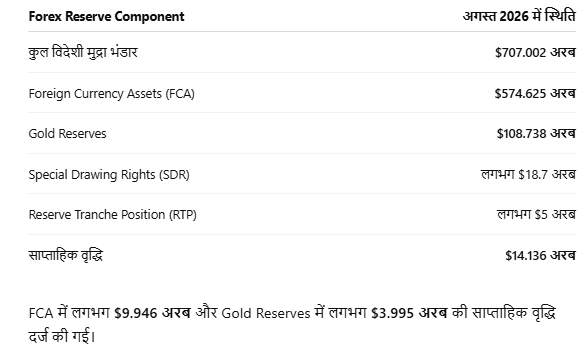
India Forex Reserves: India’s foreign exchange reserves (Forex Reserves) are an important indicator of the country’s economic and financial stability. In August 2026, India’s Forex Reserves once again crossed the $700 billion mark. According to the latest available data, India’s foreign exchange reserves stood at around $707.002 billion as of the week ended August 7, 2026, registering an increase of approximately $14.136 billion over the previous week.
India’s foreign exchange reserves primarily consist of Foreign Currency Assets (FCA), Gold Reserves, Special Drawing Rights (SDRs), and Reserve Tranche Position (RTP). The Reserve Bank of India (RBI) manages these reserves with the objective of maintaining external financial stability.
India Forex Reserves 2026: Latest Data
According to the latest available August 2026 data, India’s total Forex Reserves stood at approximately $707.002 billion as of August 7, 2026. During this period, both Foreign Currency Assets and Gold Reserves recorded significant increases.
| Forex Reserve Component | Position in August 2026 |
|---|---|
| Total Foreign Exchange Reserves | $707.002 billion |
| Foreign Currency Assets (FCA) | $574.625 billion |
| Gold Reserves | $108.738 billion |
| Special Drawing Rights (SDR) | Around $18.7 billion |
| Reserve Tranche Position (RTP) | Around $5 billion |
| Weekly Increase | $14.136 billion |
Foreign Currency Assets increased by approximately $9.946 billion, while Gold Reserves increased by around $3.995 billion during the week.
Note: Forex Reserve figures can change every week. Therefore, candidates preparing for competitive examinations and current affairs should refer to the latest RBI release for updated figures.
What Are India’s Foreign Exchange Reserves?
Foreign Exchange Reserves refer to foreign assets held by a country’s central bank that can be used for international payments, intervention in the foreign exchange market, and during periods of economic stress.
In India, the Reserve Bank of India (RBI) manages the country’s foreign exchange reserves. These reserves are not simply cash held in US dollars. Instead, they consist of foreign currency assets, gold, SDRs, and the Reserve Tranche Position with the International Monetary Fund (IMF).
The RBI reports India’s foreign exchange reserves in US dollar terms, although the underlying foreign currency assets can be held in different major currencies and asset classes.
Major Components of India’s Foreign Exchange Reserves
1. Foreign Currency Assets (FCA)
Foreign Currency Assets constitute the largest component of India’s Forex Reserves. They include investments and assets denominated in major international currencies.
According to the RBI, FCA can include assets denominated in currencies such as the US dollar, euro, pound sterling, and Japanese yen. The value of FCA can change because of foreign exchange market movements, investment income, transactions, and revaluation of assets.
In August 2026, India’s FCA stood at approximately $574.625 billion, making it the largest component of the country’s total Forex Reserves.
2. Gold Reserves
Gold is another important component of India’s foreign exchange reserves. The RBI values its gold holdings based on international gold prices.
As of the week ended August 7, 2026, India’s Gold Reserves were valued at approximately $108.738 billion. Gold Reserves increased by around $3.995 billion during the week.
When international gold prices rise, the dollar value of India’s gold reserves can increase even if the RBI does not purchase additional gold.
3. Special Drawing Rights (SDR)
Special Drawing Rights, commonly known as SDRs, are international reserve assets created by the International Monetary Fund (IMF).
SDRs are not conventional currencies used for everyday transactions. Instead, they form part of the official foreign exchange reserves of IMF member countries.
4. Reserve Tranche Position (RTP)
Reserve Tranche Position refers to India’s reserve position with the IMF. It is also included in the country’s total foreign exchange reserves.
Therefore, India’s total Forex Reserves cannot be calculated simply by adding FCA and Gold Reserves. SDRs and Reserve Tranche Position also form part of the overall reserve figure.
Why Did India’s Forex Reserves Increase in August 2026?
India’s Forex Reserves witnessed a sharp increase during the first week of August 2026. The major contributors were the increase in Foreign Currency Assets and Gold Reserves.
Foreign exchange inflows and policy measures undertaken by the RBI also supported India’s external sector.
The RBI had introduced measures related to foreign currency inflows, including swap facilities, to strengthen foreign exchange liquidity. Strong inflows subsequently supported the country’s foreign exchange position.
Importance of India’s Forex Reserves
Adequate foreign exchange reserves are extremely important for a large and import-dependent economy such as India. They influence the country’s external payment capacity, currency stability, and ability to withstand global economic shocks.
Helps Maintain Rupee Stability
When there is excessive pressure on the Indian rupee, the RBI can intervene in the foreign exchange market. Adequate reserves provide the central bank with greater flexibility to manage excessive volatility.
However, a high level of Forex Reserves does not guarantee that the rupee will always remain strong. Exchange rates are also affected by global dollar demand, crude oil prices, capital flows, interest rates, and several other factors.
Supports Import Payments
India imports large quantities of crude oil, electronics, machinery, gold, and other products. Payments for many of these imports are made in foreign currencies.
Adequate Forex Reserves help India meet its external payment obligations during periods of financial or economic stress.
Provides Protection During Economic Crises
During global financial crises, sudden capital outflows, geopolitical tensions, or external economic shocks, foreign exchange reserves act as an important financial cushion.
This is why adequate reserves are considered an important indicator of India’s external-sector resilience.
Historical Growth of India’s Forex Reserves
India’s foreign exchange reserves have increased significantly over the past few decades. According to RBI data, India’s foreign exchange reserves increased from approximately $38 billion in 2000 to around $691 billion in 2026. The reserves subsequently crossed the $700 billion level in August 2026.
| Year/Period | India’s Forex Reserves |
|---|---|
| 2000 | Around $38 billion |
| March 2026 | Around $691 billion |
| August 7, 2026 | Around $707.002 billion |
This long-term increase has been supported by several factors, including India’s growing exports, services exports, remittances, capital inflows, and the RBI’s foreign exchange reserve management strategy.
Is Having Higher Forex Reserves Always Good?
In general, strong foreign exchange reserves are considered positive for an economy. However, the overall health of an economy cannot be judged solely by the size of its reserves.
It is also important to consider:
- Import cover
- External debt
- Current account position
- Capital inflows and outflows
- Composition of reserves
- Global movements in the US dollar and gold prices
Therefore, Forex Reserves should be considered one of several indicators of India’s external financial position.
Who Manages India’s Forex Reserves?
India’s foreign exchange reserves are managed by the Reserve Bank of India (RBI).
The RBI’s objective is to manage the reserves while maintaining adequate safety and liquidity and seeking reasonable returns. The central bank uses various foreign currency assets and other reserve assets as part of its reserve management strategy.
The RBI regularly publishes India’s foreign exchange reserve data.
What Is the Relationship Between Forex Reserves and the Indian Rupee?
There is an important relationship between India’s Forex Reserves and the Indian rupee.
When demand for foreign currency rises and the rupee comes under excessive pressure, the RBI can use its foreign exchange reserves to supply foreign currency to the market.
On the other hand, when the RBI purchases foreign currency, India’s reserves can increase.
However, the rupee’s exchange rate does not depend solely on Forex Reserves. Several other factors also influence the rupee, including:
- Global strength of the US dollar
- Crude oil prices
- Interest rates
- Foreign Portfolio Investment (FPI)
- India’s trade balance
- Global economic conditions
India Forex Reserves 2026: Important Facts for Exams
| Question | Answer |
|---|---|
| Who manages India’s Forex Reserves? | RBI |
| What is the largest component of India’s Forex Reserves? | Foreign Currency Assets |
| What is the second major component? | Gold |
| Which institution is associated with SDRs? | IMF |
| In which currency are Forex Reserve figures reported? | US Dollar |
| Forex Reserve in August 2026 | Around $707 billion |
| Total Reserve as of August 7, 2026 | $707.002 billion |
| Foreign Currency Assets | $574.625 billion |
| Gold Reserves | $108.738 billion |
| Weekly increase | $14.136 billion |
The most important current-affairs fact is that India’s Forex Reserves reached $707.002 billion in the week ended August 7, 2026.
भारत के विदेशी मुद्रा भंडार
भारत का विदेशी मुद्रा भंडार (Foreign Exchange Reserves) देश की आर्थिक और वित्तीय स्थिरता का एक महत्वपूर्ण संकेतक है। अगस्त 2026 में भारत का Forex Reserve एक बार फिर $700 अरब के पार पहुंच गया है। RBI के अनुसार, 7 अगस्त 2026 को समाप्त सप्ताह में भारत का विदेशी मुद्रा भंडार करीब $707.002 अरब रहा, जो पिछले सप्ताह की तुलना में लगभग $14.136 अरब की वृद्धि है।
भारत के विदेशी मुद्रा भंडार में मुख्य रूप से Foreign Currency Assets (FCA), Gold Reserves, Special Drawing Rights (SDR) और Reserve Tranche Position (RTP) शामिल होते हैं। RBI इन आंकड़ों को नियमित रूप से जारी करता है और विदेशी मुद्रा भंडार का प्रबंधन देश की बाहरी वित्तीय स्थिरता को ध्यान में रखकर करता है।
भारत विदेशी मुद्रा भंडार 2030
- अनुमानित लक्ष्य: वर्ष 2030 तक यह भंडार बढ़कर करीब 762.5 अरब डॉलर होने का अनुमान लगाया गया है।
- मुख्य घटक: इसमें विदेशी मुद्रा परिसंपत्तियां (FCA), स्वर्ण भंडार (Gold), विशेष आहरण अधिकार (SDR) और अंतर्राष्ट्रीय मुद्रा कोष (IMF) में आरक्षित स्थिति शामिल है।
- आर्थिक महत्व: यह बढ़ता भंडार देश के आयात भुगतान, रुपये के मूल्य में स्थिरता और वैश्विक आर्थिक संकटों से सुरक्षा प्रदान करने में मदद करता है।
Conclusion
India’s foreign exchange reserves remained strong in 2026. In August 2026, the country’s reserves crossed the $700 billion mark, strengthening India’s external financial position.
The increase in Foreign Currency Assets and Gold Reserves made a major contribution to the rise in total reserves. A strong Forex Reserve provides India with an important cushion against global economic uncertainty, external payment pressures, and excessive volatility in the Indian rupee.
However, the strength of an economy cannot be assessed solely through its foreign exchange reserves. Other indicators such as the trade balance, current account, external debt, capital flows, inflation, and economic growth must also be considered.
India Forex Reserves 2026 FAQs
Q1. What are India’s Forex Reserves in August 2026?
As of the week ended August 7, 2026, India’s foreign exchange reserves stood at approximately $707.002 billion.
Q2. What is the largest component of India’s Forex Reserves?
Foreign Currency Assets (FCA) are the largest component. As of August 7, 2026, FCA stood at approximately $574.625 billion.
Q3. How much gold does India have in its Forex Reserves?
As of August 7, 2026, India’s Gold Reserves were valued at approximately $108.738 billion.
Q4. Who manages India’s foreign exchange reserves?
The Reserve Bank of India (RBI) manages India’s foreign exchange reserves.
Q5. What are the benefits of increasing Forex Reserves?
Higher Forex Reserves strengthen India’s external payment capacity and provide the RBI with greater flexibility to manage excessive volatility in the foreign exchange market.
Q6. Are India’s Forex Reserves held only in US dollars?
No. Although India’s Forex Reserve figures are reported in US dollar terms, the underlying foreign currency assets can be held in different international currencies and asset classes.
Q7. Why did India’s Forex Reserves increase in 2026?
The increase during August 2026 was mainly supported by growth in Foreign Currency Assets and Gold Reserves, along with foreign exchange inflows and other factors affecting the valuation of reserve assets.
Q8. Why are Forex Reserves important for India?
Forex Reserves help India meet international payment obligations, manage external shocks, support financial stability, and provide the RBI with resources to intervene in the foreign exchange market when necessary.
Source: Reserve Bank of India (RBI) foreign exchange reserve data and related publications.