
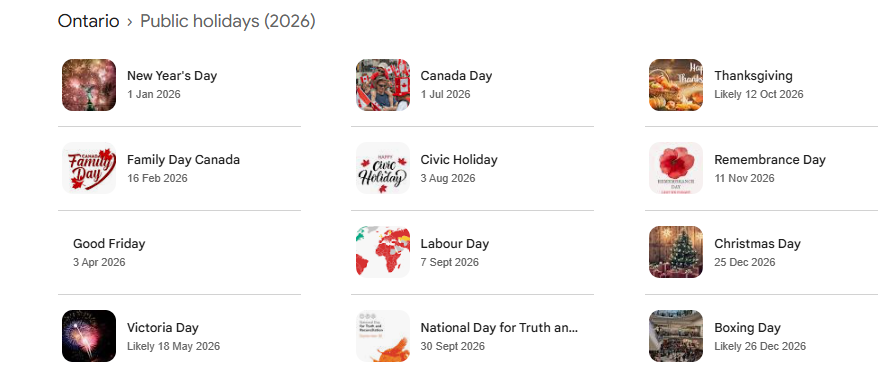
Statutory Holidays in Ontario 2026: Ontario recognizes nine public holidays (commonly called statutory or “stat” holidays) under the Employment Standards Act, 2000 (ESA). These are the only days on which most employees covered by the ESA are legally entitled to a paid day off or premium pay if they work. The list is fixed by legislation and does not change from year to year, although the calendar dates shift. Civic Holiday (first Monday in August), Easter Monday, Remembrance Day, and the National Day for Truth and Reconciliation are not statutory holidays in Ontario, even though many employers and governments observe some of them voluntarily.
Understanding the exact dates, eligibility rules, and pay entitlements helps both employers and employees plan payroll, time off, and business operations throughout the year. The following sections provide a complete overview for 2026, including the official list, long-weekend implications, and key practical considerations.
Complete List of Ontario Statutory Holidays in 2026
Ontario’s nine statutory public holidays for 2026 fall on the following dates:
- New Year’s Day – Thursday, January 1, 2026
- Family Day – Monday, February 16, 2026 (third Monday in February)
- Good Friday – Friday, April 3, 2026
- Victoria Day – Monday, May 18, 2026 (Monday before May 25)
- Canada Day – Wednesday, July 1, 2026
- Labour Day – Monday, September 7, 2026 (first Monday in September)
- Thanksgiving Day – Monday, October 12, 2026 (second Monday in October)
- Christmas Day – Friday, December 25, 2026
- Boxing Day – Saturday, December 26, 2026 (often observed on Monday, December 28 for many Monday-to-Friday workers)
These nine days form the complete statutory list. No other day in 2026 carries automatic ESA public-holiday entitlements. Employers may grant additional paid or unpaid days off through company policy or collective agreements, but they are not required to do so under provincial employment standards.
Eligibility and Public Holiday Pay Rules
Most employees in Ontario who are covered by the ESA qualify for public holiday entitlements. To be eligible for public holiday pay on a given holiday, an employee generally must work their last scheduled day before the holiday and their first scheduled day after the holiday (the “last and first” rule), unless the absence is authorized. Certain categories of workers—such as some professionals, managers, or those in specific industries—may be exempt or subject to different rules.
Public holiday pay is calculated as the total amount of regular wages earned and vacation pay payable to the employee in the four work weeks before the work week in which the public holiday occurs, divided by 20. If an eligible employee works on a public holiday, they are normally entitled to either public holiday pay plus premium pay (at least 1.5 times their regular rate) for the hours worked, or a substitute day off with public holiday pay. Written or electronic agreement is required for some alternative arrangements.
Employers must keep accurate records of hours and pay related to public holidays. Failure to provide the required entitlement can result in orders to pay, administrative penalties, or other enforcement action by the Ministry of Labour.
Long Weekends and Calendar Impact in 2026
Several 2026 statutory holidays create convenient long weekends that many Ontarians use for travel, family gatherings, or short trips. Family Day (February 16) produces a three-day weekend from Saturday to Monday. Good Friday (April 3) and the following Easter weekend offer extended time off for many. Victoria Day (May 18), Labour Day (September 7), and Thanksgiving (October 12) each deliver classic Monday long weekends. Christmas Day falling on a Friday creates a strong holiday stretch at the end of the year.
Canada Day falls mid-week on a Wednesday, so it does not generate a long weekend on its own. Boxing Day lands on a Saturday; under ESA rules, many employees whose regular work week is Monday to Friday will receive a substitute day off (commonly Monday, December 28) with public holiday pay, unless an alternative arrangement is agreed. Planning around these dates helps families book vacations, employers schedule staffing, and retailers prepare for peak shopping periods.
Days Commonly Mistaken for Statutory Holidays
Three widely observed days are frequently confused with statutory holidays but carry no automatic ESA entitlements in Ontario. Civic Holiday (Monday, August 3, 2026)—also known locally as Simcoe Day, Colonel By Day, or other municipal names—is not a public holiday under the ESA. Many government offices, banks, and businesses close, yet private-sector employers are not required to provide paid time off or premium pay. Easter Monday (April 6, 2026) and Remembrance Day (November 11, 2026) are likewise optional. The National Day for Truth and Reconciliation (September 30) is observed by the federal government and some employers but is not an Ontario statutory holiday.
Workers should always check their employment contract, collective agreement, or workplace policy to determine whether any of these optional days are granted as paid holidays by their specific employer.
Business Closures, Retail Rules, and Practical Considerations
On statutory holidays most non-emergency government offices, banks, and Canada Post locations close. Many private-sector offices also shut. Retail rules are more flexible: under the Retail Business Holidays Act, most retail stores may open on statutory holidays except for certain restricted days (Christmas Day and, in some municipalities, other holidays). Grocery stores, pharmacies, and tourist-oriented businesses often remain open with adjusted hours. Public transit typically runs on a holiday or reduced schedule.
Employers should post holiday schedules in advance, confirm eligibility for each employee, and ensure correct calculation of public holiday pay or premium pay. Employees who are required to work should receive clear notice and proper compensation. Because Boxing Day falls on a weekend in 2026, extra attention to substitute-day arrangements is advisable for Monday-to-Friday workplaces.
Federal Statutory Holidays in Canada for 2026
Federal statutory holidays (also called general holidays) apply to employees in federally regulated industries and workplaces under the Canada Labour Code. These include banks, airlines, railways, interprovincial trucking, telecommunications, broadcasting, federal Crown corporations, and the federal public service. Provincial and territorial employment standards do not apply to these workers.
Unlike provincial lists (which vary by jurisdiction), the federal list is uniform across the country, with limited exceptions (notably for Quebec on certain days).
Complete List of Federal Statutory Holidays in 2026
| Holiday | Date in 2026 | Day of Week | Notes |
|---|---|---|---|
| New Year’s Day | January 1 | Thursday | Fixed date |
| Good Friday | April 3 | Friday | — |
| Easter Monday | April 6 | Monday | Observed by most federal public-service employers |
| Victoria Day | May 18 | Monday | Monday preceding May 25 |
| Canada Day | July 1 | Wednesday | Fixed date |
| Civic Holiday | August 3 | Monday | First Monday in August (not observed in Quebec) |
| Labour Day | September 7 | Monday | First Monday in September |
| National Day for Truth and Reconciliation | September 30 | Wednesday | Fixed date since 2021 |
| Thanksgiving Day | October 12 | Monday | Second Monday in October |
| Remembrance Day | November 11 | Wednesday | Fixed date |
| Christmas Day | December 25 | Friday | Fixed date |
| Boxing Day | December 26 | Saturday | Often substituted to Monday, December 28 for many Monday–Friday workers |
Total: 11–12 days depending on whether Easter Monday is counted as a formal general holiday under a specific collective agreement or policy (it is widely observed in the federal public service).
Key Details and Eligibility
Under the Canada Labour Code, eligible employees are entitled to a paid day off on these holidays or, if they work, to holiday pay plus premium pay (usually 1.5× their regular rate) for hours worked. Eligibility generally requires the employee to have worked at least 30 days in the preceding 12 months and to meet certain attendance conditions around the holiday.
When a federal holiday falls on a weekend, a substitute day is often provided (commonly the following Monday). In 2026 this applies particularly to Boxing Day (Saturday, December 26), which many workplaces will observe on Monday, December 28.
Civic Holiday (August 3) is included on the federal list (except in Quebec). This is why federally regulated employees in most of Canada receive the August long weekend even when their provincial counterparts (e.g., in Ontario) do not have it as a statutory holiday.
Who Is Covered
Only employees whose work falls under federal jurisdiction receive these entitlements automatically. Examples include:
- Bank and credit-union employees
- Airline and airport staff
- Railway and interprovincial transportation workers
- Telecommunications and postal employees (Canada Post)
- Federal public servants and many Crown-corporation employees
Workers in provincially regulated industries (most retail, hospitality, manufacturing, construction, etc.) follow their province’s or territory’s statutory holiday list instead.
Practical Notes for 2026
- Long weekends occur on Victoria Day (May 16–18), Labour Day (September 5–7), and Thanksgiving (October 10–12).
- Canada Day falls mid-week (Wednesday).
- National Day for Truth and Reconciliation (September 30) is a mid-week weekday holiday.
- Boxing Day’s weekend placement will trigger substitute-day rules for many Monday-to-Friday schedules.
For the most authoritative confirmation, consult the Canada Labour Code Part III, the Labour Program of Employment and Social Development Canada, or your collective agreement/employer policy. Dates and entitlements can occasionally be affected by specific industry agreements or temporary government directives.
Looking Ahead and Key Takeaways
The nine statutory holidays remain consistent year after year, giving Ontarians a predictable framework for time off and premium pay. In 2026 the calendar produces several well-spaced long weekends, particularly in February, April, May, September, and October, while the mid-week Canada Day and Saturday Boxing Day require specific planning. Awareness of the difference between true statutory holidays and optional observances prevents misunderstandings about pay and time-off rights.
Both employers and employees benefit from reviewing the official ESA public-holiday provisions and consulting the Ministry of Labour or a qualified employment-law advisor when questions arise. With the complete 2026 list and the associated rules in hand, Ontarians can approach the year with clarity about when they are entitled to paid time off and how holiday pay is calculated.