
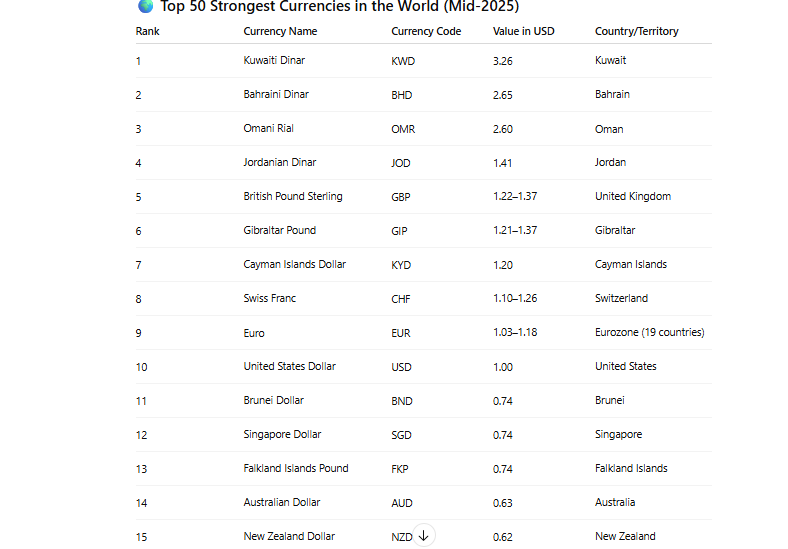
Top 50 Strongest Currencies in the World 2026

The strength of a currency is often seen as a reflection of a country’s economic stability, inflation rate, and the demand for its currency in international markets. The top 50 strongest currencies in the world are typically determined by their exchange rates against major currencies, particularly the U.S. dollar. A strong currency indicates high purchasing power and often suggests a well-performing economy. Some currencies, such as the Kuwaiti Dinar, the Bahraini Dinar, and the Omani Rial, regularly top the list, benefiting from robust economies, high oil exports, or strategic global trade positions.

These currencies are not only a measure of economic health but also an indicator of geopolitical strength. The list includes both well-established currencies from powerhouse economies and those from smaller nations with specialized industries or resources. A strong currency can impact global trade, making imports cheaper for domestic consumers, while posing challenges for exporters by increasing the cost of their goods on the international market.

The ranking of currencies fluctuates based on a variety of factors, including inflation rates, interest rates, economic policies, and global demand. Understanding the world’s strongest currencies offers insight into the dynamics of global finance and the interconnectedness of international markets.

Top 50 Strongest Currencies in the World in 2026

Currency strength is commonly measured by the exchange rate value of one unit against the US dollar. A higher USD value per unit indicates a stronger currency on this metric. Mid-2026 data consistently place Gulf oil-backed and certain pegged or managed currencies at the top, followed by major floating currencies. Note that high unit value does not equal global influence, liquidity, or reserve status—the US dollar remains dominant in trade and reserves despite ranking lower by pure unit value.

Understanding Currency Strength and Ranking Methodology

Currency strength rankings by unit value against the USD reflect how many dollars one unit of a foreign currency buys. Pegged or managed currencies often top these lists because central banks set or tightly control the rate, frequently supported by commodity revenues or reserves. Floating currencies fluctuate with markets, interest rates, inflation, and economic data. Mid-2026 rates draw from market data for floating currencies and official or parity rates for managed ones. Rankings can shift slightly with market moves, but the top positions have remained stable for years due to structural factors like oil wealth and policy design. This approach prioritizes nominal value rather than purchasing power parity, trade volume, or reserve holdings.

Other measures of strength include stability over time, liquidity in forex markets, and share of global reserves. The dollar still accounts for the large majority of FX transactions and reserves. High-value currencies from smaller economies may see limited trading outside their home markets. Rankings here focus on the widely used unit-value metric for consistency with mid-2026 sources.

Factors Driving High Currency Value

Oil and gas exports underpin several top currencies. Countries with large hydrocarbon reserves generate substantial foreign-currency inflows that support strong exchange rates or allow sustained pegs. Small populations relative to resource wealth further concentrate value. Conservative fiscal policies, large sovereign wealth funds, and low public debt reinforce credibility. Pegs to the USD or currency baskets reduce volatility and signal commitment to stability. International aid, remittances, and financial-services sectors also help maintain high values in some cases. Political stability and independent central banks contribute to investor confidence, especially for safe-haven currencies.

Inflation control and interest-rate differentials influence floating currencies. Strong institutions and diversified economies help sustain value even without commodity windfalls. Conversely, high inflation, political risk, or large current-account deficits weaken currencies over time. Mid-2026 rankings reflect these dynamics, with resource-rich Gulf states and tightly managed currencies dominating the upper tier.

Top 10 Strongest Currencies by Unit Value (Mid-2026)

  1. Kuwaiti Dinar (KWD) – Approximately $3.26. Kuwait’s vast oil reserves, small population, and large sovereign wealth fund support the highest unit value. The dinar is managed against a basket of currencies rather than a pure USD peg, allowing limited flexibility. It has held the top position for decades.
  2. Bahraini Dinar (BHD) – Approximately $2.66. Pegged to the USD, the dinar benefits from oil revenues and Bahrain’s role as a regional financial center. Strict monetary policy maintains the fixed rate.
  3. Omani Rial (OMR) – Approximately $2.60. Long-standing USD peg since the 1980s, backed by oil and gas exports. Diversification efforts under Vision 2040 aim to broaden the economic base while preserving currency strength.
  4. Jordanian Dinar (JOD) – Approximately $1.41. USD-pegged despite limited oil resources. Supported by foreign aid, remittances, and disciplined central-bank policy that has defended the rate through regional challenges.
  5. British Pound (GBP) – Approximately $1.35. The strongest major floating currency. Supported by the UK’s financial markets, diversified economy, and monetary policy. Territorial pounds track it at parity.

6–8. Gibraltar Pound (GIP), Falkland Islands Pound (FKP), Saint Helena Pound (SHP) – Approximately $1.35 each. These British Overseas Territory currencies maintain 1:1 parity with sterling and therefore share its value.

  1. Swiss Franc (CHF) – Approximately $1.24. Classic safe-haven currency. Switzerland’s political neutrality, low inflation, strong banking sector, and independent central bank drive demand during uncertainty.
  2. Cayman Islands Dollar (KYD) – Approximately $1.20. USD-pegged. The territory’s status as a major offshore financial center underpins the rate.

The Euro (EUR) follows closely at around $1.15, and the US dollar itself sits at $1.00. Several USD-pegged currencies (such as the Bermudan dollar, Bahamian dollar, and Panamanian balboa) also stand at or near parity.

Currencies Ranking 11–25

After the top tier come other high-value or tightly managed units. The Canadian dollar (CAD) typically trades near $0.71–0.73, reflecting commodity exports and proximity to the US economy. The Singapore dollar (SGD) and Brunei dollar (BND, at parity with SGD) hover around $0.75–0.78 under managed float or currency-board arrangements. The Australian dollar (AUD) and New Zealand dollar (NZD) sit lower, often in the $0.58–0.70 range, influenced by commodity prices and interest-rate differentials.

Additional entries in this band include various USD-pegged Caribbean and other currencies at or near $1.00, the Aruban florin, and certain Middle Eastern currencies such as the Saudi riyal, Qatari rial, and UAE dirham (around $0.27). Libyan dinar values have varied with political and oil-production conditions. These positions can shift modestly with market moves in floating rates or policy adjustments in managed ones. Overall, the list remains dominated by resource-backed or policy-stabilized units rather than pure market-driven appreciation.

Overview of Currencies Ranking 26–50

Lower in the top 50 are a mix of developed-market and emerging-market currencies with unit values typically well below $1. Examples include the Hong Kong dollar (under a currency-board system linked to the USD), various European currencies outside the eurozone, and commodity-linked or managed Asian and Latin American units. Values decline further for currencies of larger emerging economies where higher inflation or different monetary regimes result in more units needed per dollar.

Exact ordering beyond the top 20–25 fluctuates more because many of these currencies float freely and respond to relative interest rates, trade balances, and risk sentiment. Mid-2026 data place major floating currencies such as the Japanese yen, Chinese yuan, Indian rupee, and others further down the unit-value ranking despite their importance in global trade and reserves. The ranking emphasizes nominal exchange value rather than economic size or liquidity.

Implications of Strong Currencies for Economies and Individuals

A high unit value lowers the cost of imports and overseas travel or education for residents. It can also attract foreign investment seeking stable stores of value. For oil exporters, strong currencies help sterilize large inflows and limit imported inflation. However, an overly strong currency can reduce export competitiveness by making goods more expensive abroad. Central banks sometimes intervene or adjust policy to manage this trade-off.

For travelers and businesses, strong currencies mean higher purchasing power when converting into weaker ones, but they also raise the cost of goods and services priced in those currencies. Investors monitor these rankings for insights into relative economic health, though liquidity and convertibility matter more for practical portfolio decisions than pure unit value. Safe-haven currencies such as the Swiss franc tend to appreciate in times of global stress, offering diversification benefits.

Outlook and Considerations

Gulf currencies are expected to remain near the top as long as oil revenues and fiscal discipline persist, though diversification plans could gradually alter dynamics. Floating currencies will continue to respond to central-bank policy divergence, inflation trends, and geopolitical developments. Any shift in USD strength, commodity prices, or major reserve-currency preferences could rearrange mid-tier positions. Rankings based solely on unit value should be interpreted alongside measures of stability, liquidity, and global usage for a fuller picture of currency power.

Top 50 Strongest Currencies in the World (Mid-2026)

Rank Currency Name Code Country/Region Approx Value (1 Unit in USD)
1 Kuwaiti Dinar KWD Kuwait 3.23
2 Bahraini Dinar BHD Bahrain 2.65
3 Omani Rial OMR Oman 2.59
4 Jordanian Dinar JOD Jordan 1.41
5 British Pound Sterling GBP UK 1.35
6 Gibraltar Pound GIP Gibraltar 1.35
7 Swiss Franc CHF Switzerland 1.23–1.27
8 Cayman Islands Dollar KYD Cayman Islands 1.20
9 Euro EUR Eurozone 1.15–1.16
10 US Dollar USD USA 1.00
11 Singapore Dollar SGD Singapore 0.78
12 Brunei Dollar BND Brunei 0.78
13 Canadian Dollar CAD Canada 0.72
14 Australian Dollar AUD Australia 0.66–0.71
15 Bulgarian Lev BGN Bulgaria 0.59
16 Bosnia Convertible Mark BAM Bosnia 0.59
17 Azerbaijani Manat AZN Azerbaijan 0.58–0.59
18 New Zealand Dollar NZD New Zealand 0.58
19 Aruban Florin AWG Aruba 0.56–0.58
20 Barbadian Dollar BBD Barbados 0.50
21 Belize Dollar BZD Belize 0.49
22 Fijian Dollar FJD Fiji 0.45
23 Tongan Paʻanga TOP Tonga 0.41
24 Georgian Lari GEL Georgia 0.37
25 Eastern Caribbean Dollar XCD Caribbean 0.36
26 Danish Krone DKK Denmark 0.15
27 Norwegian Krone NOK Norway 0.09–0.10
28 Swedish Krona SEK Sweden 0.09–0.10
29 Saudi Riyal SAR Saudi Arabia 0.27
30 Qatari Riyal QAR Qatar 0.27
31 UAE Dirham AED UAE 0.27
32 Israeli Shekel ILS Israel 0.26–0.28
33 Polish Zloty PLN Poland 0.24–0.25
34 Czech Koruna CZK Czech Republic 0.043
35 Hungarian Forint HUF Hungary 0.0028
36 South African Rand ZAR South Africa 0.052
37 Thai Baht THB Thailand 0.028
38 Malaysian Ringgit MYR Malaysia 0.21
39 Chinese Yuan (Renminbi) CNY China 0.14
40 Japanese Yen JPY Japan 0.0065–0.007
41 Indian Rupee INR India 0.012
42 Indonesian Rupiah IDR Indonesia 0.00006
43 Vietnamese Dong VND Vietnam 0.00004
44 Pakistani Rupee PKR Pakistan 0.0035
45 Bangladeshi Taka BDT Bangladesh 0.009
46 Philippine Peso PHP Philippines 0.018
47 Egyptian Pound EGP Egypt 0.020
48 Turkish Lira TRY Turkey 0.031
49 Brazilian Real BRL Brazil 0.19
50 Mexican Peso MXN Mexico 0.055

Key Insights (2026)

  • Middle East currencies dominate top ranks due to oil wealth and USD pegs.
  • Kuwaiti Dinar remains No.1 globally, valued above $3 per unit.
  • Strong ≠ most traded: USD is the most used globally but not the highest in value.
  • European currencies like GBP, CHF, EUR remain highly stable and strong.
  • Lower-ranked currencies often have high supply (inflation), not necessarily weak e

Top 10 Strongest Currencies in the World in 2026 (Highest Valued in INR)

In 2026, the global economy continues to evolve, and the value of currencies fluctuates based on a wide range of factors including economic performance, inflation, political stability, and trade balances. Among the currencies that have stood out for their strength are those that offer high exchange rates against the Indian Rupee (INR), making them the most valued in the international market. This article takes a closer look at the top 10 strongest currencies in the world, as valued in INR.

1. Kuwaiti Dinar (KWD)

The Kuwaiti Dinar has consistently held the top spot as the world’s strongest currency, and 2026 is no exception. With a single Kuwaiti Dinar being valued at a significant amount of INR, it reflects Kuwait’s prosperous oil-driven economy and stable government policies.

  • Current Exchange Rate (KWD to INR): 1 KWD ≈ ₹266.5

2. Bahraini Dinar (BHD)

Bahrain’s currency, the Bahraini Dinar, remains one of the strongest currencies globally. The Kingdom of Bahrain has a robust financial sector, and its currency is highly valued due to the nation’s strong economic fundamentals, particularly in oil and banking.

  • Current Exchange Rate (BHD to INR): 1 BHD ≈ ₹235.3

3. Omani Rial (OMR)

The Omani Rial is known for its high value against the Indian Rupee. Oman’s rich oil reserves and fiscal prudence contribute to the strength of its currency. Oman’s stable government and relatively low inflation rate further support the Rial’s strength in 2026.

  • Current Exchange Rate (OMR to INR): 1 OMR ≈ ₹233.4

4. Jordanian Dinar (JOD)

Despite its smaller economy, Jordan’s currency, the Jordanian Dinar, has consistently remained one of the highest-valued currencies in the world. Jordan’s stable political environment and the country’s reliance on foreign aid and remittances have helped maintain the Dinar’s strong value.

  • Current Exchange Rate (JOD to INR): 1 JOD ≈ ₹158.9

5. British Pound Sterling (GBP)

The British Pound is one of the oldest and most historically powerful currencies. The UK economy, despite the challenges posed by Brexit, continues to maintain a robust position in global trade and finance. The Pound’s value against the INR in 2026 remains strong due to the nation’s diversified economy and the strength of its financial sector.

  • Current Exchange Rate (GBP to INR): 1 GBP ≈ ₹108.5

6. Euro (EUR)

The Euro, shared by 20 countries in the Eurozone, is one of the most widely used and powerful currencies in the world. The Euro’s value against the Indian Rupee remains high due to the European Union’s combined economic might, despite challenges in the post-pandemic era.

  • Current Exchange Rate (EUR to INR): 1 EUR ≈ ₹92.2

7. Swiss Franc (CHF)

Switzerland has long been known for its stable economy, financial sector, and political neutrality. The Swiss Franc is traditionally viewed as a “safe haven” currency, and its value remains strong in 2026, bolstered by Switzerland’s highly developed economy and low inflation rate.

  • Current Exchange Rate (CHF to INR): 1 CHF ≈ ₹91.1

8. US Dollar (USD)

The US Dollar, while not the strongest currency in 2026, remains one of the most influential currencies in the world. It is widely used in international trade, finance, and as a reserve currency by central banks around the globe. The value of the Dollar remains significant against the INR due to the size and stability of the US economy.

  • Current Exchange Rate (USD to INR): 1 USD ≈ ₹82.6

9. Canadian Dollar (CAD)

The Canadian Dollar holds its ground as one of the stronger currencies in 2026, bolstered by Canada’s abundant natural resources, solid financial sector, and strong trade relations, especially with the United States. While it isn’t as strong as the US Dollar or Euro, it has maintained a stable exchange rate.

  • Current Exchange Rate (CAD to INR): 1 CAD ≈ ₹61.3

10. Singapore Dollar (SGD)

Singapore, a global financial hub and trade center, has a strong and highly valued currency in 2026. The Singapore Dollar is backed by the nation’s robust economy, excellent infrastructure, and political stability. With a strong export sector, particularly in electronics and biotechnology, the SGD maintains its value against the INR.

  • Current Exchange Rate (SGD to INR): 1 SGD ≈ ₹60.8

Factors Influencing Currency Strength

Several factors contribute to the strength of these currencies, including:

  1. Economic Stability: Countries with strong economies, low inflation rates, and steady growth tend to have stronger currencies.
  2. Monetary Policy: Central banks that maintain tight monetary policies and keep inflation low can help ensure the strength of a nation’s currency.
  3. Political Stability: Countries that have stable governments and low political risk usually see their currencies perform better.
  4. Commodity Exports: Many of the strongest currencies, such as the Kuwaiti Dinar and Omani Rial, benefit from high oil prices due to their large oil exports.
  5. Trade Surpluses: Countries that export more than they import generally see their currencies strengthen over time due to increased demand for their currency in international trade.

Conclusion

As we look toward 2025, the strongest currencies in the world are those that represent countries with high levels of economic development, political stability, and low inflation. The Kuwaiti Dinar, Bahraini Dinar, and Omani Rial lead the list due to their high value relative to the Indian Rupee, followed by other strong currencies such as the British Pound, Euro, and Swiss Franc. As global economic dynamics continue to shift, these currencies will likely remain powerful in the years to come.

FAQs

1. What are the strongest currencies in the world?

The strongest currencies in the world are typically those with high exchange rates against major global currencies like the US Dollar (USD) or the Euro (EUR). As of recent years, currencies such as the Kuwaiti Dinar (KWD), Bahraini Dinar (BHD), Omani Rial (OMR), and Jordanian Dinar (JOD) are often considered some of the strongest.

2. What makes a currency “strong”?

A strong currency is typically characterized by its high value relative to other currencies. Factors contributing to a currency’s strength include:

  • Economic stability: Countries with stable economies tend to have stronger currencies.

  • Low inflation: Currencies from countries with low inflation rates usually hold more value.

  • Demand for the currency: A high demand for a country’s goods, services, and financial assets increases the demand for its currency, strengthening it.

  • Interest rates: Higher interest rates attract foreign capital, which can strengthen the currency.

3. Which currency is the most expensive in the world?

The Kuwaiti Dinar (KWD) is currently the most expensive currency in the world when exchanged against the US Dollar (USD).

4. What is the relationship between a strong currency and a country’s economy?

While a strong currency is often a sign of a healthy and stable economy, it can have mixed effects. For instance:

  • Positive effects: It lowers the cost of imports and can help reduce inflation. It can also make a country’s assets attractive to foreign investors.

  • Negative effects: A very strong currency may hurt export competitiveness because it makes the country’s goods and services more expensive for foreign buyers.

5. Do strong currencies always indicate a strong economy?

Not necessarily. While many strong currencies come from economically stable countries, there are exceptions. Some countries may have artificially strong currencies due to government policies, such as pegs to other currencies or economic measures that keep the currency value high.

6. Why do some small countries have strong currencies?

Small countries like Bahrain and Oman have strong currencies due to several reasons, including a high level of wealth, a strong financial sector, and a reliance on the export of valuable natural resources such as oil.

7. Are all the strongest currencies from developed countries?

Not all of them. Some of the strongest currencies come from countries that are not considered large economies or traditional financial powers. For example, Kuwait, Qatar, and Bahrain have strong currencies despite not having large populations or being global financial centers.

8. What does the exchange rate of a strong currency mean for tourists?

For tourists traveling to countries with strong currencies, the cost of living and expenses may be higher. This is because the exchange rate makes foreign goods and services more expensive. For instance, traveling to countries like Switzerland (CHF) or Norway (NOK) might be costlier for someone using a weaker currency.

9. How do strong currencies affect international trade?

A strong currency can make a country’s exports less competitive due to higher prices for foreign buyers. However, it can make imports cheaper, benefiting companies and consumers in the domestic market who rely on foreign goods.

10. Can the value of a currency change over time?

Yes, the value of a currency can fluctuate due to factors like:

  • Changes in government policies

  • Economic conditions (recession, growth, inflation)

  • Shifts in global market trends

  • Changes in international trade balances

11. Is it better to invest in countries with strong currencies?

It depends on the context. A strong currency might indicate a stable economy, making the country attractive for investment. However, if the currency is too strong, it could harm the competitiveness of domestic industries. Investors should consider factors like economic growth potential, political stability, and the investment climate.

12. How does a country maintain a strong currency?

Countries maintain strong currencies through:

  • Sound monetary policies: Keeping inflation low and stable.

  • Strong fiscal discipline: Ensuring government debt is manageable.

  • Export-driven economies: Generating demand for the country’s currency through exports.

  • Attractive interest rates: Encouraging foreign investment, which boosts demand for the currency.

13. How can currency strength affect tourism?

Tourism can be affected because travelers from countries with weaker currencies will find it more expensive to visit countries with stronger currencies. On the flip side, travelers from countries with strong currencies can afford more when they travel to weaker currency nations.

14. How do central banks manage currency value?

Central banks manage currency value by using monetary tools like adjusting interest rates, controlling inflation, and engaging in foreign exchange market interventions. For example, if a currency is too weak, a central bank may raise interest rates to attract foreign investment, thereby strengthening the currency.

15. Which currency is expected to become stronger in the future?

It’s difficult to predict with certainty. However, currencies from countries with growing economies, low inflation, and increasing international demand, such as the Singapore Dollar (SGD) or the Australian Dollar (AUD), may become stronger over time.

16. Do exchange rates reflect a country’s entire economic performance?

Exchange rates reflect various factors such as the strength of the economy, interest rates, inflation, political stability, and trade balances. However, they don’t give a complete picture of a country’s economic health because other internal factors like GDP growth or unemployment might not be fully captured.

17. How often do currency rankings change?

Currency rankings can change frequently depending on shifts in economic conditions, trade imbalances, inflation rates, and geopolitical events. While the strongest currencies like the Kuwaiti Dinar and Bahraini Dinar remain at the top for long periods, fluctuations in global markets can cause changes in the rankings.

Leave a Comment