
India is known around the world for its ancient temples, rich spiritual traditions and centuries-old religious heritage. Some of the country’s major temples are also remarkable for the enormous wealth accumulated through generations of offerings, donations, gold, jewellery, land holdings, bank deposits and other assets.
However, there is an important distinction between a temple’s total wealth and its annual income. A temple may have accumulated assets worth thousands of crores but receive relatively modest yearly donations, while another may generate several thousand crores in annual revenue. This is particularly important when comparing temples such as the Sree Padmanabhaswamy Temple and Tirumala Tirupati Venkateswara Temple.
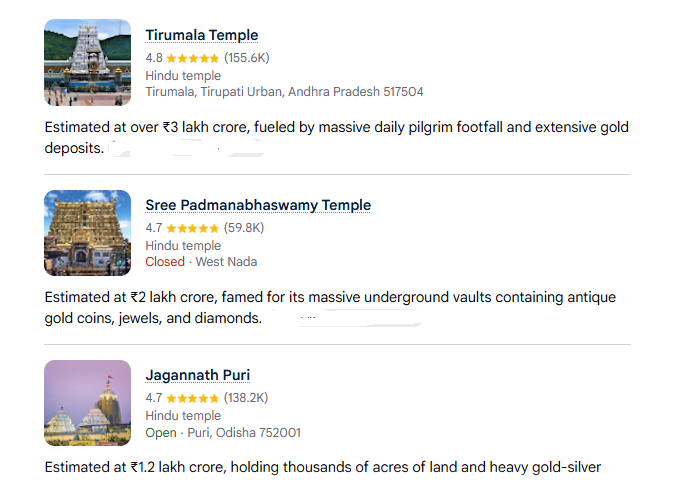
Based on available reports and publicly discussed estimates in 2026, the following are among India’s richest temples and religious shrine institutions. The figures should be treated as estimated values rather than a single official ranking, because many temples do not publish a consolidated market valuation of all their gold, land, jewellery and historical assets.
Top 10 Richest Temples in India 2026
| Rank | Temple | Location | Estimated wealth/assets or annual financial scale |
|---|---|---|---|
| 1 | Tirumala Tirupati Venkateswara Temple | Andhra Pradesh | Around ₹2.26 lakh crore in widely reported asset estimates; 2026-27 TTD budget: ₹5,456.26 crore |
| 2 | Sree Padmanabhaswamy Temple | Kerala | More than ₹1.2 lakh crore in estimated treasure value |
| 3 | Shirdi Sai Baba Temple | Maharashtra | Around ₹3,000 crore in reported assets; annual income can reach several hundred crores |
| 4 | Guruvayur Sree Krishna Temple | Kerala | Around ₹1,700–2,500 crore |
| 5 | Shri Mata Vaishno Devi Shrine | Jammu & Kashmir | More than ₹2,000 crore in reported assets; FY2023-24 income ₹683.04 crore |
| 6 | Golden Temple (Sri Harmandir Sahib) | Punjab | Large gold holdings and substantial annual donations; exact consolidated wealth is not officially stated |
| 7 | Jagannath Temple | Odisha | Significant land, jewellery and financial assets; estimates vary widely |
| 8 | Kashi Vishwanath Temple | Uttar Pradesh | More than ₹500 crore in some reported asset estimates |
| 9 | Siddhivinayak Temple | Maharashtra | Around ₹125 crore in reported value/financial assets |
| 10 | Meenakshi Amman Temple | Tamil Nadu | Several crores in annual revenue; substantial historical and property assets |
Note: These figures come from different reporting periods and methodologies and therefore should not be interpreted as an audited, apples-to-apples ranking.
1. Tirumala Tirupati Venkateswara Temple, Andhra Pradesh
The Tirumala Tirupati Venkateswara Temple, popularly known as Tirupati Balaji Temple, is one of the most financially powerful religious institutions in India. Located in the Tirumala Hills of Andhra Pradesh, the temple attracts enormous numbers of devotees throughout the year.
Reports in 2026 have placed the broader assets managed by the Tirumala Tirupati Devasthanams (TTD) at around ₹2.26 lakh crore, although such estimates can vary depending on what is included in the calculation.
What is less disputed is the scale of its annual financial operations. TTD approved a ₹5,456.26 crore budget for 2026-27. The budget projected ₹1,880 crore from hundi offerings, ₹1,205 crore from interest on deposits, ₹650 crore from prasadam sales and ₹175 crore from the auction of devotees’ hair.
This makes Tirupati particularly noteworthy because it is not merely wealthy due to historical assets; it also generates enormous recurring revenue.
Major sources of Tirupati’s income
- Hundi donations
- Interest earned on bank deposits
- Prasadam sales
- Seva and darshan tickets
- Accommodation
- Kalyanamandapam bookings
- Auction of tonsured hair
- Donations in gold and other valuables
The TTD also operates educational, medical and welfare institutions, meaning a significant portion of its resources is used for pilgrim facilities and social services.
2. Sree Padmanabhaswamy Temple, Kerala
If the question is which Indian temple is famous for having the most extraordinary accumulated treasure, the Sree Padmanabhaswamy Temple in Thiruvananthapuram is usually the first name that comes up.
The temple’s enormous wealth became internationally famous following the inventory of its underground vaults. Gold ornaments, coins, precious stones, jewellery, idols and other historical objects were discovered. Various reports have estimated the treasure at more than ₹1.2 lakh crore.
The important point is that this figure is an estimated value of treasure, not equivalent to an annual income or a conventional business-style net worth. Many of the objects are antiques and religious artefacts whose historical and cultural value cannot be accurately captured simply by calculating their gold or gemstone content.
This is why Padmanabhaswamy is often described as India’s richest temple even though Tirupati has a much larger publicly reported annual operating budget.
3. Shirdi Sai Baba Temple, Maharashtra
The Shri Saibaba Sansthan Trust in Shirdi is another major religious institution with substantial financial resources.
The shrine attracts devotees from across India and abroad. Donations are made in the form of cash, gold, silver and other valuables. A 2026 report estimated the temple’s assets at around ₹3,000 crore, with annual income potentially reaching around ₹700 crore in some years.
One of the notable features of the Shirdi trust is its emphasis on charitable activities. Temple resources are used for healthcare, accommodation, food distribution, education and other public-oriented activities.
This makes Shirdi an important example of how religious donations can support a wider network of social services.
4. Guruvayur Sree Krishna Temple, Kerala
Kerala has more than one temple with enormous financial and historical significance. The Guruvayur Sree Krishna Temple in Thrissur district is another prominent example.
Often described as one of India’s wealthiest temples, Guruvayur has accumulated considerable wealth through donations, gold, jewellery, temple properties and investments. Recent estimates place its assets at approximately ₹1,700 crore to ₹2,500 crore, while annual income has been reported in the range of ₹250 crore to ₹400 crore.
The temple receives substantial offerings from devotees, particularly during important festivals and religious occasions.
Its wealth is therefore not limited to cash reserves. Gold and jewellery, property and other institutional assets also contribute to its overall financial strength.
5. Shri Mata Vaishno Devi Shrine, Jammu & Kashmir
The Shri Mata Vaishno Devi Shrine in Katra is among India’s most visited pilgrimage destinations. Millions of devotees undertake the journey to the cave shrine every year.
Reports have placed the Shrine Board’s assets at more than ₹2,000 crore, while its annual income is also substantial. According to the Shrine Board’s reported FY2023-24 figures, total income was ₹683.04 crore, including ₹255.39 crore from offerings and donations. Total expenditure was reported at ₹494.23 crore.
The Shrine Board’s revenue is not generated only from donations. Pilgrim accommodation, facilities, helicopter services and other services also contribute to its finances.
The money is used extensively for maintaining the pilgrimage infrastructure and providing facilities to devotees.
6. Golden Temple, Amritsar, Punjab
The Golden Temple, officially known as Sri Harmandir Sahib, occupies a unique position in this list because its financial structure and religious administration differ from many Hindu temple trusts.
The shrine is famous for its gold-covered architecture and the enormous community kitchen, or langar, which provides free meals to visitors regardless of religion, caste or background.
The temple receives substantial donations from devotees around the world. Reports have estimated annual financial collections at around ₹500 crore, although a simple “net worth” figure is difficult to establish because the institution’s wealth includes gold work, religious artefacts, properties, donations and community-service infrastructure.
The Golden Temple’s greatest financial significance is perhaps its ability to turn donations into large-scale community service. The langar is one of the world’s best-known examples of community food service.
7. Jagannath Temple, Puri, Odisha
The Jagannath Temple in Puri is one of India’s most important pilgrimage centres and one of the four Char Dham sites.
Apart from donations and offerings, the temple’s financial importance comes from its land holdings, jewellery, properties and historical assets. Some reports have valued the temple’s assets at around ₹150 crore, while other estimates can differ substantially because land and other properties are difficult to value uniformly.
The temple is also associated with the famous Rath Yatra, which brings huge numbers of devotees to Puri every year.
Its wealth therefore has both financial and cultural dimensions, with centuries-old traditions contributing to its importance.
8. Kashi Vishwanath Temple, Varanasi, Uttar Pradesh
The Kashi Vishwanath Temple is one of India’s most revered Shiva temples and one of the twelve Jyotirlingas.
Located in Varanasi, the temple has witnessed a major transformation in its surrounding pilgrimage infrastructure following the development of the Kashi Vishwanath Dham corridor.
Some recent reports have placed the temple’s assets at more than ₹500 crore, while other sources have focused on its annual donations and revenue rather than total wealth.
The temple receives offerings from devotees throughout the year, with major religious occasions producing particularly high footfall.
Because the temple’s wider ecosystem includes pilgrimage infrastructure and development-related assets, comparing its “net worth” directly with temples holding centuries-old treasure can be misleading.
9. Siddhivinayak Temple, Mumbai
Mumbai’s Shri Siddhivinayak Ganapati Temple is one of India’s best-known Ganesha temples and attracts devotees from across the country, including prominent personalities.
The temple is financially strong because of regular donations and offerings. Reports have estimated its overall value at approximately ₹125 crore, while some reports have highlighted daily offerings running into tens of lakhs of rupees.
The temple also holds gold and other valuable assets. Its Ganesha idol is particularly famous, and the shrine’s popularity has helped it maintain a steady stream of donations.
Unlike Padmanabhaswamy, however, Siddhivinayak’s financial scale is more closely associated with regular donations and institutional investments than with an enormous ancient treasure vault.
10. Meenakshi Amman Temple, Madurai, Tamil Nadu
The Meenakshi Amman Temple in Madurai is one of India’s most spectacular temple complexes. Its towering gopurams and thousands of sculptures make it an architectural landmark as well as a major pilgrimage destination.
The temple attracts thousands of visitors daily and generates revenue through donations, religious activities and other temple-related sources. One 2025 report estimated annual revenue at around ₹6 crore, although this should not be confused with the total value of its historical buildings, land and other assets.
Its importance in a list of India’s wealthiest temples comes not simply from its annual cash collection but from the enormous cultural, architectural and historical value associated with the complex.
Which Is the Richest Temple in India?
The answer depends on what is meant by “richest.”
If the comparison is based on historical treasure, the Sree Padmanabhaswamy Temple is generally regarded as the richest, with treasure estimates exceeding ₹1.2 lakh crore.
If the comparison is based on annual financial operations and recurring income, Tirumala Tirupati Venkateswara Temple stands out. TTD’s approved 2026-27 budget is ₹5,456.26 crore, making the scale of its annual operations exceptionally large.
Therefore, saying simply that one temple is “the richest” can be misleading unless the measurement being used is clearly stated.
Why Do Indian Temples Have So Much Wealth?
The enormous wealth of India’s major temples has accumulated over centuries. There is no single source responsible for it.
1. Devotee donations
Cash donations are one of the biggest sources of recurring income for major pilgrimage centres. Millions of devotees contribute small and large amounts throughout the year.
2. Gold and jewellery
Devotees often donate gold ornaments, silver items, diamonds and other valuables. Over several generations, these offerings can become substantial institutional assets.
3. Land and property
Many historic temples received land grants from rulers, kingdoms and devotees. Over time, these holdings became important components of their overall wealth.
4. Bank deposits and investments
Large temple trusts and shrine boards may maintain substantial deposits. Interest income can therefore become a major recurring source of revenue, as illustrated by TTD’s 2026-27 budget projections.
5. Pilgrimage-related services
Accommodation, prasadam, special darshan, religious services and other facilities can generate significant revenue at high-footfall temples.
Temple Wealth Does Not Mean Cash in the Bank
This is one of the most important points to understand when reading about India’s richest temples.
Suppose a temple is reported to have assets worth ₹2,000 crore. That does not mean the temple has ₹2,000 crore sitting as cash in a bank account.
The figure may include:
- Gold ornaments
- Silver articles
- Diamonds and gemstones
- Historical artefacts
- Land
- Buildings
- Fixed deposits
- Bank balances
- Investments
- Temple properties
- Religious infrastructure
Similarly, the ₹1.2 lakh crore figure associated with Padmanabhaswamy largely relates to estimated treasure rather than annual income.
How Do Temples Use Their Wealth?
The money collected by major religious institutions is generally used for much more than daily temple rituals.
Depending on the institution, funds can support:
- Free food and langar
- Hospitals and healthcare
- Schools and colleges
- Scholarships
- Pilgrim accommodation
- Roads and transport facilities
- Sanitation
- Water supply
- Temple maintenance
- Preservation of heritage structures
- Staff salaries
- Disaster relief and charitable activities
- Community welfare programmes
For example, TTD’s 2026-27 budget included ₹118.89 crore for improving educational institutions, along with allocations for pilgrim amenities, security and infrastructure.
Why Are the Wealth Estimates So Different?
Readers may notice that different websites give dramatically different figures for the same temple. This happens because there is no common formula for calculating temple wealth.
One source may calculate only:
Gold + cash + bank deposits
Another may include:
Gold + land + buildings + jewellery + investments + historical assets
A third may report:
Annual donations or annual revenue
These are three completely different measurements.
For example, TTD’s annual budget for 2026-27 is ₹5,456.26 crore, but that does not mean TTD’s total assets are worth only ₹5,456.26 crore. The budget represents a year’s planned income and expenditure.
Top Richest Temples in India: Key Takeaways
India’s wealthiest temples represent a fascinating combination of faith, history, property, gold and large-scale charitable administration.
- Sree Padmanabhaswamy Temple is famous for its extraordinary historical treasure.
- Tirumala Tirupati Venkateswara Temple has one of India’s largest recurring revenue streams and an enormous institutional network.
- Shirdi Sai Baba Temple manages substantial assets while supporting welfare activities.
- Guruvayur Temple has accumulated significant wealth through donations, gold and property.
- Vaishno Devi Shrine operates a large pilgrimage infrastructure and records hundreds of crores in annual income.
- Golden Temple is particularly notable for its gold architecture and massive langar service.
- Jagannath Temple possesses important land, jewellery and historical assets.
- Kashi Vishwanath has become a major pilgrimage and heritage centre in Varanasi.
- Siddhivinayak receives substantial recurring donations in Mumbai.
- Meenakshi Amman Temple combines religious importance with immense architectural and historical value.
Final Word
The richest temples in India cannot be compared in exactly the same way as companies or wealthy individuals. Their “wealth” is spread across gold, jewelry, land, buildings, deposits, donations, and priceless historical objects. In many cases, the cultural and religious value of these assets is impossible to express accurately in rupees.
For 2026, the clearest distinction is this: Padmanabhaswamy stands out for its legendary accumulated treasure, while Tirupati stands out for its enormous recurring income and institutional financial scale. TTD’s official 2026-27 budget of ₹5,456.26 crore provides a particularly strong indication of the scale of its current operations.
Disclaimer: Temple wealth figures quoted in public reports are estimates and may change as new financial statements, asset disclosures, or valuations become available. Historical gold, jewellery, land and artefacts are especially difficult to value consistently. Therefore, the ranking above should be viewed as an informative comparison rather than an audited league table.