
Unemployment remains one of the most pressing socio-economic challenges of our time, affecting millions across developed and developing nations. It occurs when individuals who are willing and able to work cannot find suitable employment. While global unemployment rates have stabilized around 4.9% in recent years according to International Labour Organization (ILO) projections for 2026, this figure masks deeper issues of underemployment, informal work, and youth joblessness. In India, official rates hover near 5%, yet structural problems, high youth unemployment, and a vast informal sector reveal a more complex crisis. This article examines the causes, consequences, and potential solutions for both India and the world.
Unemployment
Unemployment is defined as a situation where people actively seeking work remain without jobs at prevailing wage rates. Globally, nearly 186 million people are projected to be unemployed in 2026, with a broader “jobs gap” exceeding 400 million when including discouraged workers. Youth face particularly high rates, often double the overall average, while women and those in low-income countries experience persistent disadvantages. In India, the Periodic Labour Force Survey shows overall rates around 5%, but youth unemployment frequently exceeds 14-16%, and over 90% of the workforce remains in informal employment without social security. Understanding unemployment requires distinguishing types such as structural, cyclical, frictional, seasonal, and disguised unemployment, each demanding tailored responses. Addressing it is essential for sustainable growth, social stability, and realizing demographic potential in countries like India.
Causes of Unemployment
Global Causes
Technological advancement and automation displace routine jobs across manufacturing and services, reducing demand for low-skilled labour worldwide. Economic cycles create cyclical unemployment during recessions when demand falls and firms cut production. Globalization shifts production to lower-cost regions, causing job losses in higher-wage economies while creating uneven gains elsewhere. Skills mismatches arise as education systems lag behind evolving industry needs in digital, green, and advanced manufacturing sectors. Demographic pressures, including ageing populations in developed nations and youth bulges in developing ones, strain labour markets differently. Institutional factors such as rigid labour laws, high unionization in some sectors, and inadequate social protection further influence unemployment levels.
Causes Specific to India
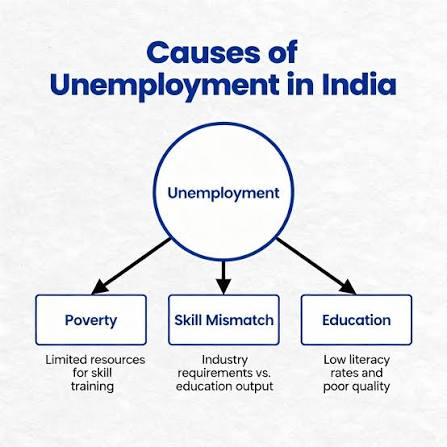
Rapid population growth and a large youth cohort entering the labour force each year outpace formal job creation, despite strong GDP growth. Jobless growth has become a structural feature, with employment elasticity of growth falling sharply as capital-intensive methods replace labour. A severe skills mismatch persists: higher education produces graduates whose qualifications do not align with industry requirements, leading to high unemployment among the educated. Agriculture still absorbs around 40% of the workforce despite contributing far less to GDP, resulting in widespread disguised unemployment and low productivity. The dominance of the informal sector (over 90% of workers) offers precarious work without contracts or benefits, masking true underemployment. Limited manufacturing expansion and slow non-farm job creation fail to absorb surplus rural labour migrating to cities.
Consequences of Unemployment
Economic Consequences
Unemployment represents a permanent loss of potential output and wasted human capital, lowering national GDP below its productive capacity. Reduced household incomes decrease consumer spending, weakening aggregate demand and discouraging further business investment in a self-reinforcing cycle. Governments face higher fiscal burdens through welfare spending and unemployment benefits while collecting less tax revenue from idle workers. Long-term unemployment erodes skills and productivity, making re-entry into the labour market harder and raising future training costs. In developing economies, reliance on informal and low-productivity work perpetuates poverty and limits structural transformation. Global inequality widens as advanced economies recover faster while low-income countries struggle with persistent jobs gaps.
Social and Psychological Consequences
Prolonged joblessness lowers living standards, restricts access to education and healthcare for families, and traps households in poverty cycles. It increases inequality by concentrating opportunities among the skilled and connected while marginalizing youth, women, and rural populations. Social unrest, protests, and political instability often rise when large numbers of educated young people remain unemployed. Individuals experience stress, loss of self-esteem, mental health challenges, and higher risks of social isolation or substance abuse. Family structures suffer as delayed marriages, migration pressures, and intergenerational transmission of disadvantage become common. Communities face eroded social cohesion when economic participation is unevenly distributed across regions and demographic groups.
Consequences for India and the World
In India, high youth unemployment risks squandering the demographic dividend, with millions of graduates unable to secure quality jobs and many returning to low-productivity agriculture. Persistent informality and underemployment keep incomes low, constrain domestic demand, and hinder the transition to high-income status. Globally, nearly 300 million workers live in extreme working poverty and over 2 billion remain in informal employment, limiting progress on Sustainable Development Goals. Youth not in employment, education or training (NEET) number around 260 million worldwide, creating long-term scars on lifetime earnings and social stability. Uneven recovery across regions threatens international trade, migration pressures, and geopolitical tensions. Without decisive action, technological change and climate impacts could deepen these divides further.
Solutions to Unemployment
Global Solutions and Best Practices
Governments should pursue expansionary policies during downturns, combining public investment in infrastructure with targeted support for labour-intensive sectors. Continuous investment in education, vocational training, and lifelong upskilling prepares workers for technological shifts, including AI and green transitions. Strengthening social protection systems provides safety nets while encouraging labour mobility and formalization of informal work. Active labour market policies such as job matching services, apprenticeships, and wage subsidies improve transitions into employment. International cooperation on trade, technology transfer, and standards for decent work helps distribute the gains from globalization more evenly. Promoting entrepreneurship, supporting small and medium enterprises, and fostering inclusive growth models that prioritize quality jobs over pure capital intensity yield lasting results.
Unemployment Types
In economics, unemployment is typically classified into several main types based on its causes. The primary categories are:
1. Frictional Unemployment
- Short-term unemployment that occurs when people are between jobs, entering the labor force for the first time, or re-entering after a break.
- Caused by the normal process of job search, matching workers with suitable positions, or geographic/career transitions.
- Generally considered healthy and inevitable in a dynamic economy (e.g., recent graduates looking for work or someone quitting to find a better role).
2. Structural Unemployment
- Longer-term unemployment resulting from a mismatch between workers’ skills, education, or location and the requirements of available jobs.
- Causes include technological change (automation replacing certain jobs), shifts in industry demand, globalization, or changes in consumer preferences.
- Often requires retraining, education, or relocation to resolve.
3. Cyclical Unemployment
- Unemployment that rises and falls with the business cycle.
- Increases during economic recessions or downturns (when demand for goods and services falls and firms lay off workers) and decreases during expansions.
- Closely tied to overall economic growth and is a key focus of macroeconomic policy (e.g., fiscal or monetary stimulus).
4. Seasonal Unemployment
- Temporary unemployment linked to regular, predictable seasonal patterns in certain industries.
- Common in agriculture, tourism, construction, retail (holiday seasons), and fishing.
- Workers in these sectors often expect and plan for periods of unemployment.
Other Related Categories
- Technological unemployment: A subset of structural unemployment driven specifically by automation, AI, and other productivity-enhancing technologies that reduce the need for certain types of labor.
- Classical (or real-wage) unemployment: Occurs when wages are kept above the market-clearing level (e.g., by minimum wage laws, strong unions, or efficiency wages), so the quantity of labor supplied exceeds demand.
- Voluntary vs. involuntary unemployment: Distinguishes between people who choose not to work at prevailing wages (voluntary) and those who want work at current wages but cannot find it (involuntary). Most official unemployment measures focus on the latter.
Natural Rate of Unemployment
The sum of frictional + structural unemployment is often called the natural rate of unemployment (or NAIRU — non-accelerating inflation rate of unemployment). Cyclical unemployment is the component that moves the actual unemployment rate above or below this natural rate.
These categories help policymakers, economists, and analysts diagnose the causes of joblessness and design appropriate responses (e.g., job-search assistance for frictional, training programs for structural, or stimulus for cyclical).
Solutions Tailored for India
Expanding labour-intensive manufacturing in textiles, food processing, construction, and electronics through Production-Linked Incentive schemes and easier credit for MSMEs can absorb large numbers of workers. Strengthening skill development programs such as Skill India, PMKVY, and industry-linked apprenticeships must better align curricula with market needs and expand formal vocational pathways. Enhancing rural employment guarantees like MGNREGA while promoting diversification into non-farm activities and portable social security supports mobility. Promoting entrepreneurship through Startup India, easier formalization, and digital public infrastructure enables self-employment and small business growth. Labour reforms that balance flexibility for firms with worker protections, combined with higher female labour force participation measures, can broaden opportunities. Sustained focus on creating quality formal jobs, raising manufacturing’s employment share, and investing in human capital remains essential to convert India’s demographic advantage into lasting prosperity.
Global unemployment remains historically low and stable around 4.9% in 2026 (roughly 186 million people), according to the International Labour Organization (ILO), but this masks weaker job quality, high informality, youth challenges, and structural risks. The broader “jobs gap” (people who want work but cannot find it) is projected at about 408 million.
Global Trends
- Rate and numbers: The unemployment rate held near 4.9% in 2025 and is projected to stay at that level through 2026–2027. Absolute numbers edge up slightly with labor-force growth (to ~186 million unemployed in 2026).
- Employment growth: Projected at ~1.0% in 2026—below the prior decade’s average. Strongest in low-income countries (~3.1%), weaker in upper-middle-income economies (~0.5%) due to aging populations and slower labor-force growth in richer countries.
- Regional and group differences: Latin America and the Caribbean are expected to see further declines in unemployment in the medium term; Northern America faces some upward pressure. Youth unemployment is ~12.4% (more than double the overall rate). About 20% of young people (~260 million) are not in employment, education, or training (NEET). Women face persistent participation gaps (roughly 24% less likely than men to be in the labor force in some analyses).
- Quality and vulnerability issues: Progress on decent work has stalled. Over 2 billion workers are in informal employment; hundreds of millions live in extreme working poverty (under ~$3/day). Risks include AI-driven disruption, trade/policy uncertainty, debt, and demographics.
Headline stability reflects resilience after the pandemic recovery, but it is not equivalent to a healthy, inclusive labor market.
United States Trends (as of June 2026)
The U.S. unemployment rate stood at 4.2% in June 2026 (down from 4.3% in May), near multi-year lows and little changed over the prior year.
- Nonfarm payrolls rose by only +57,000 (well below expectations), following stronger earlier months in 2026. Gains continued in professional/business services, health care, and social assistance; leisure and hospitality lost jobs.
- The number of unemployed was ~7.1 million. Long-term unemployment (27 weeks or longer) was ~1.9 million—up hundreds of thousands over the year and representing ~27% of the unemployed. Median duration of unemployment has lengthened.
- Labor-force participation fell to 61.5% (lowest since early 2021) and the employment-population ratio to 59.0%. The broader U-6 measure (including marginally attached and part-time for economic reasons) was around 7.9%.
- Household survey data have shown weaker employment dynamics than the establishment (payroll) survey in recent months. Demographic rates remain relatively low for prime-age workers, with some variation by age, sex, and education.
Overall, the U.S. labor market has stabilized after a period of cooling, with low headline unemployment but softening job growth, rising long-term joblessness, and declining participation.
Impacts of Unemployment (and of Prolonged or Elevated Rates)
Unemployment affects individuals, households, firms, and the broader economy:
Economic impacts
- Reduced consumer spending and aggregate demand, which can slow GDP growth and create feedback loops (weaker sales → further hiring caution).
- Higher fiscal costs (unemployment benefits, social programs) and lower tax revenues.
- Skill atrophy and hysteresis: longer spells make re-employment harder and can raise the natural rate of unemployment.
- Wage and inflation effects: tight markets support wage growth; slack reduces it and can ease price pressures. Persistent underemployment or low participation constrains potential output.
- Inequality: lower-skilled, younger, and minority workers are often hit harder; long-term unemployment widens gaps.
Social and individual impacts
- Income loss, higher poverty risk, and financial stress for households.
- Mental and physical health declines (depression, anxiety, higher mortality risks in severe cases), family strain, and reduced educational or training investment.
- For youth: scarring effects on lifetime earnings, career progression, and social outcomes. High NEET rates amplify these.
- Broader societal effects can include reduced social cohesion, higher crime in some contexts, and political pressures.
Positive or mitigating aspects when rates are low Low unemployment (as currently seen in many advanced economies) supports income growth, reduces hardship, and can encourage labor-force re-entry—though falling participation in the U.S. and quality deficits globally limit these benefits. Policy responses (training, active labor-market programs, social protection, and support for transitions related to technology or demographics) can reduce scarring and improve matching.
Trends and impacts vary sharply by country, sector, and demographic group. Data come primarily from the ILO’s Employment and Social Trends 2026 / related outlooks and the U.S. Bureau of Labor Statistics (BLS) Employment Situation reports through June 2026. For country-specific or sectoral details, more granular sources (national statistical agencies, OECD, etc.) are useful.
Conclusion
Unemployment is not merely an economic statistic but a profound challenge to human dignity, social stability, and sustainable development in both India and the world. Its roots lie in structural shifts, technological change, demographic pressures, and policy gaps that differ across contexts yet share common features of skills mismatch and inadequate job quality. The consequences extend far beyond lost output to include deepened inequality, social unrest, and wasted potential, particularly among the young. Effective solutions require coordinated action: demand-side stimulus and industrial policies alongside supply-side investments in skills, social protection, and inclusive institutions. For India, converting high growth into widespread quality employment is critical to realizing Viksit Bharat ambitions. Globally, prioritizing decent work, productivity with equity, and adaptation to technological and climate transitions can close the jobs gap and build more resilient societies.