
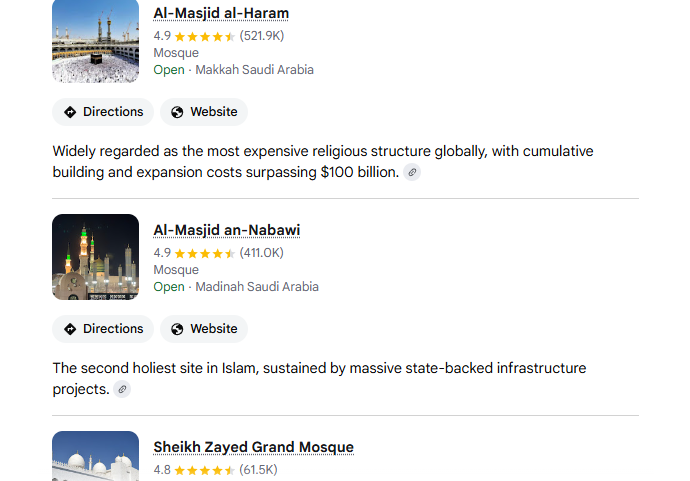
Mosques are not only places of worship; some of the world’s most prominent Islamic religious complexes are also associated with enormous real-estate holdings, endowments, hotels, commercial properties and government-funded development projects. This is particularly visible around the two holiest mosques in Islam—Masjid al-Haram in Makkah and the Prophet’s Mosque in Madinah.
However, there is an important point to understand before discussing the richest mosques in the world: most mosques do not publish a conventional “net worth” or balance sheet. Therefore, it would be misleading to claim that a particular mosque personally owns a specific amount of wealth unless that figure has been officially disclosed.
For this article, the ranking is based primarily on publicly reported construction and expansion expenditure, associated endowment projects and the scale of assets connected with the mosque complex. These figures should therefore be treated as an indication of financial scale, rather than the personal wealth of a mosque.
Top 10 Richest Mosques in the World
| Rank | Mosque | Country | Major reported investment / financial scale |
|---|---|---|---|
| 1 | Masjid al-Haram | Saudi Arabia | More than SAR 100 billion for a major expansion project |
| 2 | Prophet’s Mosque | Saudi Arabia | SAR 25 billion in property compensation alone; multiple major expansions |
| 3 | King Abdul Aziz Endowment / Haram complex | Saudi Arabia | SAR 6 billion original project approval |
| 4 | Djamaa el Djazaïr (Great Mosque of Algiers) | Algeria | About US$898 million construction cost |
| 5 | Hassan II Mosque | Morocco | About €585 million construction cost |
| 6 | Sheikh Zayed Grand Mosque | UAE | About AED 2.167 billion construction cost |
| 7 | Faisal Mosque | Pakistan | About SAR 130 million construction expenditure |
| 8 | Grand Jamia Mosque, Lahore | Pakistan | About PKR 4 billion construction cost |
| 9 | Sultan Qaboos Grand Mosque | Oman | About OMR 15 million reported construction cost |
| 10 | Istiqlal Mosque | Indonesia | Large state-funded national mosque; major renovation alone cost US$35 million |
Note: These figures are not directly comparable because some refer to original construction, while others refer to expansion, land acquisition or associated endowment projects. There is no universally accepted global ranking of mosques by net worth.
1. Masjid al-Haram, Makkah- Saudi Arabia
Masjid al-Haram, or the Grand Mosque of Makkah, is in a financial category of its own. It surrounds the Kaaba and is the destination of millions of Muslims performing Hajj and Umrah every year.
The Saudi government has invested enormous sums in expanding and modernising the mosque and its surrounding infrastructure. A major King Abdullah expansion project was estimated at more than SAR 100 billion and was designed to substantially increase the mosque’s capacity.
The financial scale becomes even clearer when associated developments are considered. The King Abdul Aziz Endowment, for example, was approved as a SAR 6 billion project and included residential, hotel, commercial and other facilities serving pilgrims.
Estimated financial scale
More than SAR 100 billion for the cited major expansion project
This does not mean Masjid al-Haram has SAR 100 billion sitting in a bank account. It represents the reported cost of a huge development programme.
2. Prophet’s Mosque, Madinah- Saudi Arabia
The Prophet’s Mosque, known as Al-Masjid an-Nabawi, is another religious complex whose financial scale is difficult to measure through conventional “net worth” calculations.
Saudi Arabia has undertaken several large expansion and development programmes around the mosque. During one major expansion phase, properties covering about 12.5 hectares were expropriated, with compensation reaching approximately SAR 25 billion.
Earlier expansion work also involved billions of riyals. A 2006 expansion was reported to cost SAR 4.7 billion, while earlier modernisation of the two Holy Mosques involved more than SAR 13 billion.
The Saudi government’s official information says the third Saudi expansion was the largest expansion in the mosque’s history and was designed to increase capacity substantially.
Financial scale
At least SAR 25 billion in one reported property-compensation component, in addition to multibillion-riyal construction and development programs.
3. King Abdul Aziz Endowment and the Makkah Haram Complex
It is useful to distinguish the mosque itself from the enormous ecosystem of endowments and commercial properties around it.
The King Abdul Aziz Endowment for the Holy Haram was approved as a SAR 6 billion development project. It included high-rise towers, hotels, residential units, shops, prayer facilities and parking.
Such endowment properties are particularly important in understanding the financial strength surrounding major mosques. In Islamic tradition, waqf assets can generate income that is used for religious, charitable and public purposes.
Consequently, the financial influence of the Makkah religious complex extends far beyond the physical prayer halls.
Reported project value
SAR 6 billion at the time of project approval
The present market value of surrounding real estate should not be confused with this historical construction figure.
4. Djamaa el Djazaïr- Great Mosque of Algiers, Algeria
The Great Mosque of Algiers, also known as Djamaa el Djazaïr, is one of the most expensive modern mosque projects outside Saudi Arabia.
The mosque was completed in 2019 after years of construction. Its reported official construction cost was approximately US$898 million. The project was financed by the Algerian state.
The complex is famous for its enormous scale and its approximately 265-metre minaret, one of the tallest religious structures of its kind.
Construction investment
Approximately US$898 million
Unlike a conventional commercial property, this expenditure should be viewed as the cost of creating a major national religious and architectural complex.
5. Hassan II Mosque- Casablanca, Morocco
The Hassan II Mosque in Casablanca is another mosque associated with an exceptionally large construction budget.
Construction was completed in 1993, and reported costs were around €585 million, although estimates have also been presented in the range of US$400–700 million depending on the source and method of calculation.
One remarkable aspect of its financing was public participation. Around 12 million people reportedly contributed to the project through public subscriptions.
The mosque can accommodate approximately 105,000 people when its outdoor areas are included, making it one of the world’s most impressive Islamic architectural complexes.
Reported construction cost
Around €585 million
6. Sheikh Zayed Grand Mosque- Abu Dhabi, UAE
The Sheikh Zayed Grand Mosque is one of the most recognisable mosques in the world and a major landmark of Abu Dhabi.
Construction began in the 1990s and was completed in 2007. The Emirates News Agency reported the building’s construction cost at approximately AED 2.167 billion.
Other published sources commonly put the cost at around AED 2 billion, equivalent at the time to roughly US$545 million.
The mosque has 82 domes, four minarets and a capacity exceeding 41,000 people.
Construction investment
Approximately AED 2.0–2.167 billion
It is important to remember that construction cost is not the same as current property value.
7. Faisal Mosque- Islamabad, Pakistan
The Faisal Mosque is Pakistan’s national mosque and one of the country’s best-known architectural landmarks.
The mosque was funded by Saudi Arabia following support from King Faisal. Construction began in 1976, and published historical sources put the expenditure at approximately SAR 130 million.
Its unusual tent-like architectural design makes it different from many traditional mosques. The complex occupies a large area at the foot of the Margalla Hills.
Reported construction expenditure
Approximately SAR 130 million
Because construction took place decades ago, converting this amount into today’s dollars or rupees would produce a very different figure.
8. Grand Jamia Mosque, Lahore- Pakistan
The Grand Jamia Mosque in Bahria Town Lahore is one of Pakistan’s largest modern mosques.
The mosque was constructed at a reported cost of approximately PKR 4 billion and was inaugurated in 2014. It can accommodate around 70,000 worshippers and features extensive Islamic architectural decoration.
The complex also contains facilities such as an Islamic art gallery and educational spaces, making it more than simply a prayer hall.
Construction cost
Approximately PKR 4 billion
The actual present-day value of the land and surrounding development could be considerably different from the historical construction cost.
9. Sultan Qaboos Grand Mosque- Muscat, Oman
The Sultan Qaboos Grand Mosque is Oman’s largest mosque and one of the country’s most important architectural landmarks.
The mosque was officially opened in 2001 and can accommodate approximately 20,000 worshippers. Kuwait News Agency reported that Sultan Qaboos personally financed the construction and that the project cost OMR 15 million.
The building is known for its large prayer hall, extensive stonework, decorative interiors and enormous carpet.
Reported construction cost
OMR 15 million
The figure represents the reported construction cost rather than the total economic value of the mosque’s land and surrounding property.
10. Istiqlal Mosque- Jakarta, Indonesia
Istiqlal Mosque is Indonesia’s national mosque and one of Southeast Asia’s most important Islamic landmarks.
The mosque was constructed over a long period, with the foundation stone laid in 1961 and the building inaugurated in 1978. It has a capacity of more than 120,000 people.
More recently, the mosque underwent a major renovation between 2019 and 2020 at a reported cost of approximately US$35 million. The renovation included improvements to the marble exterior, lighting, electrical and plumbing systems, gardens, plaza areas and other facilities.
Recent renovation investment
Approximately US$35 million
This is the renovation figure, not the total historical value of the mosque.
Wealth vs Construction Cost: What Is the Difference?
This is perhaps the most important part of the topic.
When people search for the “richest mosque in the world,” they often expect a number similar to the net worth of a billionaire or company. But mosques generally do not operate that way.
A mosque may have:
- Land and buildings
- Waqf/endowment properties
- Hotels and commercial properties
- Donations
- Government funding
- Educational institutions
- Charitable facilities
- Rental income
- Historical assets
But these assets may belong to different legal entities or government authorities rather than directly to the mosque.
For example, Saudi Arabia’s General Authority for Awqaf supervises registered waqf activities and provides services related to waqf registration. Its current website reports billions of riyals in expenditure across different endowment-related sectors, illustrating the broader scale of the waqf system.
Therefore, saying “this mosque is worth $100 billion” without a documented asset statement would be inaccurate.
Which Is the Richest Mosque in the World?
If “richest” means the mosque associated with the largest publicly reported development expenditure, Masjid al-Haram in Makkah is the strongest candidate.
Its major expansion programmes have involved sums exceeding SAR 100 billion, while the surrounding Makkah religious-development ecosystem includes additional endowment, hotel, commercial and infrastructure projects.
The Prophet’s Mosque in Madinah is another exceptional case, with enormous investments in expansion and surrounding property acquisition.
However, there is no official global ranking of mosques by net worth, so rankings below the two Holy Mosques should be understood as comparisons of reported project expenditure rather than audited wealth.
Top 10 Mosques by Reported Financial Scale at a Glance
Important: The chart is illustrative only because the underlying figures are in different currencies and historical periods. It should not be used as a precise wealth ranking.
Why Are the Two Holy Mosques Financially Different?
Masjid al-Haram and the Prophet’s Mosque are unlike ordinary local mosques because they serve millions of pilgrims and visitors.
Their development involves not just prayer areas but also:
- Large-scale crowd-management systems
- Roads and tunnels
- Air-conditioning systems
- Hotels and accommodation
- Water and sanitation facilities
- Security infrastructure
- Transport facilities
- Land acquisition
- Courtyards and pedestrian areas
- Large-scale expansion of prayer spaces
For example, the King Abdullah expansion of Masjid al-Haram included new buildings, courtyards, tunnels and service facilities such as air-conditioning, electricity and drinking-water systems.
This explains why expenditure connected with these mosques can reach levels normally associated with major infrastructure projects.
Are These Mosques Actually “Rich”?
Not necessarily.
A mosque costing hundreds of millions of dollars to construct does not mean that it has hundreds of millions of dollars in cash or investments.
A better way to understand the term richest mosque is:
Richest by construction value ≠ richest by cash ≠ richest by endowment assets ≠ richest by surrounding real-estate value.
These are four completely different measurements.
For example, a historic mosque may own or be associated with valuable waqf properties but have relatively modest construction expenditure. Conversely, a newly constructed national mosque may have an extremely high construction cost but comparatively limited income-generating assets.
Final Verdict
The Masjid al-Haram in Makkah stands out as the world’s most financially significant mosque complex when measured by the scale of publicly reported expansion and infrastructure expenditure. A major expansion programme alone was estimated at more than SAR 100 billion.
The Prophet’s Mosque in Madinah follows as another extraordinarily large religious development, with billions of riyals spent on expansion and property acquisition.
Outside Saudi Arabia, the Great Mosque of Algiers, Hassan II Mosque and Sheikh Zayed Grand Mosque stand among the most expensive modern mosque projects based on their reported construction costs.
Ultimately, there is no reliable audited list of the “10 richest mosques” by net worth. The figures available publicly are mostly construction costs, expansion budgets, land-compensation payments and associated endowment projects. Treating these as the actual wealth of a mosque would give a misleading picture.
FAQs
1. Which is the richest mosque in the world?
Masjid al-Haram in Makkah is generally the strongest candidate when ranking mosques by the scale of publicly reported expansion and development expenditure. A major expansion programme was estimated at more than SAR 100 billion.
2. How much is Masjid al-Haram worth?
There is no officially published audited “net worth” for Masjid al-Haram. However, major expansion and infrastructure programmes have involved more than SAR 100 billion, while associated endowment and commercial developments add another layer of financial value.
3. Which is the most expensive mosque outside Saudi Arabia?
Djamaa el Djazaïr, the Great Mosque of Algiers, is among the most expensive modern mosques outside Saudi Arabia, with an official reported construction cost of about US$898 million.
4. How much did Sheikh Zayed Grand Mosque cost?
The Sheikh Zayed Grand Mosque was reported to have cost approximately AED 2.167 billion to construct.
5. Is mosque wealth the same as mosque construction cost?
No. Construction cost shows how much was spent to build a mosque or project. Wealth would require information about current assets, liabilities, endowments, land, investments and income. Most mosques do not publish such audited net-worth figures.
6. Why are Masjid al-Haram and the Prophet’s Mosque so expensive?
Their development includes enormous prayer areas as well as land acquisition, tunnels, roads, courtyards, cooling systems, utilities, crowd-management infrastructure and facilities for millions of pilgrims.