
India is one of the world’s biggest sugar-producing and sugar-consuming countries, but a change in domestic production can quickly affect prices. In August 2026, the issue has become particularly important because the Government of India has permitted duty-free imports of 1 million metric tonnes of raw sugar to improve domestic availability and contain rising prices. The move comes after domestic sugar prices increased sharply over a short period.
This raises an important question: Which countries produce the most sugar in the world, and from which of them can India realistically import sugar?
Brazil is the strongest candidate because it is not only the world’s largest sugar producer but also by far the dominant exporter. Thailand and Australia are other important international suppliers. However, production alone does not determine whether a country is a good import source. India also has to consider exportable surplus, quality, freight costs, port connectivity, international prices, government policy and the type of sugar required.
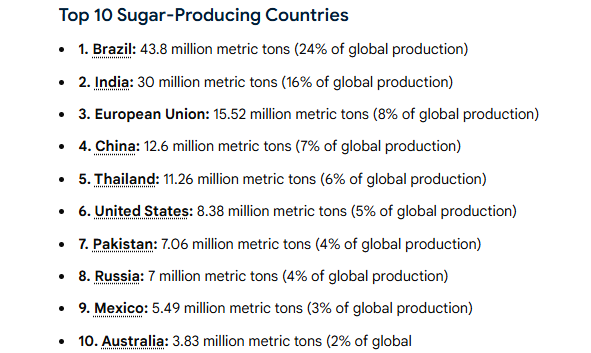
Top 10 Sugar Producing Countries in the World
USDA data for the 2025/26 marketing year places Brazil and India at the top of global sugar production. Global output is estimated at about 189.3 million metric tonnes, with higher production in Brazil and India helping offset lower output in the European Union.
The following ranking uses 2025/26 production estimates compiled from USDA-based global sugar data. Marketing years differ between countries, so these figures should be understood as marketing-year estimates rather than calendar-year production.
| Rank | Country/Region | Sugar Production 2025/26* | Position in Global Market |
|---|---|---|---|
| 1 | Brazil | ~43.8 million tonnes | World’s largest producer and exporter |
| 2 | India | ~30.0 million tonnes | Major producer and consumer |
| 3 | European Union | ~15.5 million tonnes | Major beet-sugar producer |
| 4 | China | ~12.6 million tonnes | Large producer and importer |
| 5 | Thailand | ~11.25 million tonnes | Major exporter |
| 6 | United States | ~8.38 million tonnes | Large producer, but also import-dependent |
| 7 | Pakistan | ~7.06 million tonnes | Important regional producer |
| 8 | Russia | ~7.0 million tonnes | Major beet-sugar producer |
| 9 | Mexico | ~5.49 million tonnes | Significant producer and exporter |
| 10 | Australia | ~3.83 million tonnes | Major export-oriented producer |
*Approximate 2025/26 raw-value production estimates based on USDA-linked global sugar data.
Sugar Production Comparison
1. Brazil
Brazil is the clear leader in the global sugar industry. USDA’s Brazil outlook projected 2025/26 sugar production at around 44.7 million tonnes, with exports of about 35.8 million tonnes. This enormous exportable surplus makes Brazil the most obvious international source when a large sugar-consuming country such as India needs additional supplies.
Brazil’s advantage is not simply its production volume. It has an extensive sugarcane-processing industry, dedicated export infrastructure and an established global customer base.
For India, Brazilian raw sugar is particularly attractive when domestic refineries can process it efficiently. However, freight costs and the timing of shipments are important because Brazil is geographically distant from India.
Import potential for India: Very High
2. India
India itself is the world’s second-largest sugar producer in the 2025/26 estimates, with output of around 30 million tonnes. USDA expects India’s recovery in production to be one of the major factors supporting the global sugar market.
Normally, India would not need to depend heavily on imports because of its enormous domestic sugar industry. However, a production shortfall can quickly change the situation.
In August 2026, the government allowed 1 million tonnes of duty-free raw sugar imports, with the policy aimed at increasing domestic availability before the major festival consumption period.
Import potential: Not applicable as a normal supplier; India is the buyer in this context.
3. European Union
The European Union is one of the world’s largest sugar-producing regions, with production estimated at around 15.5 million tonnes for 2025/26.
Most European sugar production comes from sugar beet rather than sugarcane. Although the EU is an important sugar market, it is not necessarily India’s first choice for emergency raw-sugar imports.
Higher production costs, transportation considerations and the EU’s own market policies can make European sugar less competitive for India compared with Brazil or Thailand.
Import potential for India: Moderate to Low
4. China
China is another major sugar producer, with 2025/26 production estimated at around 12.6 million tonnes in USDA-linked data.
However, China’s domestic consumption is also very large. USDA’s China Sugar Annual projected 2025/26 consumption at approximately 15.7 million tonnes, substantially above domestic production.
That means China is structurally a sugar-importing market rather than an obvious source for India.
Import potential for India: Low
5. Thailand
Thailand is one of the most important alternatives to Brazil. It is a major sugarcane producer and an established exporter to Asian markets.
USDA expected Thailand’s 2025/26 sugar production to increase by about 2% from the previous marketing year, although exports were expected to be affected by the recovery of exports from Brazil and India.
For India, Thailand has a geographical advantage over Brazil because of its location in Southeast Asia. Freight and delivery times can therefore be competitive, depending on international prices and shipping conditions.
Import potential for India: High
6. United States
The United States is a major sugar producer, but it is not a natural large-volume source for India’s sugar requirements.
The U.S. sugar market operates under a highly managed import system involving tariff-rate quotas and other policy mechanisms. USDA forecasts U.S. sugar production at roughly 8.4–8.5 million tonnes in the relevant 2025/26 data.
Since the U.S. itself maintains a significant domestic sugar market, exporting large volumes to India is unlikely to be the most practical option.
Import potential for India: Low
7. Pakistan
Pakistan is among the world’s significant sugar producers and is geographically close to India.
On paper, Pakistan could look like an attractive source because transportation costs could be lower than shipments from Brazil. However, sugar trade between India and Pakistan is affected by broader bilateral trade restrictions and government policy.
Therefore, production capacity does not automatically translate into an accessible supply option for Indian importers.
Import potential for India: Very Low under present trade conditions
8. Russia
Russia is a major sugar-beet producer, with production of roughly 7 million tonnes in 2025/26 estimates.
However, geographical distance, logistics, trade routes and product specifications make Russia less attractive than traditional cane-sugar exporters for India’s current requirement.
Import potential for India: Low
9. Mexico
Mexico produces more than 5 million tonnes of sugar and is an important sugar producer in the Americas.
However, much of Mexico’s international sugar trade is influenced by its relationship with the United States. This reduces the likelihood that Mexico would become India’s first-choice supplier for a large emergency import programme.
Import potential for India: Moderate but limited
10. Australia
Australia may be smaller than Brazil, India or Thailand in total production, but it is an important export-oriented sugar producer.
Its sugar industry has strong experience in international trade, and Australia has a strategic location for Asian markets. For India, Australian sugar can therefore be considered as a secondary sourcing option.
The main challenge is that Australia’s production is considerably smaller than Brazil’s, so its ability to supply a very large emergency requirement is more limited.
Import potential for India: Moderate to High
From Which Countries Can India Import Sugar?
If the question is specifically about practical suppliers for India’s 2026 import requirement, the ranking looks different from the production ranking.
| Country | Production Capacity | Export Availability | Suitability for India | Overall Potential |
|---|---|---|---|---|
| Brazil | Very High | Very High | Excellent for raw sugar | Very High |
| Thailand | High | High | Strong Asian logistics advantage | High |
| Australia | Moderate | High | Reliable export-oriented supplier | Moderate-High |
| Mexico | Moderate | Moderate | Possible but less attractive | Moderate |
| European Union | High | Limited/variable | Beet sugar and policy constraints | Low-Moderate |
| Russia | High | Variable | Logistics and trade issues | Low |
| China | High | Low | China itself needs imports | Low |
| United States | High | Limited | Managed domestic market | Low |
| Pakistan | High | Potentially regional | Bilateral trade restrictions are a major barrier | Very Low |
Why Brazil Is India’s Best Option
Brazil stands out for several reasons.
1. Huge Exportable Surplus
Brazil produces substantially more sugar than it consumes domestically, leaving a large quantity available for international markets. USDA’s 2025/26 forecast put Brazilian exports at around 35.8 million tonnes.
This is the biggest reason Brazil can potentially supply India at scale.
2. Strong Global Supply Chain
Brazil has decades of experience exporting sugar to international markets. Bulk terminals, storage facilities, shipping infrastructure and established trading companies make large-volume transactions easier.
3. Raw Sugar Availability
India’s 2026 emergency import decision is focused on raw sugar. Brazilian mills are major suppliers of raw sugar to the international market.
4. Global Price Competitiveness
Brazil’s enormous production scale can provide cost advantages. However, the final landed cost in India will depend on the international sugar price, freight, insurance, port charges, exchange rates and applicable taxes or exemptions.
Why Thailand Is the Second Major Option
Thailand is particularly important because it is a major sugar exporter located much closer to India than Brazil.
Its geographical position can reduce shipping time and potentially lower freight expenses. Thailand is also deeply integrated into the Asian sugar trade.
However, availability can fluctuate depending on Thailand’s harvest, domestic demand and export commitments. USDA expected Thailand’s production to increase in 2025/26, but also noted that its exports could face competition from recovering Brazilian and Indian shipments.
What About Pakistan?
Pakistan is geographically one of the most logical suppliers for India, but geography alone is not enough.
India-Pakistan trade restrictions can prevent an otherwise economically attractive trade route from becoming commercially viable. Therefore, Pakistan should not be considered a practical source unless the relevant Indian government policy and bilateral trade conditions permit such imports.
What About China?
China’s position is even less attractive for India.
Although China produces more than 12 million tonnes of sugar, it also consumes a large amount. USDA projected China’s 2025/26 consumption at 15.7 million tonnes against production of about 11.5 million tonnes in its country report.
China is therefore more likely to compete for imported sugar than to become a dependable large-scale supplier to India.
Why Does India Need to Import Sugar Despite Being a Top Producer?
This is an important point because India is itself the world’s second-largest sugar producer.
Sugar production varies considerably from one season to another. Weather conditions, monsoon performance, sugarcane acreage, cane yields, sugar recovery rates and the diversion of sugarcane into ethanol can all influence the quantity available for domestic consumption.
The global outlook also highlights the importance of the sugar-versus-ethanol decision, particularly in Brazil and India.
When domestic production falls and prices rise, imports can act as a short-term supply adjustment mechanism.
India’s 2026 Import Decision
The most important development for the Indian sugar market in August 2026 is the government’s decision to permit 1 million metric tonnes of raw sugar imports without duty. The permission is intended to increase supply and moderate domestic prices ahead of the festival season.
The decision is particularly notable because India had generally remained a major sugar producer and exporter in recent years. Reuters reported that this was India’s first significant sugar-import move in nearly a decade.
The import window is scheduled to run until October 31, 2026, according to the reported government decision, giving importers a relatively short period to arrange purchases and shipments.
Which Sugar Should India Import?
For an emergency supply operation, India does not necessarily need to import refined white sugar.
Raw sugar can be imported and processed by suitable refineries. This gives India greater flexibility in sourcing from large cane-sugar exporters such as Brazil and Thailand.
The choice should depend on:
- Raw sugar quality and polarization
- International sugar price
- Freight and insurance costs
- Delivery time
- Port availability
- Refinery capacity
- Exchange-rate movement
- Government import conditions
- Supplier reliability
- Final landed cost
Major Ports That Could Matter
Sugar imports are naturally suited to ports with bulk-handling and storage infrastructure. Depending on the government’s operational guidelines and importer eligibility, western and southern Indian ports can be strategically important for shipments from Brazil, Thailand and Australia.
Historically, India’s raw-sugar import arrangements have included designated ports in western, southern and eastern zones. A past DGFT notification, for example, specified ports including Kandla, Mumbai/JNPT, Chennai, Tuticorin, Mangalore, Kakinada, Haldia and Paradip for a duty-free raw-sugar quota. Current 2026 import arrangements should, however, be checked against the latest DGFT/Department of Commerce notification rather than relying on historical port allocations.
What Factors Should India Consider Before Importing?
Importing sugar is not simply a question of finding the country with the lowest quoted price.
Landed Cost
The actual cost includes the international price plus freight, insurance, port handling, customs-related costs, financing and other expenses.
Shipping Time
Brazil has the largest supply capacity, but the distance to India means cargo can take longer to arrive. Thailand and Australia can offer useful diversification.
Quality
Raw sugar specifications must match the processing capability of Indian refineries. Quality differences can affect refining efficiency and final recovery.
Currency Risk
Sugar is internationally traded in U.S. dollars. A weaker rupee can increase the landed cost even when the international sugar price remains unchanged.
International Prices
If global sugar prices rise sharply, importing may provide less relief to Indian consumers. Conversely, a global supply surplus can make imports more attractive.
Domestic Production Outlook
India should avoid importing too much sugar if domestic production is expected to recover strongly. Excessive imports could put downward pressure on domestic sugar prices and affect sugar mills and cane farmers.
Can India Import Sugar From Brazil in 2026?
Yes, Brazil is the most logical large-scale international source, subject to the conditions of India’s 2026 import policy.
Brazil is the world’s leading sugar producer and exporter, and USDA’s 2025/26 outlook estimated Brazilian sugar exports at around 35.8 million tonnes.
Recent reporting on India’s 1-million-tonne duty-free import decision specifically identified Brazil as a likely major source, although shipment timing is a constraint because of the distance between the two countries.
Therefore, Brazil is likely to play the central role if India needs to source a substantial portion of its emergency raw-sugar requirement.
Can India Import Sugar From Thailand?
Yes, Thailand is another strong possibility.
Thailand is a major global exporter and is geographically closer to India. Its supply can provide an important alternative to Brazil.
For India, using more than one supplier could also reduce dependence on a single market. Brazil could provide the bulk of the requirement, while Thailand and Australia could serve as alternative or supplementary sources.
India’s Best Sugar Import Options: Final Ranking
Based on production, export capacity, market accessibility and India’s geographic position, the practical ranking can be summarized as follows:
| Rank | Country | Why India Should Consider It |
|---|---|---|
| 1 | Brazil | Massive production and export surplus; strongest source for bulk raw sugar |
| 2 | Thailand | Major exporter and geographically closer to India |
| 3 | Australia | Reliable export-oriented industry and Asian market access |
| 4 | Mexico | Significant producer, but less practical than Brazil/Thailand |
| 5 | European Union | Large producer but less attractive for India’s emergency raw-sugar requirement |
| 6 | Russia | Large production but weaker logistical fit |
| 7 | China | Large producer but also a major sugar importer |
| 8 | United States | Large market with tightly managed sugar trade |
| 9 | Pakistan | Geographically attractive but bilateral trade restrictions are a major obstacle |
India Should Not Depend on One Country
Although Brazil is the obvious first choice, India should ideally maintain multiple sourcing options.
A diversified procurement strategy could involve:
Brazil → primary bulk supplier
Thailand → secondary Asian supplier
Australia → additional diversification
This approach can protect India from unexpected weather problems, shipping disruptions, port congestion or sudden changes in export policies.
The OECD-FAO outlook also emphasizes that the global sugar export market is highly concentrated, with Brazil expected to remain the dominant exporter and Thailand another major supplier.
Impact of Sugar Imports on Indian Consumers
The main objective of emergency imports is to increase availability.
If additional sugar reaches the domestic market at competitive landed prices, wholesale prices may come under pressure. This can eventually benefit households and industries that use sugar, including:
- Beverage manufacturers
- Biscuit companies
- Confectionery manufacturers
- Dairy and ice-cream businesses
- Bakeries
- Food-processing companies
- Hotels and restaurants
However, the impact will depend on the quantity actually imported, arrival timing and the difference between international and domestic prices.
Impact on Indian Sugar Mills and Farmers
Imports can have two sides.
For consumers and food manufacturers, lower sugar prices can be positive. But for sugar mills and sugarcane farmers, a sharp decline in domestic sugar prices can reduce margins.
Therefore, the government has to balance three interests:
- Affordable sugar for consumers
- Financial viability of sugar mills
- Fair returns for sugarcane farmers
This is why sugar imports in India are usually treated as a policy decision rather than a completely free-market transaction.
Conclusion
Brazil is the clear first choice for India if the country needs to import sugar in large quantities in 2026. It combines enormous production, a huge export surplus and an established international sugar trade network.
Thailand is the strongest alternative because of its large export capacity and proximity to Asian markets. Australia can provide another dependable source, while Mexico and other producers are secondary options.
The key point is that the world’s biggest sugar producers are not necessarily India’s best import suppliers. China, the United States and Pakistan produce substantial quantities, but domestic demand, trade policies or bilateral restrictions make them less practical for India’s immediate requirements.
India’s August 2026 decision to allow 1 million tonnes of duty-free raw-sugar imports demonstrates how quickly a major producing country can turn to international markets when domestic supply and prices become a concern.
For the current situation, a sensible sourcing strategy would therefore be to prioritize Brazil, keep Thailand as a major alternative, and use Australia as an additional diversification option, while continuously comparing landed costs, shipping schedules and domestic production forecasts.
In short: Brazil is the most likely answer to “Where can India import sugar from?”—but Thailand and Australia can help India diversify its supply chain.
Frequently Asked Questions
1. Which country produces the most sugar in the world?
Brazil is the world’s largest sugar producer. USDA data puts Brazil’s 2025/26 production at roughly 43.8–44.7 million tonnes, depending on the dataset and revision.
2. Is India the largest sugar-producing country?
No. India is generally ranked second, behind Brazil, in the latest USDA global production estimates.
3. From which country can India import sugar in 2026?
Brazil is the most likely major source, followed by Thailand and potentially Australia, subject to India’s import policy and commercial terms. Recent reporting on India’s 2026 duty-free import decision specifically points to Brazil as a likely major supplier.
4. How much sugar has India allowed to be imported duty-free in 2026?
India has allowed 1 million metric tonnes of raw sugar to be imported duty-free under the current emergency measure, according to reporting published on August 20, 2026.
5. Why is India importing sugar despite producing so much?
India’s domestic sugar output can fluctuate because of weather, sugarcane yields, sugar recovery and the allocation of cane toward ethanol. Imports can be used temporarily to increase availability and control price pressure.
6. Is Brazil a bigger sugar exporter than India?
Yes. Brazil is by far the world’s leading sugar exporter. The OECD-FAO outlook expects Brazil to maintain a dominant position in global sugar exports over the coming decade.
7. Can India import sugar from Thailand?
Yes, provided the applicable Indian import rules and commercial conditions allow it. Thailand is one of the world’s major sugar exporters and is geographically closer to India than Brazil.
8. Can India import sugar from Pakistan?
Theoretically, Pakistan has substantial sugar production and geographic proximity, but bilateral trade restrictions make it an impractical source under current conditions.
9. What type of sugar is India likely to import?
The current 2026 emergency measure concerns raw sugar, which can be processed by eligible Indian refineries.
10. Will sugar imports reduce prices in India?
They can help increase domestic availability and reduce supply pressure, but the actual impact depends on the quantity imported, landed cost, timing of arrivals and domestic production. India is using the 2026 import measure specifically to address rising domestic prices.
Data note: Sugar statistics are reported by marketing year, and the marketing year differs between countries. Production figures should therefore not be interpreted as calendar-year totals. India’s import/export rules can also change through DGFT and other government notifications, so importers should verify the latest notification before entering a contract. The Government’s TradeStat system provides commodity-by-country import data through June 2026 and is updated periodically.