
Crude oil remains one of the most important commodities in the global economy. It powers cars, trucks, aircraft, ships and industries, while also serving as a key raw material for plastics, chemicals, fertilizers and numerous other products. Even with the rapid growth of renewable energy and electric vehicles, oil continues to play a central role in global energy security.
In 2026, the global oil market is being shaped not only by production and consumption but also by geopolitical tensions, supply disruptions, refinery capacity and changing energy policies. The United States, Saudi Arabia and Russia remain among the world’s biggest oil-producing countries, while the United States, China and India are among the largest consumers.
Recent data also show that the 2026 oil market is unusually volatile. The U.S. Energy Information Administration (EIA) expects global oil consumption to decline by about 1.2 million barrels per day on average in 2026, while disruptions around the Strait of Hormuz have affected global inventories and supply flows.
What Is Oil Production?
Oil production refers to the amount of crude oil extracted from underground reserves and brought to the surface for processing. It is generally measured in barrels per day (bpd).
Countries with large reserves do not necessarily produce the most oil. Production depends on factors such as:
- Proven oil reserves
- Investment in exploration and drilling
- Oil extraction technology
- Production costs
- Government policies
- OPEC/OPEC+ production agreements
- Geopolitical conditions
- Refining and export infrastructure
The United States is particularly important because its production is supported by large-scale shale oil operations. Saudi Arabia and other Gulf producers, meanwhile, remain critical because of their large conventional reserves and relatively low production costs.
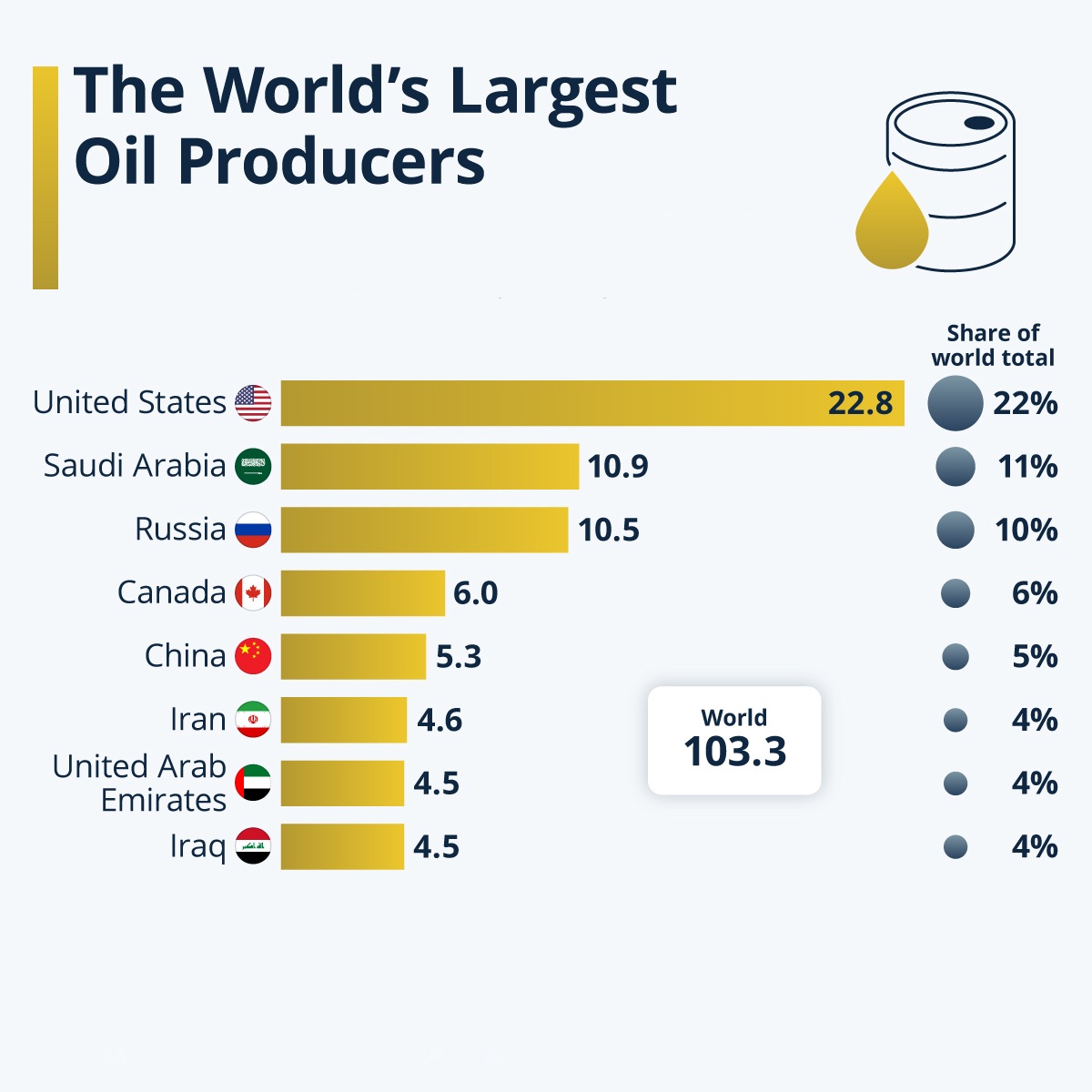
Top Oil Producing Countries in the World 2026
The following ranking represents the major oil-producing countries based on recent production data and 2026 market estimates. Exact daily output can change from month to month because of OPEC+ quotas, maintenance, sanctions and geopolitical disruptions.
| Rank | Country | Approx. Oil Production | Major Position |
|---|---|---|---|
| 1 | United States | 13+ million barrels/day | Largest producer |
| 2 | Saudi Arabia | Around 10 million+ bpd | Leading OPEC producer |
| 3 | Russia | Around 10 million bpd | Major global exporter |
| 4 | Canada | Around 5 million bpd | Major North American producer |
| 5 | Iran | Around 4 million+ bpd | Major Middle Eastern producer |
| 6 | Iraq | Around 4 million bpd | Major OPEC producer |
| 7 | China | Around 4 million bpd | Leading Asian producer |
| 8 | Brazil | Around 4 million bpd | Major offshore producer |
| 9 | United Arab Emirates | Around 3–4 million bpd | Major Gulf producer |
| 10 | Kuwait | Around 2.5–3 million bpd | Important OPEC producer |
Production figures are approximate and can vary depending on whether a source counts crude oil alone or crude plus condensates and other petroleum liquids.
Recent EIA data show the United States, Russia, Saudi Arabia, Canada, Iran, Iraq, China and Brazil among the world’s leading producers.
1. United States
The United States is the world’s largest oil producer. Its position has been strengthened by the development of shale oil fields, particularly in regions such as the Permian Basin.
The U.S. has a unique position in the global oil market because it is simultaneously a major producer, consumer, refiner and exporter. Its production capacity allows the country to respond relatively quickly to changes in global prices.
The growth of U.S. production has also reduced the country’s dependence on imported crude compared with previous decades. However, the United States remains one of the world’s biggest oil-consuming economies.
2. Saudi Arabia
Saudi Arabia is one of the most influential oil-producing countries in the world. It possesses enormous conventional oil reserves and has some of the world’s lowest-cost production resources.
The country is a key member of OPEC and has historically played a central role in decisions affecting global oil supply. Changes in Saudi production can have a significant impact on international crude prices.
Saudi Arabia’s importance extends beyond production. Its large export capacity and spare production capacity have traditionally allowed it to act as an important stabilising force during periods of supply disruption.
3. Russia
Russia remains one of the world’s largest oil producers and exporters despite sanctions and restrictions imposed following its invasion of Ukraine.
European countries substantially reduced their dependence on Russian crude after 2022, prompting Russia to redirect a greater share of its exports toward Asian markets. China and India have become particularly important destinations for Russian oil.
Russia’s enormous geographical size and extensive oil infrastructure make it a major participant in the global petroleum market.
4. Canada
Canada is another major oil producer, with a large share of its production coming from oil sands in Alberta.
Canadian oil production is particularly important to the North American market because of its close connection with U.S. refineries. Pipeline infrastructure allows large volumes of Canadian crude to reach American refining centres.
Canada also has substantial proven oil reserves, although oil-sands production generally has higher costs and environmental challenges than conventional crude production.
5. Iran
Iran has some of the world’s largest petroleum reserves and remains an important oil-producing country.
However, sanctions, investment restrictions and geopolitical tensions have affected Iran’s ability to fully utilise its production and export potential. Changes in sanctions enforcement can therefore have a direct impact on Iranian oil exports and global supply.
6. Iraq
Iraq is one of the world’s major oil producers and has enormous untapped petroleum resources.
Most Iraqi production comes from large oil fields in the south, although the country has faced infrastructure, security and political challenges that have affected production and exports.
Iraq has ambitious plans to expand production substantially. In August 2026, Iraq announced a goal of increasing production to 8–10 million barrels per day within six years, subject to investment and infrastructure development.
7. China
China is both a major producer and the world’s largest oil-importing country.
Although China produces millions of barrels of crude each day, domestic production is not sufficient to satisfy its enormous refining and industrial requirements. Consequently, China imports large quantities of crude from Russia, the Middle East, Africa and other suppliers.
China’s refining industry is also among the world’s largest, giving the country significant influence over refined petroleum-product markets.
8. Brazil
Brazil has emerged as one of the most important oil producers in the Americas.
Its growth has been driven primarily by offshore production, especially from the pre-salt fields located beneath thick layers of rock and salt.
Brazil’s increasing production has strengthened South America’s position in the global oil market. The country is also becoming an important supplier to Asian and other international markets.
9. United Arab Emirates
The UAE is a major oil producer and an important energy exporter.
Abu Dhabi contains the overwhelming majority of the UAE’s oil resources. The country has invested heavily in increasing production capacity and developing advanced energy infrastructure.
The UAE also has an important role in global oil markets through its participation in OPEC-related production decisions.
10. Kuwait
Kuwait has one of the world’s largest proven oil reserves relative to its population.
Oil dominates Kuwait’s economy and remains its most important export commodity. The country has historically maintained significant production capacity and is an important member of OPEC.
Top Oil Consuming Countries in the World 2026
Oil consumption measures the quantity of petroleum products and crude-equivalent energy used by a country. Consumption includes fuel used for transportation, electricity generation, industrial activity, petrochemicals and other purposes.
The largest consumers are generally countries with large populations, highly developed transport systems, major manufacturing industries or significant petrochemical sectors.
| Rank | Country | Approx. Oil Consumption | Major Reason |
| 1 | United States | Around 20 million bpd | Transport and industry |
| 2 | China | Around 16 million bpd | Manufacturing and transport |
| 3 | India | Around 5 million+ bpd | Transport and economic growth |
| 4 | Russia | Around 3.8 million bpd | Industry and transport |
| 5 | Saudi Arabia | Around 3.5 million bpd | Transport, power and industry |
| 6 | Brazil | Around 3.2 million bpd | Transport and industry |
| 7 | Japan | Around 3.1 million bpd | Transport and industry |
| 8 | South Korea | Around 2.5 million bpd | Refining and manufacturing |
| 9 | Iran | Around 2.4 million bpd | Domestic energy use |
| 10 | Canada | Around 2.3 million bpd | Transport and industry |
Recent country-level consumption data place the United States, China and India clearly ahead of most other oil-consuming economies.
1. United States – World’s Largest Oil Consumer
The United States is both the world’s largest oil producer and its largest consumer.
The country’s enormous vehicle fleet, aviation sector, trucking industry and industrial base create huge petroleum demand. Gasoline and diesel account for a substantial share of petroleum consumption.
This combination of high production and high consumption makes the United States unique in the global oil market.
2. China – Major Industrial Oil Consumer
China is the second-largest oil-consuming country and one of the world’s largest crude oil importers.
Its enormous manufacturing sector, transportation system, petrochemical industry and aviation market contribute to high petroleum demand.
China has also been investing heavily in electric vehicles, renewable energy and alternative fuels. These changes could gradually reduce the growth of petroleum consumption.
Recent market developments demonstrate China’s importance: Chinese refiners have been diversifying crude imports from Brazil, Africa and other regions amid Middle East supply disruptions.
3. India – One of the Fastest-Growing Major Oil Markets
India is the world’s third-largest oil-consuming country and one of the most important growth markets for petroleum.
Rising vehicle ownership, urbanisation, industrial development, aviation growth and increasing economic activity are supporting petroleum demand.
India is also a major refining hub. Large refineries process imported crude and supply petroleum products to the domestic market as well as export markets.
India’s dependence on imported crude makes international oil prices particularly important for the country’s economy. Recent reporting indicates that India has been importing more Russian crude amid disruptions in Middle Eastern supply routes.
4. Russia
Russia has a large domestic market for petroleum products because of its enormous territory, transportation requirements and industrial base.
As one of the world’s major producers, Russia has substantial domestic refining capacity as well as a large export industry.
5. Saudi Arabia
Saudi Arabia’s oil consumption is relatively high despite its comparatively small population.
Petroleum is heavily used in transportation, industry and energy-related activities. Historically, oil-fired power generation and high cooling demand have also contributed to domestic energy consumption.
6. Brazil
Brazil’s large transportation sector contributes significantly to oil demand.
The country also has a major refining industry and a large population spread across extensive distances, supporting demand for gasoline, diesel and aviation fuels.
7. Japan
Japan is one of the world’s largest developed-country oil consumers despite having limited domestic oil resources.
The country therefore relies heavily on imported energy. Petroleum continues to be important for transportation, industry and petrochemical production.
8. South Korea
South Korea has a highly developed industrial and manufacturing economy.
Its refineries and petrochemical facilities consume large quantities of crude oil, while petroleum products are also used across transportation and industry.
9. Iran
Iran has substantial domestic oil resources and therefore has historically maintained high domestic petroleum consumption.
Subsidies and relatively low domestic fuel prices have also supported petroleum demand, although energy-efficiency policies and changing economic conditions can affect consumption.
10. Canada
Canada is both a major producer and consumer of oil.
Its large geography means transportation requires substantial fuel use, while industrial activities and the energy sector also contribute to petroleum consumption.
Oil Production vs Oil Consumption
A country’s position in the oil market becomes easier to understand when production and consumption are compared.
| Country | Production Position | Consumption Position | Overall Situation |
| United States | Very High | Very High | Major producer and consumer |
| Saudi Arabia | Very High | High | Large exporter |
| Russia | Very High | High | Major exporter |
| Canada | High | Moderate | Major exporter |
| China | High | Very High | Major importer |
| India | Moderate | Very High | Major importer |
| Brazil | High | High | Producer with growing market |
| Iran | High | High | Major producer and consumer |
| Iraq | High | Moderate | Major exporter |
| Japan | Very Low | High | Major importer |
The biggest difference can be seen between countries such as Saudi Arabia and Iraq, which produce much more oil than they consume, and countries such as China, India and Japan, which consume much more oil than they produce.
Top Oil Producers vs Consumers: What Does It Mean?
Oil production and consumption are not distributed equally around the world.
Some countries have huge reserves but relatively small populations. They can therefore produce more oil than they consume and export the surplus.
Other countries have huge populations and industrial economies but limited domestic reserves. These countries have to import crude oil to meet their energy requirements.
This creates an interconnected global market in which oil moves from producing regions to consuming regions through pipelines, tankers and other infrastructure.
Why Are Oil-Producing Countries Important?
Oil-producing countries have a major influence on the global economy because petroleum remains essential for transportation and industry.
A reduction in production can tighten global supply and increase prices. Conversely, increased production can improve supply availability and put downward pressure on prices.
OPEC and OPEC+ decisions are therefore closely followed by governments, businesses, investors and consumers around the world.
The OPEC Monthly Oil Market Report regularly tracks global oil demand, supply and market developments.
Why Are Oil-Consuming Countries Important?
Large consuming countries influence global oil demand.
When economies grow rapidly, demand for transportation fuel, aviation fuel and industrial petroleum products can rise. When economic growth slows, demand may weaken.
The energy transition is also changing consumption patterns. Electric vehicles, renewable electricity, improved fuel efficiency and alternative fuels could reduce oil demand in some sectors.
However, oil remains difficult to replace completely in aviation, heavy transport, shipping and petrochemicals.
Global Oil Market Outlook for 2026
The 2026 oil market is facing an unusual combination of supply disruptions, geopolitical uncertainty and changing demand forecasts.
The EIA’s latest outlook indicates that global oil consumption is expected to decrease by an average of 1.2 million barrels per day in 2026. It also expects oil inventories to remain under pressure because of disruptions affecting global oil flows.
The International Energy Agency has also revised its demand outlook during 2026. Its March report projected oil consumption growth of about 640,000 barrels per day for 2026, while later market developments and higher prices have led to a more cautious outlook.
At the same time, geopolitical developments have created major uncertainty. Reuters reported that OPEC production increased substantially in July 2026 as Gulf producers restored some disrupted supply.
These developments demonstrate why oil production and consumption figures can change significantly during the year.
What Are the Major Factors Affecting Oil Prices in 2026?
Several factors are influencing the oil market in 2026:
1. Geopolitical Conflicts
Wars and political tensions in major oil-producing regions can disrupt production, exports and shipping routes.
2. OPEC+ Production Decisions
OPEC+ production targets can influence the amount of crude entering the international market.
3. Global Economic Growth
Economic expansion generally increases fuel demand, while recessions can reduce consumption.
4. Electric Vehicles
The increasing use of EVs can reduce gasoline and diesel demand, particularly in passenger transportation.
5. Renewable Energy
Solar, wind, nuclear and other energy sources can gradually reduce the role of oil in certain energy applications.
6. Refinery Capacity
Having enough crude oil is not sufficient; it must also be processed into usable fuels. Recent disruptions have highlighted the importance of refining capacity and the availability of specific crude grades.
Is India a Major Oil Producer or Consumer?
India is primarily a major oil-consuming and importing country.
Although India has domestic oil production, it is far smaller than its total petroleum requirement. Consequently, the country imports a large share of its crude oil.
India’s rapidly expanding economy, growing automobile ownership, aviation sector and industrial development are expected to keep it among the world’s most important oil markets.
At the same time, India is expanding renewable energy, electric mobility and other alternatives to reduce long-term dependence on imported fossil fuels.
Which country produces the most oil in the world in 2026?
The United States remains the world’s leading oil producer, with production exceeding 13 million barrels per day in recent estimates. Production levels can fluctuate depending on market conditions and the definition of petroleum liquids used by different datasets.
Which country consumes the most oil in the world?
The United States is the world’s largest oil-consuming country, followed by China and India. Recent 2026 country-level estimates place U.S. consumption at roughly 20 million barrels per day.
Is India among the top oil-consuming countries?
Yes. India is the world’s third-largest oil-consuming country and one of the major growth markets for petroleum.
Which country has the largest oil reserves?
Venezuela has the world’s largest proven crude oil reserves, although reserve size and actual production are two different measures. Countries with very large reserves do not necessarily rank first in daily production.
Why does China import so much oil?
China’s domestic oil production is not enough to satisfy its enormous transportation, manufacturing, refining and petrochemical requirements. It therefore imports crude from multiple international suppliers.
Which country exports the most oil?
The ranking can vary depending on whether the comparison uses crude exports, total petroleum liquids or refined petroleum products. Saudi Arabia, Russia, the United States, Canada, Iraq and other major producers are among the world’s most important oil exporters.
Is global oil consumption increasing in 2026?
Forecasts have changed considerably during 2026. The EIA’s latest outlook cited above expects global oil consumption to decline by about 1.2 million barrels per day on average in 2026, while other organisations have published different forecasts.
What is the unit used to measure oil production?
Oil production and consumption are commonly measured in barrels per day (bpd). One standard oil barrel contains approximately 159 litres.
Which countries are most dependent on imported oil?
Countries such as India, China, Japan and South Korea rely heavily on imported crude because their domestic production does not fully meet their consumption requirements.
Will oil remain important in the future?
Yes. Although renewable energy and electric vehicles are changing the energy landscape, oil is expected to remain important for transportation, aviation, shipping, petrochemicals and industrial applications for years to come. The pace of change will depend on technology, government policies, prices and global economic growth.
Conclusion
The global oil market in 2026 is dominated by a small group of powerful producers and consumers. The United States, Saudi Arabia and Russia remain among the leading oil-producing countries, while the United States, China and India are the largest consumers.
The most important point is that production and consumption are not the same thing. A country can be a major producer and still consume enormous quantities of oil, as the United States demonstrates. Conversely, countries such as India, China and Japan have enormous energy requirements but depend heavily on imports.
In 2026, geopolitical tensions, OPEC+ policies, supply-chain disruptions, refinery capacity, electric vehicles and renewable energy are all influencing the oil market. As the global energy system gradually changes, understanding the world’s leading oil producers and consumers remains essential for understanding international trade, inflation, transportation costs and energy security.