
India and China have a deeply interconnected trade relationship. Chinese products are widely present in Indian markets, ranging from smartphones, electronics and machinery to chemicals, solar equipment, auto components and industrial goods. At the same time, India has been trying to reduce excessive dependence on Chinese imports through domestic manufacturing, import restrictions, quality-control measures and production-linked incentives.
The question of whether India could completely ban Chinese imports has therefore gained attention. As of August 2026, there is no blanket ban on Chinese goods in India. Instead, the government has been using targeted trade measures, technical regulations, quality standards, anti-dumping duties and restrictions in selected sectors. The government also stated in Parliament in February 2026 that it takes appropriate measures from time to time to address concerns, including those related to national interest.
Chinese Products Imported into India
China remains one of India’s largest sources of imported goods. According to UN Comtrade-based data, India’s imports from China were approximately US$149.49 billion in 2025, compared with about US$126.96 billion in 2024. The increase was around 17.7%.
The scale of imports is important because Chinese goods are not limited to consumer products. A substantial portion consists of industrial inputs, electronic components, machinery, chemicals and other products used by Indian manufacturers.
Major Chinese Products Imported by India
| Rank | Product Category | Approx. Import Value from China in 2025 |
|---|---|---|
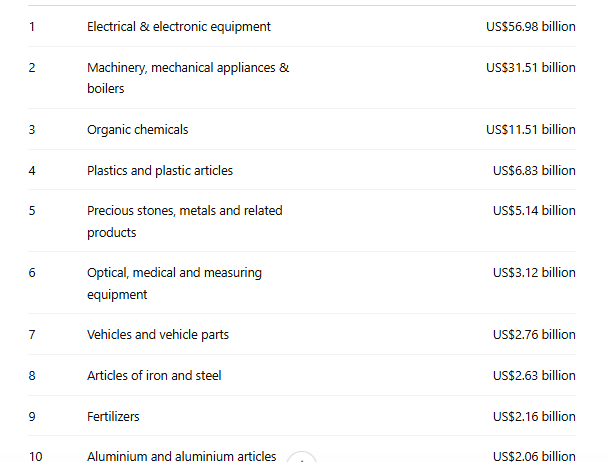
| 1 | Electrical & electronic equipment | US$56.98 billion |
| 2 | Machinery, mechanical appliances & boilers | US$31.51 billion |
| 3 | Organic chemicals | US$11.51 billion |
| 4 | Plastics and plastic articles | US$6.83 billion |
| 5 | Precious stones, metals and related products | US$5.14 billion |
| 6 | Optical, medical and measuring equipment | US$3.12 billion |
| 7 | Vehicles and vehicle parts | US$2.76 billion |
| 8 | Articles of iron and steel | US$2.63 billion |
| 9 | Fertilizers | US$2.16 billion |
| 10 | Aluminium and aluminium articles | US$2.06 billion |
| 11 | Miscellaneous chemical products | US$2.01 billion |
| 12 | Iron and steel | US$1.67 billion |
| 13 | Glass and glassware | US$1.67 billion |
Source: UN Comtrade-based 2025 trade data.
Chinese Product List in India
The following are some of the most important categories in which Chinese products or Chinese-origin components are commonly found in India.
1. Smartphones and Mobile Phones
Chinese companies have historically had a major presence in India’s smartphone market. Apart from finished smartphones, India also imports communication equipment, electronic components, displays, integrated circuits and other parts from China.
Telephone sets and communication apparatus represented one of the largest individual product categories in recent China-to-India trade data, with imports worth more than US$16 billion in the latest reported period.
2. Electronic Components
Chinese imports include:
- Integrated circuits
- Printed circuit boards and components
- Displays and display modules
- Chargers and adapters
- LED components
- Electronic controllers
- Communication equipment
- Computer components
- Consumer electronics parts
This is one of the biggest challenges for any proposal to completely ban Chinese imports because many Indian manufacturers depend on imported components.
3. Computers and IT Equipment
India imports various computer-related products and components from China, including:
- Laptops and computer components
- Data-processing equipment
- Computer accessories
- Storage-related components
- Networking equipment
- Electronic peripherals
Automatic data-processing machines and units were among the major individual Chinese export categories supplied to India.
4. Electrical Machinery
Electrical machinery represents India’s largest broad import category from China. The category includes a wide range of products used by households, businesses and industrial companies.
Examples include:
- Motors
- Transformers
- Power equipment
- Electrical components
- Switchgear components
- Cables and related equipment
- Battery components
- Industrial electrical equipment
5. Industrial Machinery
Chinese machinery is used in numerous Indian industries, including manufacturing, construction, packaging, textiles and infrastructure.
Products can include:
- Factory machinery
- Packaging machines
- Textile machinery
- Construction equipment
- Machine tools
- Pumps
- Compressors
- Industrial equipment
- Mechanical appliances
Machinery and mechanical appliances accounted for roughly US$31.51 billion of India’s imports from China in 2025.
6. Chemicals
China is an important supplier of chemicals and chemical intermediates to Indian industries.
Major categories include:
- Organic chemicals
- Chemical intermediates
- Industrial chemicals
- Pharmaceutical intermediates
- Dyes and pigments
- Specialty chemicals
- Miscellaneous chemical products
Organic chemicals alone accounted for approximately US$11.51 billion of India’s imports from China in 2025.
7. Pharmaceuticals and Pharmaceutical Raw Materials
India is a major pharmaceutical producer, but its pharmaceutical industry relies on imported active pharmaceutical ingredients (APIs) and chemical intermediates for certain medicines.
China has historically been an important source of these inputs. Therefore, an immediate blanket ban could potentially affect Indian pharmaceutical manufacturers unless alternative suppliers or domestic capacity are available.
8. Solar Equipment
Solar manufacturing is another strategically important area. China has a dominant position in several parts of the global solar supply chain, while India has been expanding its domestic manufacturing capacity.
India’s policy approach has increasingly focused on developing domestic manufacturing rather than simply eliminating all Chinese inputs overnight.
9. Auto Components
Chinese-origin products and components are also found in the automotive supply chain.
These can include:
- Electric vehicle components
- Motors
- Electronic components
- Lighting components
- Batteries and battery-related products
- Machinery parts
- Automotive accessories
A complete ban could therefore affect both vehicle manufacturers and aftermarket businesses.
10. Toys and Consumer Goods
Chinese products are particularly visible in consumer markets.
Common examples include:
- Toys
- Decorative products
- Household accessories
- Stationery
- Low-cost electronics
- Kitchen accessories
- Plastic products
- Small appliances
- Festival and gift items
Unlike industrial components, many consumer products can potentially be replaced more easily by domestic manufacturers or alternative suppliers.
India Could Restrict Chinese Imports, But a Complete Ban Would Be Difficult
India has the legal and policy tools to restrict particular imports when there are grounds involving national security, public interest, standards, unfair trade practices or other policy objectives.
However, a complete ban on all Chinese imports would be significantly more complicated because China supplies a very large volume of industrial inputs and components to Indian businesses.
India’s imports from China reached approximately US$149.49 billion in 2025. A sudden prohibition could therefore affect manufacturing costs, supply chains, availability of components and consumer prices.
The more realistic approach is likely to remain sector-specific restrictions and diversification rather than an overnight blanket ban.
Why Would India Want to Reduce Chinese Imports?
Several factors encourage India to reduce excessive dependence on China.
1. Large Trade Deficit
India’s imports from China substantially exceed its exports to China. UN Comtrade-based data puts India’s 2025 trade deficit with China at approximately US$131.41 billion.
Reducing unnecessary imports could help India narrow this imbalance over the long term.
2. National Security
Certain technologies and equipment can have strategic importance. India therefore has an interest in ensuring that critical infrastructure does not become excessively dependent on a single foreign supplier.
3. Domestic Manufacturing
Reducing imports can create opportunities for Indian companies if domestic production becomes competitive.
The government has been pursuing manufacturing incentives and industrial policies designed to increase local production and value addition.
4. Supply-Chain Security
Recent geopolitical tensions have demonstrated the risks of relying heavily on a single country for critical inputs.
India’s policy direction increasingly emphasizes diversification and resilient supply chains.
Which Chinese Products Could Face Restrictions?
A future Indian policy would be more likely to target specific product categories rather than all Chinese goods simultaneously.
Potential areas of greater scrutiny could include:
| Sector | Examples of Products | Likelihood of Targeted Restrictions |
|---|---|---|
| Critical electronics | Communication and sensitive electronic equipment | High |
| Telecom equipment | Network and communication equipment | High |
| Defence-related products | Strategic equipment/components | Very High |
| Critical infrastructure | Selected equipment and machinery | High |
| Solar equipment | Cells, modules and components | Medium to High |
| Steel | Selected Chinese steel products | Medium to High |
| Chemicals | Selected industrial chemicals | Medium |
| Consumer electronics | Finished products/components | Medium |
| Toys | Low-cost consumer toys | Medium |
| Industrial machinery | Selected machinery | Medium |
| Auto components | Selected products | Medium |
| General consumer goods | Household and lifestyle products | Low to Medium |
This should not be interpreted as an official list of products that India has decided to ban. It represents sectors where import controls, standards, tariffs or other measures could theoretically be considered.
India Is Already Using Targeted Trade Measures
India has not relied solely on outright bans. Its trade-policy toolkit includes:
- Anti-dumping duties
- Quality Control Orders
- Bureau of Indian Standards requirements
- Import licensing or monitoring
- Customs scrutiny
- Technical standards
- Domestic manufacturing incentives
- Public procurement restrictions
- Sector-specific import policies
The government’s February 2026 parliamentary response specifically said that appropriate measures are undertaken from time to time to address concerns, including those involving national interest.
Chinese Steel Under Scrutiny
Steel provides a useful example of how India may approach Chinese imports.
Recent reporting indicated that India was monitoring steel imports, particularly supplies from China, before deciding whether additional restrictions were required.
This illustrates an important distinction: monitoring, tariffs and trade remedies are not the same as a blanket import ban.
India Is Also Trying to Build Domestic Alternatives
Rather than banning every Chinese product, India can reduce dependence by making domestic manufacturing more competitive.
A recent example is the proposed incentive programme for high-value construction and infrastructure equipment. Reuters reported on August 21, 2026, that India was preparing a roughly US$1.2 billion incentive scheme aimed at boosting domestic production of equipment such as tunnel-boring machines, firefighting equipment and elevators. One stated objective is to reduce dependence on Chinese imports in strategically important equipment.
This approach could be more sustainable than an immediate ban because it creates Indian alternatives before imports are substantially restricted.
What Would Happen If India Completely Banned Chinese Imports?
A complete ban would have both advantages and disadvantages.
Possible Benefits
1. Boost to Indian manufacturing:
Domestic companies could gain market share in products currently dominated by Chinese suppliers.
2. Lower import dependence:
India could become less dependent on a single major source of supply.
3. Strategic autonomy:
Critical sectors could develop domestic supply chains.
4. Employment opportunities:
Expansion of domestic manufacturing could create jobs.
5. Reduced trade deficit:
If imports were replaced by domestic production or alternative suppliers, India’s trade deficit with China could decline.
Possible Disadvantages
1. Higher prices:
Chinese products are often highly competitive on price. Replacing them could increase costs.
2. Higher manufacturing costs:
Indian businesses that use Chinese components could face higher input costs.
3. Supply-chain disruption:
Industries that depend on Chinese machinery, chemicals or electronic components could experience shortages.
4. Impact on consumers:
Electronics, household products and other goods could become more expensive.
5. Difficulty finding substitutes:
Some specialized components may not have immediately available alternatives.
6. Risk of retaliatory measures:
China could respond with restrictions on Indian exports or other trade measures.
Why a Blanket Ban May Not Be Practical
The biggest challenge is that “Chinese imports” are not synonymous with “Chinese consumer products.”
A smartphone assembled in India may contain components manufactured in China. Similarly, an Indian factory may use Chinese machinery, chemical intermediates or electronic components to manufacture a product domestically.
Therefore, banning finished Chinese consumer products would be very different from eliminating Chinese inputs from Indian manufacturing.
The latest trade data demonstrates the scale of this dependence: electrical and electronic equipment alone accounted for nearly US$57 billion of imports from China in 2025, while machinery accounted for another US$31.5 billion.
India-China Trade: Key Numbers
| Indicator | Latest figure |
|---|---|
| India’s imports from China, 2025 | ~US$149.49 billion |
| India’s imports from China, 2024 | ~US$126.96 billion |
| Increase in imports, 2025 | ~17.7% |
| India’s trade deficit with China, 2025 | ~US$131.41 billion |
| Largest import category | Electrical & electronic equipment |
| Second-largest category | Machinery & mechanical appliances |
| Organic chemicals | ~US$11.51 billion |
Is India Already Banning Some Chinese Products?
India has previously introduced restrictions affecting particular Chinese-linked products, companies, technologies and applications. However, these measures should not be confused with a general ban on all Chinese merchandise.
For example, India imposed restrictions on certain Chinese investments following the 2020 border tensions. The government also banned more than 200 Chinese-linked mobile applications over time on security and sovereignty-related grounds.
Import policy, investment policy and digital-platform restrictions are separate policy areas, so a restriction in one area does not automatically mean that all physical imports from China are prohibited.
Could India Ban Chinese Imports in the Future?
Yes, India could impose additional restrictions on selected Chinese products if the government determines that doing so serves economic, security or other policy objectives.
However, based on the current policy direction, a complete ban on every Chinese product is considerably less likely than targeted restrictions, higher duties, quality requirements, import monitoring and domestic-manufacturing incentives.
India’s recent approach suggests a gradual strategy:
Reduce dependence → develop domestic capacity → diversify suppliers → regulate sensitive imports → restrict selected products where necessary.
This is particularly important because India itself needs access to affordable components, machinery and raw materials to maintain manufacturing growth.
What Should Consumers Do?
Consumers who want to reduce dependence on Chinese products can check the country of origin before purchasing.
Look for:
- Country of Origin
- Manufacturer details
- Importer details
- BIS certification where applicable
- Product warranty
- Indian manufacturing information
- Quality and safety certifications
However, consumers should remember that “Made in India” does not necessarily mean that every component was manufactured in India. Modern supply chains are international, and Indian products may contain imported components.
Chinese Products Ban in India: FAQs
Is India banning Chinese products in 2026?
No blanket ban on all Chinese products is currently in force. India continues to import substantial quantities of Chinese goods while using targeted trade, quality, security and manufacturing policies.
Which Chinese products does India import the most?
Electrical and electronic equipment is the largest broad category, followed by machinery and mechanical appliances. Organic chemicals, plastics, metals, medical equipment, vehicles and components are also significant categories.
Can India legally stop Chinese imports?
India can impose import restrictions and trade measures under applicable laws and policies. However, the nature and justification of any restriction depend on the product, policy objective and applicable international trade obligations.
Why doesn’t India simply ban all Chinese products?
Because China is deeply integrated into India’s industrial supply chains. A complete ban could raise costs and disrupt electronics, machinery, chemicals, pharmaceuticals, solar manufacturing and other industries.
Which Chinese products are most likely to face restrictions?
Sensitive technology, strategic equipment, certain industrial products and sectors where domestic manufacturing can realistically replace imports are more likely to receive targeted scrutiny.
Is India trying to replace Chinese imports?
Yes. India is pursuing domestic manufacturing, supply-chain diversification and industrial incentives to reduce dependence on China in strategically important sectors. The proposed 2026 construction-equipment incentive programme is one recent example.
Will Chinese products become more expensive in India?
They can become more expensive if India imposes higher duties, anti-dumping measures, quality requirements or other restrictions. However, the actual effect depends on the individual product and policy.
What is India’s biggest problem with Chinese imports?
The central issue is not simply the presence of Chinese consumer products. It is the combination of a very large trade deficit and dependence on China for critical industrial inputs, electronics, machinery and chemicals.
Conclusion
India’s relationship with Chinese imports is more complicated than simply choosing between “ban” and “no ban.” China is a major supplier of consumer goods, but it is also deeply embedded in Indian manufacturing through electronics, machinery, chemicals, components and industrial equipment.
With imports from China reaching about US$149.49 billion in 2025, an immediate blanket ban would carry substantial economic costs.
Therefore, the more practical strategy for India is likely to be targeted restrictions combined with domestic manufacturing, supply-chain diversification and stronger quality and security standards. If Indian manufacturing capacity expands sufficiently, the government could progressively restrict imports in selected sectors without causing major disruptions.
In short: India can ban or restrict specific Chinese products, but a complete ban on all Chinese imports would be economically difficult. The likely path is selective restrictions and a gradual reduction in strategic dependence rather than an overnight blanket ban.