
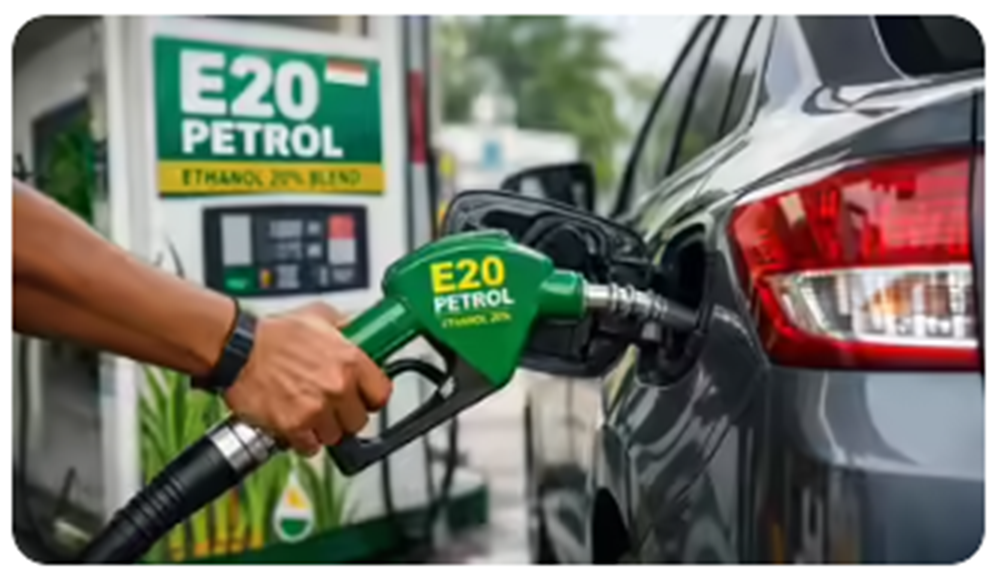
E20 petrol has become an important part of India’s transition towards cleaner and more domestically sourced transport fuels. The term E20 refers to petrol containing up to 20% ethanol blended with 80% petrol. Ethanol is a renewable biofuel that can be produced from agricultural feedstocks and other biomass sources.
India has been steadily increasing ethanol blending in petrol to reduce dependence on imported crude oil, support the domestic agricultural and biofuel economy, and reduce greenhouse-gas emissions. E20 petrol was officially launched at selected fuel stations in February 2023, and its availability has subsequently expanded across the country.
For vehicle owners, however, one important question remains: Does E20 petrol affect mileage, engine performance or vehicle life? The answer depends largely on the vehicle’s compatibility and engine technology.
What is E20 petrol?
E20 petrol is a blend containing 20% ethanol and 80% gasoline (petrol) by volume. The “E” stands for ethanol, while “20” indicates the maximum ethanol proportion in the blend.
For example, if you have 10 litres of E20 petrol, approximately
| Component | Quantity |
|---|---|
| Petrol/Gasoline | 8 litres |
| Ethanol | 2 litres |
| Total | 10 litres |
Ethanol has a high octane value, which can support efficient combustion in engines designed for the fuel. At the same time, ethanol contains less energy per liter than conventional petrol, which is one of the main reasons why mileage can decrease in some vehicles.
IndianOil says E20 is intended for E20-compatible vehicles and highlights reduced dependence on fossil fuels and lower greenhouse-gas emissions as key objectives of ethanol blending.
Why is E20 Petrol Being Used in India?
India imports a significant amount of crude oil to meet its energy requirements. Increasing ethanol blending allows a portion of petrol demand to be met using domestically produced renewable fuel.
The ethanol-blending program has several objectives:
- Reduce crude-oil import dependence.
- Save foreign exchange.
- Increase the use of renewable fuel.
- Provide an additional market for agricultural products and biomass.
- Reduce greenhouse-gas emissions.
- Encourage development of ethanol-compatible vehicles.
- Improve India’s energy security.
IndianOil has reported that ethanol-blending initiatives have contributed to foreign-exchange savings and lower carbon emissions while also supporting rural economic activity.
E20 Petrol vs Normal Petrol
| Feature | Normal Petrol | E20 Petrol |
|---|---|---|
| Ethanol content | Lower/varies by fuel specification | Up to 20% |
| Main fuel | Gasoline | Gasoline + ethanol |
| Renewable component | Lower | Higher |
| Energy per litre | Higher | Lower than pure gasoline |
| Mileage | Generally higher, all else equal | Can be somewhat lower |
| Octane contribution | Depends on petrol grade | Ethanol has high octane |
| Environmental objective | Conventional fuel | Lower fossil-fuel dependence |
| Vehicle compatibility | Broadly established | Depends on vehicle design and manufacturer specifications |
Benefits of E20 Petrol
1. Reduces Dependence on Imported Crude Oil
One of the biggest advantages of ethanol blending is that ethanol can replace a portion of petroleum-derived gasoline. This can reduce the amount of petrol that needs to be produced from imported crude oil.
For a country with a large and growing transportation sector, increasing the domestic renewable component of fuel can contribute to greater energy security.
2. Helps Reduce Greenhouse-Gas Emissions
Ethanol is a biofuel derived from renewable sources. Replacing part of fossil gasoline with ethanol can reduce the lifecycle dependence on fossil fuels.
IndianOil identifies reduced greenhouse-gas emissions as one of the sustainability objectives of E20 fuel.
However, the actual environmental benefit depends on how the ethanol is produced, transported and processed, so E20 should not be interpreted as a completely emission-free fuel.
3. Supports the Domestic Ethanol Industry
Higher ethanol blending creates demand for domestically produced ethanol. This can encourage investment in distilleries, biofuel infrastructure and related supply chains.
The programme can also create additional markets for agricultural feedstocks and biomass.
4. High Octane Properties of Ethanol
Ethanol has a relatively high octane rating. This property can help prevent knocking and can be beneficial when engines are specifically calibrated to take advantage of higher-octane fuel.
The benefit is therefore more meaningful in an engine designed or calibrated for ethanol-blended fuel rather than simply assuming that every vehicle will deliver higher performance with E20.
5. Cleaner Combustion Characteristics
Ethanol contains oxygen within its molecular structure, which can contribute to cleaner combustion under appropriate engine conditions.
IndianOil states that E20 promotes cleaner burning and can reduce certain harmful pollutants such as carbon monoxide.
6. Improves Energy Security
Increasing domestic ethanol use diversifies India’s transportation-fuel supply. Instead of depending entirely on petroleum, the fuel system can incorporate a renewable domestic component.
This is particularly important when international crude-oil prices or geopolitical developments create uncertainty in energy markets.
Does E20 Petrol Give Better Mileage?
Generally, E20 petrol does not provide better mileage than petrol with less ethanol. The main reason is that ethanol contains less energy per litre than gasoline.
Consequently, a vehicle may require slightly more fuel to travel the same distance.
However, the actual mileage difference depends on:
- Vehicle model and engine design
- Engine calibration
- Driving style
- Traffic conditions
- Tyre pressure
- Air-conditioning usage
- Vehicle load
- Fuel quality
- Road conditions
- Maintenance
Therefore, it is incorrect to claim that every vehicle will experience exactly the same mileage reduction.
E20 Mileage Example
Suppose a vehicle previously delivered 20 km/litre under a particular set of conditions. After switching to E20, its mileage could be somewhat lower depending on the engine and calibration.
This does not mean that every vehicle will automatically lose a fixed number of kilometres per litre. Manufacturer specifications and real-world driving conditions are more important.
Does E20 Petrol Damage the Engine?
For a vehicle designed and certified for E20, using E20 petrol according to the manufacturer’s recommendations should not be considered inherently damaging to the engine.
The Government has stated that extensive field trials found no compatibility issues or adverse impact on vehicle performance with E20 in the tested compatible vehicles.
The situation can be different for older vehicles that were not designed for higher ethanol blends. Ethanol can affect certain materials, seals, fuel-system components and storage characteristics, which is why vehicle compatibility matters.
Always check the owner’s manual or manufacturer’s recommendation before assuming that a vehicle is E20-compatible.
E20 Petrol and Older Vehicles
Older vehicles are one of the major areas of consumer concern.
A vehicle manufactured before widespread E20 compatibility may have fuel-system components that were designed around lower ethanol concentrations. In such cases, long-term use of higher ethanol blends may have different effects depending on the vehicle’s materials, age, and condition.
Therefore, owners of older petrol cars and motorcycles should check the following:
- The vehicle’s manufacturing year.
- The manufacturer’s E20 compatibility statement.
- The owner’s manual.
- Recommended fuel specifications.
- Warranty or service documentation.
Do not rely solely on the vehicle’s age; manufacturer-specific compatibility is the better guide.
Drawbacks of E20 Petrol
1. Potential Reduction in Mileage
The most commonly discussed drawback is lower fuel economy. Ethanol has lower energy content per litre than gasoline, so vehicles can consume somewhat more fuel for the same distance.
The effect varies significantly between vehicles.
2. Compatibility Concerns for Older Vehicles
Vehicles that were not designed for higher ethanol blends may not have the same level of fuel-system compatibility as newer E20-ready models.
This is particularly important for owners of older cars, motorcycles, and scooters.
3. Ethanol Can Absorb Moisture
Ethanol is hygroscopic, meaning it can absorb water from its surroundings. Proper fuel storage and quality control are therefore important.
This is especially relevant throughout the fuel-storage and distribution chain. In August 2026, Indian oil marketing companies reported additional nationwide testing after concerns about moisture and chloride in E20 fuel and said tested fuel quality remained within prescribed specifications, while isolated deviations identified during surveillance were addressed.
4. Possible Increase in Fuel Consumption
Even when an E20-compatible vehicle operates normally, its fuel consumption can be higher than with a lower-ethanol petrol blend because of the lower energy density of ethanol.
For drivers covering very high monthly distances, even a modest change in fuel economy can become noticeable.
5. Transition Challenges
India’s transition to higher ethanol blending requires changes throughout the automotive ecosystem.
These include:
- Fuel storage infrastructure
- Distribution systems
- Vehicle calibration
- Fuel-system materials
- Consumer awareness
- Testing and quality control
- Manufacturer compatibility
The transition is therefore much broader than simply changing the fuel available at petrol pumps.
Is E20 Petrol Safe for Cars and Bikes?
Yes, for vehicles that are designed or certified for E20.
Before using E20 regularly, owners should check the manufacturer’s fuel recommendation. Newer E20-compatible vehicles are designed with appropriate fuel-system materials and engine calibration.
For an older vehicle, do not assume compatibility simply because E20 is available at the petrol pump.
Is E20 Petrol Good for the Environment?
E20 can provide environmental benefits because it incorporates renewable ethanol into petrol and can reduce reliance on fossil fuels.
IndianOil specifically identifies lower greenhouse-gas emissions and improved air quality among the objectives of E20.
However, the environmental impact of ethanol depends on its production pathway, feedstock, agricultural practices, energy consumption and transportation. Therefore, E20 is better viewed as a lower-fossil-fuel alternative, rather than a zero-emission fuel.
Does E20 Petrol Affect Vehicle Performance?
For compatible vehicles, E20 is intended to provide normal operation. Performance depends on the engine’s design and calibration.
Ethanol’s high octane characteristics can be useful in engines optimized for it. But a higher ethanol percentage does not automatically mean more power or better acceleration in every vehicle.
The Government’s recent response on the ethanol-blending programme states that field trials found no compatibility issues or adverse vehicle-performance impact in the tested E20-compatible vehicles.
How to Check Whether Your Vehicle Supports E20?
The easiest approach is to check the manufacturer’s documentation.
Check These Sources:
1. Owner’s manual:
Look for the recommended ethanol blend or fuel specification.
2. Fuel label near the fuel cap:
Some vehicles display the maximum ethanol blend they support.
3. Manufacturer’s website:
Vehicle manufacturers may publish E20 compatibility information based on model and production year.
4. Authorized service centre:
If you are uncertain, ask an authorized dealer or service centre.
5. Vehicle documentation:
Check the specifications supplied with your vehicle.
E20 Petrol: Advantages and Disadvantages at a Glance
| Advantages | Disadvantages |
|---|---|
| Reduces fossil-fuel dependence | May reduce mileage |
| Supports renewable fuel use | Lower energy content per litre |
| Can reduce greenhouse-gas emissions | Older vehicles may have compatibility concerns |
| Supports domestic ethanol production | Requires careful fuel-quality management |
| Ethanol has high octane properties | Transition requires vehicle and infrastructure changes |
| Improves energy diversification | Actual benefits vary by vehicle and ethanol source |
Frequently Asked Questions About E20 Petrol
Is E20 petrol 20% ethanol?
Yes. E20 refers to petrol blended with up to 20% ethanol by volume, with the remaining portion being gasoline.
Is E20 petrol good or bad?
E20 has important benefits for energy security, renewable-fuel use and emissions reduction, but it can also result in somewhat lower mileage. Whether it is suitable for a particular vehicle depends primarily on its E20 compatibility.
Does E20 reduce mileage?
It can. Ethanol contains less energy per litre than gasoline, so E20 can result in lower fuel economy. The actual difference varies by vehicle and driving conditions.
Can I use E20 petrol in an old car?
Do not assume that an old car is compatible with E20. Check the manufacturer’s recommendation for your specific model and production year.
Does E20 damage a compatible vehicle?
An E20-compatible vehicle is designed to operate on the blend. Government field-trial information has reported no compatibility or adverse-performance issues in tested compatible vehicles.
Does E20 increase engine life?
E20 should not be considered a fuel that automatically increases engine life. Engine durability depends on vehicle design, fuel compatibility, maintenance and operating conditions.
Is E20 cheaper than normal petrol?
The retail price of petrol is determined by several factors, including crude-oil prices, taxes, refining, transportation and marketing costs. Therefore, the presence of ethanol does not by itself guarantee that E20 will be cheaper at every petrol station.
Does E20 petrol improve performance?
Not necessarily. Ethanol has high-octane properties, but any performance benefit depends on whether the engine is calibrated to take advantage of those properties.
Conclusion
E20 petrol is petrol containing up to 20% ethanol and represents an important step in India’s ethanol-blending programme. Its major advantages include reducing dependence on fossil fuels, supporting domestic biofuel production, improving energy security and potentially reducing lifecycle greenhouse-gas emissions.
The biggest concern for consumers is usually mileage. Because ethanol contains less energy per litre than gasoline, E20 may deliver somewhat lower fuel economy in some vehicles. Compatibility is another important consideration, particularly for older cars and two-wheelers.
For consumers, the simplest rule is: if your vehicle is E20-compatible, use E20 according to the manufacturer’s recommendations; if you own an older vehicle, check compatibility before making assumptions.
As of 2026, E20 is an established part of India’s fuel transition, and oil marketing companies continue to monitor fuel quality across the supply chain.