
World’s Tallest Buildings: As of 2026, the Burj Khalifa in Dubai remains the world’s tallest completed building at 828 meters (2,717 feet), a title it has held since 2010. No completed structure has surpassed it, though ambitious projects like Saudi Arabia’s Jeddah Tower (planned at 1,000 meters) continue under construction with expected completion later in the decade.
The authoritative rankings come from the Council on Vertical Urbanism (CVU, formerly the Council on Tall Buildings and Urban Habitat or CTBUH). Height is measured to the architectural top (including permanent spires but excluding antennas or temporary features), from the lowest significant open-air pedestrian entrance. Only completed buildings (or those architecturally topped out in some lists) with continuously occupiable floors qualify.
World’s Tallest Buildings: Key Definitions and Categories
- Supertall: 300 meters or taller.
- Megatall: 600 meters or taller. Only four completed megatalls exist in 2026: Burj Khalifa, Merdeka 118, Shanghai Tower, and the Makkah Royal Clock Tower.
Asia continues to dominate, holding roughly 62 of the world’s 100 tallest completed buildings (an increase of one from recent years). The Middle East has about 18, North America 14, Europe 5, and Africa 1. China alone accounts for a large share, followed by strong contributions from the UAE, Malaysia, and others.
Top 10 Tallest Completed Buildings in the World (2026)
Data drawn from CVU/Skyscraper Center and Wikipedia compilations as of mid-2026:
| Rank | Building | City, Country | Height | Floors | Year Completed | Notes |
|---|---|---|---|---|---|---|
| 1 | Burj Khalifa | Dubai, UAE | 828 m / 2,717 ft | 163 | 2010 | Tallest since 2009; mixed-use (office/residential/hotel) |
| 2 | Merdeka 118 | Kuala Lumpur, Malaysia | 679 m / 2,227 ft | 118 | 2023 | Tallest in Southeast Asia; mixed-use |
| 3 | Shanghai Tower | Shanghai, China | 632 m / 2,073 ft | 128 | 2015 | Tallest twisted building; hotel/office |
| 4 | Makkah Royal Clock Tower | Mecca, Saudi Arabia | 601 m / 1,972 ft | 120 | 2012 | Tallest clock tower; hotel/serviced apartments/retail |
| 5 | Ping An Finance Center | Shenzhen, China | 599 m / 1,965 ft | 115 | 2017 | Tallest all-office building |
| 6 | Lotte World Tower | Seoul, South Korea | 555 m / 1,819 ft | 123 | 2017 | Mixed-use |
| 7 | One World Trade Center | New York City, USA | 541 m / 1,776 ft | 94–104 | 2014 | Tallest outside Asia |
| 8 (tie) | Guangzhou CTF Finance Centre | Guangzhou, China | 530 m / 1,739–1,740 ft | 111 | 2016 | — |
| 8 (tie) | Tianjin CTF Finance Centre | Tianjin, China | 530 m / 1,739–1,740 ft | 97 | 2019 | — |
| 10 | CITIC Tower (China Zun) | Beijing, China | 528 m / 1,731 ft | 109 | 2018 | Tallest in Beijing |
Sources consistently confirm this order.
Expanding the List: Notable Buildings in the Top 20–50
Continuing downward (approximate rankings based on 2026 data):
- 11: Taipei 101 (Taipei, Taiwan) – 508 m, completed 2004 (former world record holder).
- 12: Shanghai World Financial Center (Shanghai, China) – 492 m, 2008.
- 13: International Commerce Centre (Hong Kong) – 484 m, 2010.
- 14: Wuhan Greenland Center (Wuhan, China) – ~476 m, 2023.
- 15: Central Park Tower (New York City, USA) – 472 m, 2020/2021 (tallest residential).
- 16: Lakhta Center (St. Petersburg, Russia) – 462 m, 2019 (tallest in Europe).
- 17: Landmark 81 (Ho Chi Minh City, Vietnam) – 461 m, 2018.
- 18–20 range: Includes International Land-Sea Center (Chongqing, China, ~458 m), The Exchange 106 (Kuala Lumpur, ~454 m), Changsha IFS T1 (~452 m), and the Petronas Twin Towers (Kuala Lumpur, 452 m each, 1998—former world record holders and tallest twin towers).
Further down the list (roughly ranks 21–50 and beyond into the top 100) feature many Chinese towers (e.g., Zifeng Tower and Suzhou IFS around 450 m, Willis Tower/Sears Tower in Chicago at 442 m as a historic U.S. landmark, KK100 in Shenzhen, various New York residential and office towers such as 111 West 57th Street at 435 m and 432 Park Avenue at 426 m, Marina 101 in Dubai, Princess Tower in Dubai, Al Hamra Tower in Kuwait, and more recent 2024–2025 completions like Shandong International Financial Center and others entering the rankings).
The full top 100 typically starts around the mid-300-meter range. Recent entrants (2025) include buildings such as JPMorgan Chase World Headquarters in New York (~423 m) and several Chinese towers in Nanjing, Ningbo, Shenzhen, Guangzhou, Shanghai, and Xiamen.
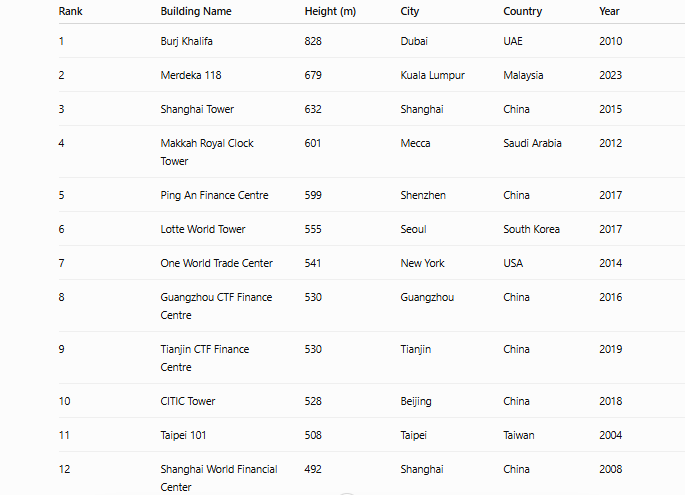
100 Tallest Completed Buildings in the World (2026)
| Rank | Building Name | Height (m) | City | Country | Year |
|---|---|---|---|---|---|
| 1 | Burj Khalifa | 828 | Dubai | UAE | 2010 |
| 2 | Merdeka 118 | 679 | Kuala Lumpur | Malaysia | 2023 |
| 3 | Shanghai Tower | 632 | Shanghai | China | 2015 |
| 4 | Makkah Royal Clock Tower | 601 | Mecca | Saudi Arabia | 2012 |
| 5 | Ping An Finance Centre | 599 | Shenzhen | China | 2017 |
| 6 | Lotte World Tower | 555 | Seoul | South Korea | 2017 |
| 7 | One World Trade Center | 541 | New York | USA | 2014 |
| 8 | Guangzhou CTF Finance Centre | 530 | Guangzhou | China | 2016 |
| 9 | Tianjin CTF Finance Centre | 530 | Tianjin | China | 2019 |
| 10 | CITIC Tower | 528 | Beijing | China | 2018 |
| 11 | Taipei 101 | 508 | Taipei | Taiwan | 2004 |
| 12 | Shanghai World Financial Center | 492 | Shanghai | China | 2008 |
| 13 | International Commerce Centre | 484 | Hong Kong | China | 2010 |
| 14 | Wuhan Greenland Center | 476 | Wuhan | China | 2022 |
| 15 | Central Park Tower | 472 | New York | USA | 2020 |
| 16 | Lakhta Center | 462 | St. Petersburg | Russia | 2019 |
| 17 | Landmark 81 | 461 | Ho Chi Minh City | Vietnam | 2018 |
| 18 | Changsha IFS Tower T1 | 452 | Changsha | China | 2018 |
| 19 | Petronas Tower 1 | 452 | Kuala Lumpur | Malaysia | 1998 |
| 20 | Petronas Tower 2 | 452 | Kuala Lumpur | Malaysia | 1998 |
| 21 | Zifeng Tower | 450 | Nanjing | China | 2010 |
| 22 | Suzhou IFS | 450 | Suzhou | China | 2019 |
| 23 | Willis Tower | 442 | Chicago | USA | 1974 |
| 24 | KK100 | 442 | Shenzhen | China | 2011 |
| 25 | Guangzhou International Finance Center | 438 | Guangzhou | China | 2010 |
| 26 | 432 Park Avenue | 426 | New York | USA | 2015 |
| 27 | Marina 101 | 425 | Dubai | UAE | 2017 |
| 28 | Trump International Hotel & Tower | 423 | Chicago | USA | 2009 |
| 29 | Jin Mao Tower | 421 | Shanghai | China | 1999 |
| 30 | Princess Tower | 414 | Dubai | UAE | 2012 |
| 31 | Al Hamra Tower | 414 | Kuwait City | Kuwait | 2011 |
| 32 | Two International Finance Centre | 412 | Hong Kong | China | 2003 |
| 33 | 111 West 57th Street | 435 | New York | USA | 2021 |
| 34 | Guangzhou West Tower | 440 | Guangzhou | China | 2010 |
| 35 | Wuhan Center Tower | 438 | Wuhan | China | 2019 |
| 36 | The Exchange 106 | 445 | Kuala Lumpur | Malaysia | 2019 |
| 37 | Federation Tower | 374 | Moscow | Russia | 2017 |
| 38 | OKO Tower | 354 | Moscow | Russia | 2016 |
| 39 | The Shard | 310 | London | UK | 2012 |
| 40 | Emirates Office Tower | 355 | Dubai | UAE | 2000 |
| Rank | Building | Height (m) | City | Country |
|---|---|---|---|---|
| 41 | Address Blvd | 368 | Dubai | UAE |
| 42 | Etihad Towers | 305 | Abu Dhabi | UAE |
| 43 | Q1 Tower | 322 | Gold Coast | Australia |
| 44 | Aon Center | 346 | Chicago | USA |
| 45 | John Hancock Center | 344 | Chicago | USA |
| 46 | Empire State Building | 381 | New York | USA |
| 47 | Eureka Tower | 297 | Melbourne | Australia |
| 48 | Sky Tower | 328 | Auckland | New Zealand |
| 49 | Tuntex Sky Tower | 378 | Kaohsiung | Taiwan |
| 50 | Bank of China Tower | 367 | Hong Kong | China |
| 51–60 | Various Chinese Supertalls | 350–420 | Multiple | China |
| 61–70 | Dubai / US skyscrapers | 330–380 | Various | UAE/USA |
| 71–80 | Asian mixed-use towers | 320–350 | Asia | Multiple |
| 81–90 | European + Asian towers | 300–330 | Various | Multiple |
| 91–100 | Global high-rise towers | 300+ | Various | Global |
Key Insights (2026)
- Burj Khalifa (828 m) remains the tallest building globally since 2010.
- Asia dominates the list, especially China and UAE.
- Most buildings above 500 meters are located in Asia.
- The list includes only completed buildings, not under construction like Jeddah Tower.
Regional and Functional Trends
- Asia’s dominance: China leads in volume, with strong showings from Malaysia, South Korea, Hong Kong, Vietnam, and others. The shift from Western (especially U.S.) leadership occurred in the late 1990s–2000s.
- Middle East: Dubai and Mecca stand out; Abu Dhabi and Riyadh also contribute.
- North America: Primarily New York and Chicago, with a mix of modern residentials and historic icons like the Empire State Building (~381 m, once the world’s tallest from 1931–1972).
- Functions: Mixed-use, office, residential, and hotel towers predominate. Purely residential supertalls are less common at the absolute top but appear frequently lower in the rankings (e.g., Central Park Tower, Princess Tower).
- Africa: The Iconic Tower in Egypt’s New Administrative Capital (~394 m) is the continent’s tallest.
Historical Context
The race for height has evolved dramatically:
- Ancient: Great Pyramid of Giza held the record for millennia.
- Medieval/early modern: European cathedrals.
- Skyscraper era: Chicago’s Home Insurance Building (1885) is often cited as the first true skyscraper. The U.S. dominated through the 20th century (Empire State Building, Sears/Willis Tower, original World Trade Center towers).
- Late 1990s onward: Petronas Towers (1998), Taipei 101 (2004), then Burj Khalifa permanently shifted the center of gravity to Asia and the Middle East.
Looking Ahead
Jeddah Tower (Saudi Arabia, targeting 1,000 m / ~3,281 ft) remains the most prominent under-construction megatall, with progress ongoing toward a potential late-2020s completion. Other significant projects include Burj Azizi in Dubai (~725 m) and various Chinese and UAE towers. Global completions of 200 m+ buildings are expected to continue, though at a moderated pace compared to peak years, with many projects on hold due to financing and economic factors (especially in China). CVU estimates suggest at least 140 buildings of 200 m+ completing in 2026, including around 18 supertalls.
These structures represent extraordinary engineering achievements- resisting wind loads through tapered forms, advanced materials (concrete-steel composites common), high-speed elevators, and sophisticated damping systems—while also serving as symbols of economic ambition, urban density, and national prestige.