
A ration card is an essential government document under the National Food Security Act (NFSA) 2013. It enables eligible households to access subsidised food grains and other essentials through the Public Distribution System (PDS). In 2026, most states have streamlined the process with online portals, Smart PDS systems, and Aadhaar-based verification, making it easier to apply from home or through Common Service Centres (CSCs).
What is a Ration Card?
A ration card serves as both an identity document and a key to subsidised rations. Under NFSA, Priority Households (PHH) receive 5 kg of food grains per person per month at highly subsidised rates (₹1–3 per kg), while Antyodaya Anna Yojana (AAY) families get 35 kg per household. Above Poverty Line (APL) or Non-Priority Household cards mainly act as identity proof. The One Nation One Ration Card (ONORC) scheme allows beneficiaries to collect rations from any Fair Price Shop (FPS) across India. Digital or e-ration cards are now widely issued and can be downloaded as PDFs.
Types of Ration Cards in 2026
There are three main categories. AAY cards are for the poorest and most vulnerable groups such as landless labourers, widows, disabled persons, and destitute families. PHH cards cover priority households whose income falls below the state-defined threshold. APL or Non-Priority cards are issued to families above the poverty line who still need the document for identity or other purposes. Colour coding and exact benefits vary slightly by state, but the NFSA framework remains uniform. States may also issue smart or digital versions linked to biometric authentication.
Eligibility Criteria for Ration Card
Any Indian citizen residing in a particular state can apply, provided the family does not already hold a ration card elsewhere. The household must share a common kitchen and meet the state’s income or vulnerability criteria for the desired category. For AAY, applicants usually belong to specific vulnerable groups. Residence in the state for a minimum period (often one year) is commonly required. New families formed after marriage or separation from a joint family are also eligible. Income limits differ by state—for example, Delhi raised its annual family income ceiling to ₹1.20 lakh in 2026.
Documents Required for New Ration Card
Aadhaar cards of all family members are mandatory in 2026 for e-KYC and seeding. Address proof such as a recent electricity bill, rent agreement, water bill, or voter ID is essential. An income certificate issued by the Tehsildar or competent authority is required for PHH or AAY categories. Passport-size photographs of the head of the family (and sometimes all members) must be uploaded. Additional documents may include a bank passbook, self-declaration of no existing ration card, birth certificates for children, marriage certificate for newly formed families, or a surrender certificate if moving from another state.
How to Apply for Ration Card Online in 2026 (Step-by-Step)
Ration card issuance is a state subject, so there is no single national portal. Visit the official Food and Civil Supplies or PDS portal of your state (examples: fcs.up.gov.in for Uttar Pradesh, epds.bihar.gov.in or rconline.bihar.gov.in for Bihar, mahafood.gov.in for Maharashtra). Register using your mobile number and Aadhaar, then verify with OTP. Fill the online form with head-of-family details, all members’ names, ages, relationships, Aadhaar numbers, address, and income. Upload scanned documents (keep file size under the prescribed limit, often 500 KB). Select your preferred Fair Price Shop if required, submit the form, and note the application or reference number carefully.
Offline Application and CSC Method
If online access is difficult, visit the nearest Common Service Centre, e-Sevai centre, or district Food and Civil Supplies office. Carry original documents and photocopies. The operator will fill the form on the state portal, capture biometrics or photograph if needed, and submit the application. A nominal service charge may apply at CSCs in some states, though the government application itself is usually free. You will receive an acknowledgement with a reference number for tracking.
Application Status Check and Tracking
After submission, log in to the same state portal using your mobile number or reference ID. Most portals display real-time status—pending verification, field inspection, approved, or rejected. You may also receive SMS updates on your registered mobile. Processing typically takes 15–30 days as per statutory timelines, subject to successful document and physical verification. Keep the reference number safe for future queries.
Field Verification and Issuance
After online scrutiny, a field officer or inspector may visit your residence to verify the address, family composition, and documents. Cooperate fully and provide any additional information requested. Once approved, the ration card is issued either as a physical card or digital e-ration card. Many states now allow immediate download of the e-ration card from the portal. Link Aadhaar of all members for seamless PDS transactions under ONORC.
Benefits of Having a Ration Card in 2026
The primary benefit is access to highly subsidised food grains under NFSA and schemes like PMGKAY (extended in some states). It serves as a widely accepted identity and address proof for opening bank accounts, applying for other government schemes, and school admissions. ONORC ensures portability if you migrate for work. Smart ration cards and e-KYC reduce leakages and make the system more transparent. In several states, a valid ration card also helps in faster eligibility for schemes such as Ayushman Bharat.
Common Mistakes to Avoid
Do not apply if any family member already has a ration card in another state without first obtaining a surrender certificate. Ensure names and details exactly match Aadhaar records to avoid rejection. Upload clear, properly sized documents and do not miss any mandatory fields. Avoid paying bribes—application is free or involves only authorised CSC fees. Track the application regularly and respond promptly to any verification calls or visits.
State-Wise Portal Links (Selected)
- Uttar Pradesh: fcs.up.gov.in
- Bihar: rconline.bihar.gov.in / epds.bihar.gov.in
- Maharashtra: mahafood.gov.in / rcms.mahafood.gov.in
- Delhi: edistrict.delhigovt.nic.in
- West Bengal: wbpds.gov.in
- Tamil Nadu: tnpds.gov.in
- Karnataka: ahara.kar.nic.in
- Rajasthan: food.rajasthan.gov.in
Always verify the latest portal on the official NFSA website (nfsa.gov.in) or your state Food Department site, as links and processes may be updated.
Ration Card Kaise Banaye 2026 (Online Apply Process)
राशन कार्ड भारत में एक बहुत जरूरी सरकारी दस्तावेज है, जिसके माध्यम से सस्ती दर पर अनाज (चावल, गेहूं, आदि) मिलता है। 2026 में अब राशन कार्ड बनवाने की प्रक्रिया काफी आसान हो गई है और आप इसे घर बैठे ऑनलाइन बना सकते हैं।
Official Website (Apply Online)
ध्यान दें: राशन कार्ड हर राज्य का अलग पोर्टल होता है, इसलिए आपको अपने राज्य (जैसे UP, Delhi, Bihar) की Food & Civil Supplies वेबसाइट पर जाना होगा।
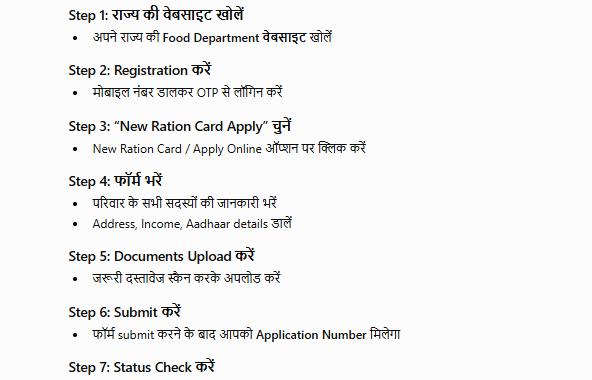
Ration Card Online Apply Process (Step-by-Step)
Step 1: राज्य की वेबसाइट खोलें
- अपने राज्य की Food Department वेबसाइट खोलें
Step 2: Registration करें
- मोबाइल नंबर डालकर OTP से लॉगिन करें
Step 3: “New Ration Card Apply” चुनें
- New Ration Card / Apply Online ऑप्शन पर क्लिक करें
Step 4: फॉर्म भरें
- परिवार के सभी सदस्यों की जानकारी भरें
- Address, Income, Aadhaar details डालें
Step 5: Documents Upload करें
- जरूरी दस्तावेज स्कैन करके अपलोड करें
Step 6: Submit करें
- फॉर्म submit करने के बाद आपको Application Number मिलेगा
Step 7: Status Check करें
- उसी नंबर से आप आवेदन की स्थिति ट्रैक कर सकते हैं
Required Documents (जरूरी दस्तावेज)
- Aadhaar Card (सभी सदस्यों का)
- Address Proof (बिजली बिल, पानी बिल आदि)
- Income Certificate
- Passport Size Photo
- Bank Passbook
- Mobile Number
Eligibility (पात्रता)
- भारतीय नागरिक होना चाहिए
- पहले से कोई राशन कार्ड नहीं होना चाहिए
- परिवार की आय सरकार द्वारा तय सीमा के अंदर हो
कुछ राज्यों में आय सीमा बढ़ाई भी गई है ताकि ज्यादा लोग लाभ ले सकें
Ration Card बनने में कितना समय लगता है?
- सामान्यतः: 15 से 30 दिन
- Verification के बाद आपका नाम लिस्ट में आ जाता है
Ration Card के फायदे
- सस्ता राशन (चावल, गेहूं, दाल)
- सरकारी योजनाओं का लाभ
- पहचान पत्र के रूप में उपयोग
जरूरी बातें (Important Tips)
- सभी जानकारी सही भरें
- Aadhaar और मोबाइल लिंक होना चाहिए
- गलत जानकारी देने पर आवेदन reject हो सकता है
Frequently Asked Questions
Is the application free?
Yes, in most states the government fee is nil; only CSC operators may charge a small service fee.
How long does it take?
Usually 15–30 working days after successful verification.
Can I apply through UMANG app?
Some states support ration card services via UMANG; check availability for your state.
What if my application is rejected?
Correct the deficiencies and re-apply or appeal as per the portal guidelines.
Applying for a ration card in 2026 is straightforward if you prepare the correct documents and follow your state’s official process. Always use government portals or authorised CSCs, keep your reference number safe, and complete Aadhaar linking for uninterrupted benefits. For the most accurate and updated information, visit your state’s Food and Civil Supplies Department website.