
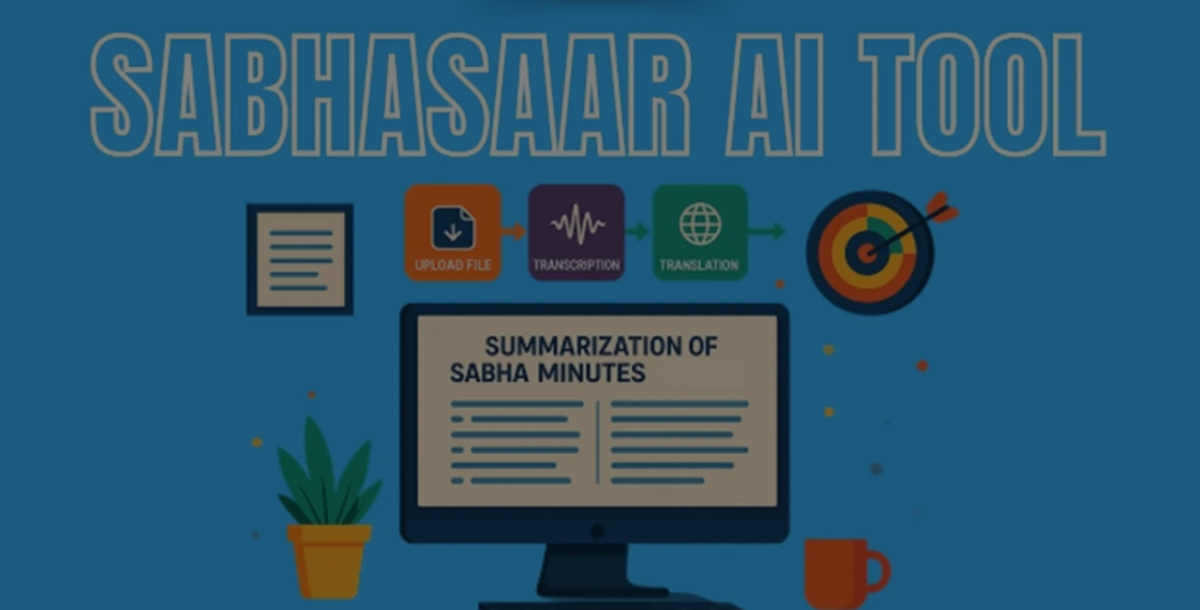
The SabhaSaar Initiative is a technology-driven parliamentary reform aimed at enhancing transparency, efficiency, and public accessibility to legislative proceedings. Launched to leverage Artificial Intelligence and digital tools, SabhaSaar enables automated summarisation, indexing, and multilingual translation of debates held in Parliament and State Legislatures. By converting lengthy discussions into concise, searchable insights, the initiative helps lawmakers, researchers, media, and citizens better understand policy deliberations. SabhaSaar also preserves institutional memory and promotes informed democratic participation. Overall, the initiative represents a significant step towards modernising legislative processes and strengthening democratic governance through accessible, data-driven parliamentary information.
SabhaSaar Initiative
In a significant move to modernise grassroots democracy, the Government of India has launched the SabhaSaar Initiative—an AI-powered digital tool designed to enhance transparency, efficiency and documentation in Gram Sabha and Panchayat meetings. Announced and rolled out on 14th August 2025 by the Ministry of Panchayati Raj, this initiative uses artificial intelligence to convert spoken discussions into structured written summaries, transforming how village-level decision-making is recorded and utilised.
What Is the SabhaSaar Initiative?
SabhaSaar is an AI-enabled voice-to-text meeting summarisation tool specifically developed to automate and standardise the process of creating Minutes of Meeting (MoM) for Gram Sabha and Panchayat gatherings. Traditionally, preparing these minutes was a time-consuming, manual task prone to delays and inconsistencies. SabhaSaar leverages Natural Language Processing (NLP) and advanced artificial intelligence to transcribe audio/video files, identify key discussion points, decisions and action items, and generate concise, structured summaries that can be used officially.
This tool is part of the broader Digital India and e-governance push to embed smart technology at the grassroots level, facilitating more effective democratic governance.
Sabhasaar Panchayat Portal
SabhaSaar is a government digital platform and AI-powered tool launched by the Ministry of Panchayati Raj, Government of India. It’s designed to automatically generate structured minutes of Gram Sabha and Panchayat meetings (Minutes of Meeting – MoM) from audio/video recordings using advanced artificial intelligence (AI) and Natural Language Processing (NLP).
Core Purpose & Functionality
AI-Driven Meeting Documentation
-
Transcribes spoken discussions from Gram Sabha or Panchayat meetings.
-
Automatically identifies key decisions and action points.
-
Generates well-formatted, structured meeting minutes.
Language Support
-
Built on Bhashini — India’s national language translation mission — allowing transcription and translation in multiple Indian languages (Hindi, Bengali, Tamil, Telugu, Marathi, Gujarati, English, etc.).
Ease of Use
-
Panchayat officials (such as Gram Panchayat secretaries) can log in using e-GramSwaraj credentials to upload audio/video files to the portal.
-
Audio/video recordings can be made with a smartphone or digital camera and uploaded later — no internet is required during recording.
Standardisation & Transparency
-
Ensures uniform minutes across Gram Sabhas and Panchayat meetings nationwide.
-
Saves time and effort compared to traditional handwritten meeting documentation.
Who Uses SabhaSaar?
-
Gram Panchayats
-
Block and District Panchayats
-
Panchayat Functionaries
-
Administrative officials involved in rural governance and record-keeping.
Official Portal
-
The SabhaSaar platform is available at:
🔗 https://sabhasaar.panchayat.gov.in/
(Note: The site may require logging in and JavaScript for full functionality.)
Adoption & Impact
-
Launched on 14 August 2025 by the Ministry of Panchayati Raj.
-
As part of the rollout, tens of thousands of Gram Panchayats have adopted the tool to generate minutes digitally.
-
It is part of India’s broader digital governance push to make Panchayat functioning more efficient and transparent.
How It Works — Basic Steps
-
Record the Meeting
-
Use a smartphone or camera to record audio/video of the Gram Sabha meeting.
-
-
Upload Recording
-
Log in to the SabhaSaar portal using e-GramSwaraj credentials and upload the file.
-
-
AI Generation
-
The AI transcribes and summarises the content into structured minutes (MoM).
-
-
Access & Use Minutes
-
The generated minutes can be used for record-keeping, transparency, and follow-up actions.
-
Benefits
✔ Time-saving: No manual writing of meeting minutes.
✔ Accuracy & Uniformity: Reduces errors and variations across documentations.
✔ Multilingual Support: Works across widely spoken Indian languages.
✔ Greater Transparency: Enhances accountability in Panchayat governance.
Key Features of SabhaSaar
AI-Enabled Voice-to-Text and Summarisation
At the heart of SabhaSaar is robust AI that can transcribe spoken content from audio and video recordings into text and then summarise it intelligently—bringing structure and clarity to what was discussed in the meeting.
Multilingual Support
Recognising India’s linguistic diversity, SabhaSaar is integrated with the Government’s Bhashini platform (National Language Translation Mission), enabling speech-to-text transcription and summarisation in multiple Indian languages along with English. This ensures that Panchayats across linguistic regions can use the tool seamlessly.
Standardised Minutes Across Regions
By automating the creation of minutes, SabhaSaar brings uniformity and quality to Panchayat records nationwide, reducing human error and variation.
Ease of Use and Accessibility
The platform is designed to be user-friendly, with training sessions and a Standard Operating Procedure (SOP) circulated to States and Union Territories to ensure smooth rollout and adoption.
Cloud-Based and Secure Processing
SabhaSaar operates on the India AI Compute Portal, under the India AI Mission, ensuring that all processing is done within government infrastructure—maintaining data sovereignty and security.
Significance of the SabhaSaar Initiative
Strengthening Decentralised Governance
Gram Sabhas are the foundation of India’s Panchayati Raj system—a constitutional framework enabling local self-governance. By automating documentation, SabhaSaar supports transparency, accountability and participatory democracy.
Enhanced Transparency and Accountability
Accurate and standardised summaries from meetings ensure that decisions are documented in real time with minimal bias or delay—boosting public trust in local governance mechanisms.
Administrative Efficiency
Village officials often spend significant time manually drafting meeting minutes. SabhaSaar reduces administrative workload, freeing officials to focus on governance and development tasks.
Supports Digital India Vision
This initiative exemplifies how AI and digital technology can improve public service delivery, aligning with India’s vision of intelligent governance and the broader Digital India mission.
Inclusive Access Through Language Technology
Integration with Bhashini ensures that users can interact with the tool in local languages, bridging digital and language divides in rural areas and supporting inclusion of diverse communities.
Latest Updates on Adoption and Implementation
Since its launch, SabhaSaar has witnessed rapid uptake across Gram Panchayats nationwide:
-
Pilot Phase in Tripura: All 1,194 Gram Panchayats were encouraged to use the tool for Special Gram Sabhas on 15th August 2025. About 87% of those Panchayats adopted SabhaSaar during the initial rollout.
-
Nationwide Adoption: By 2nd October 2025, approximately 77,198 Gram Panchayats used the tool for automated meeting summaries.
-
As of Early December 2025, more than 92,000 Gram Panchayats across States and Union Territories have adopted SabhaSaar for regular meeting documentation—showing strong traction and growing trust in the platform.
Scale of Usage
With over 92,000 Panchayats already on board and many more expected to adopt the tool in the coming months, SabhaSaar is quickly becoming a mainstream digital resource for local governance documentation. This uptake also reflects increasing digital literacy and infrastructure readiness at the grassroots level.
Challenges and the Road Ahead
While SabhaSaar represents a transformational step, there are ongoing challenges and opportunities:
-
Digital Infrastructure Gaps: Some rural areas still lack reliable internet connectivity, which may slow adoption in certain regions.
-
Training and Awareness: Continued focus is needed to train Panchayat officials and community members in utilising the technology effectively.
-
Language Robustness: While significant multilingual support exists, expanding the range and accuracy of language models could further strengthen inclusivity.
Conclusion
The SabhaSaar Initiative marks a milestone in India’s democratic and digital journey—melding artificial intelligence with grassroots governance to enhance transparency, efficiency and participation. By automating the summarisation of Gram Sabha discussions and transforming them into structured data, SabhaSaar not only strengthens local self-governance but also sets a precedent for AI-integrated public service delivery in a developing nation. Its growing adoption signals a future where technology empowers community voices and democratic processes at the most fundamental level.
FAQs
Q1. What is the SabhaSaar Initiative?
The SabhaSaar Initiative is a digital platform launched to provide summaries and key insights of parliamentary debates in a simplified and citizen-friendly format. Its main objective is to enhance transparency and public understanding of legislative discussions.
Q2. Who launched the SabhaSaar Initiative?
The SabhaSaar Initiative was launched under the aegis of Parliament of India, with support from parliamentary secretariats and digital governance bodies to improve access to legislative information.
Q3. What is the main objective of SabhaSaar?
The primary aim of SabhaSaar is to bridge the gap between Parliament and citizens by offering concise, accurate, and easily understandable summaries of Lok Sabha and Rajya Sabha proceedings.
Q4. Which parliamentary proceedings are covered under SabhaSaar?
SabhaSaar covers important debates, discussions, questions, bills, and policy-related deliberations of both the Lok Sabha and the Rajya Sabha.
Q5. What are the key features of the SabhaSaar Initiative?
Key features include:
-
Simplified summaries of parliamentary debates
-
Topic-wise and date-wise content access
-
Citizen-friendly language
-
Digital and mobile accessibility
-
Support for academic and competitive exam preparation
Q6. How does SabhaSaar promote transparency in governance?
By making parliamentary discussions easily accessible and understandable, SabhaSaar strengthens democratic participation, ensures informed citizens, and promotes accountability in governance.
Q7. Why is SabhaSaar important for students and exam aspirants?
SabhaSaar helps students and aspirants preparing for UPSC, State PSCs, SSC, and other competitive exams by providing authentic and concise parliamentary insights relevant to polity, governance, and current affairs.
Q8. How is SabhaSaar different from verbatim parliamentary records?
Unlike verbatim records that are lengthy and technical, SabhaSaar offers crisp summaries and key takeaways, making complex debates easier to understand for the general public.
Q9. How does SabhaSaar strengthen democratic values?
By encouraging awareness of legislative functioning, SabhaSaar empowers citizens, promotes informed debate, and reinforces the democratic principle of public participation in governance.
Q10. What is the overall significance of the SabhaSaar Initiative?
The SabhaSaar Initiative is significant because it:
-
Enhances legislative transparency
-
Improves citizen engagement
-
Supports digital governance
-
Encourages informed public discourse
-
Strengthens India’s democratic framework