
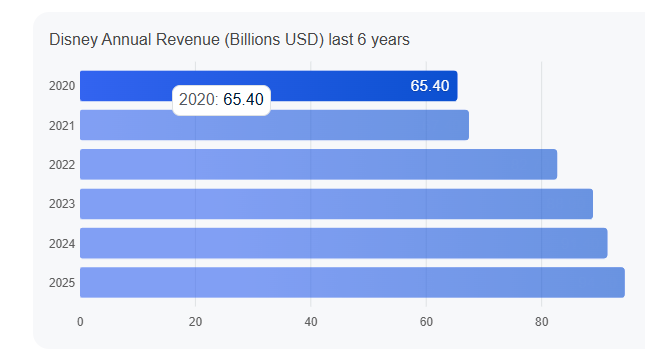
How much money does disney make in a second, minute, day, and year?: In the fiscal year 2025, The Walt Disney Company generated about $94.4 billion in revenue — the total money it earned from all its businesses including movies, parks, streaming, and merchandise. That breaks down to roughly $2,995 every second, about $179,700 per minute, around $7.29 million a day, and the full $94.4 billion in a year. These are average figures based on annual revenue and help show just how massive Disney’s global operations are, from theme parks and films to TV networks and digital streaming platforms.
How Much Money Does Disney Make? A Complete Breakdown
The Walt Disney Company is one of the largest entertainment conglomerates in the world, generating vast amounts of revenue from a variety of businesses worldwide — from theme parks to blockbuster movies and streaming services. Understanding how much money Disney makes in different time intervals — per second, minute, day, and year — helps illustrate just how powerful its economic engine is.
To compute earnings per second or per day, we use Disney’s annual revenue as the baseline — the total money the company generates from its operations before expenses. The most recent full-year revenue data shows that Disney earned roughly $91.36 billion in fiscal year 2024.
Disney’s Annual Income (Revenue)
According to Statista and Disney’s own financial releases:
-
Fiscal Year 2024 Total Revenue: $91.36 billion.
Some sources (like unofficial estimates or older data sets) may show slightly different figures (e.g., ~$82 billion), but the most reliable annual numbers come from Disney’s official reports. Using official numbers gives a more realistic estimate of current earnings.
Revenue Per Time Unit: Calculations
There are 31,536,000 seconds in a year (60 sec × 60 min × 24 hr × 365 days). Dividing annual revenue by that figure gives a rough time-based revenue estimate.
Per Second
$91,360,000,000 ÷ 31,536,000 ≈ $2,898 per second
At this scale, Disney earns nearly $2,900 every second on average from all its businesses worldwide.
Per Minute
$2,898 × 60 ≈ $173,880 per minute
So Disney makes roughly $173,000+ every minute of every day.
Per Hour & Day
-
Per hour: $173,880 × 60 ≈ $10,432,800
-
Per day: $10,432,800 × 24 ≈ $250,387,200
Disney earns roughly $250 million per day on average.
Per Year
As noted, Disney’s total annual revenue is about $91.36 billion.
What Are Disney’s Ways of Making Money?
Disney’s revenue doesn’t come from one source — it is diversified into several major business segments. Each contributes in different ways and proportions to the total revenue picture.
Below are the key income streams:
1. Parks, Experiences & Products
This segment includes:
-
Theme park and resort ticket sales: Disney World, Disneyland, Disneyland Paris, Tokyo Disney Resort, etc.
-
Hotel and resort stays: Rooms, food, and hospitality.
-
Cruise Lines: Disney Cruise Line bookings.
-
Merchandise, consumer products & licensing: Disney toys, apparel, books, games, and licensed products sold worldwide.
Parks and experiences alone generate tens of billions per year — and historically around 30–40 % of Disney’s total revenue.
Why it matters: Theme parks are high-margin businesses with repeat visitors and strong merchandise sales. Cruise and vacation segments also add significant revenue.
2. Entertainment & Media Networks
This is one of Disney’s largest revenue sources. It includes:
-
Television networks: ABC, ESPN, Disney Channel, FX, National Geographic, etc.
-
Advertising income: Ads shown during sports, TV shows, and network programming.
-
Content licensing: Disney licenses movies and shows to other platforms and TV networks globally.
-
Film studios: Box office and post-theatrical earnings (home video, licensing).
In fiscal year 2024, the entertainment segment contributed roughly $41 billion+ in revenue.
3. Direct-to-Consumer (Streaming)
Disney’s streaming services include:
-
Disney+
-
Hulu
-
ESPN+
These generate money through:
-
Monthly/annual subscription fees
-
Advertising revenue (for ad-supported subscription tiers)
-
Bundled offerings and premium add-ons
Disney’s streaming segment has grown rapidly and is increasingly profitable, though it still competes with giants like Netflix and Amazon Prime.
4. Movies & Theatrical Releases
Huge global hits — like Inside Out 2, Deadpool & Wolverine, Moana 2, and franchises like Star Wars and Marvel — continue to bring massive box office revenue, plus later DVD/Blu-ray sales and licensing. Successful films also increase merchandise sales and theme park tourism.
5. Sports & Live Events
Disney owns ESPN and related sports media properties. Revenue comes from:
-
Broadcast rights
-
Subscription fees
-
Advertising during live sports
-
Streaming rights for events
Deals like the one with WWE for exclusive streaming rights to live events add to this income stream.
Profit vs. Revenue
Remember, revenue ≠ profit. Revenue is all the money Disney gets before expenses; profit is what remains after costs.
Disney has reported strong net income growth in recent years, with net profits rising significantly in 2025 — a sign that the business is becoming more efficient even as revenue grows.
Disney in Context
Disney’s diversified revenue streams — parks, streaming, entertainment, merchandising, live sports, and licensing — collectively create a huge economic footprint.
🔹 Daily: ~$250 million
🔹 Per minute: ~$173,000
🔹 Per second: ~$2,900
🔹 Annual: ~$91 billion+
Even with global economic swings, Disney’s size and breadth of business give it impressive resilience and consistent cash flow from many interconnected sectors.
Final words
Disney earns enormous sums every second, driven by a well-diversified set of revenue streams built over decades of expansion and brand power. Whether through theme parks, beloved characters, global streaming platforms, or blockbuster films, Disney’s financial ecosystem translates into remarkable earnings across every unit of time.
Understanding these numbers helps illustrate not just Disney’s financial success — but also the complexity and scale of how modern entertainment empires make money.
FAQs
1. How much does Disney cost per day?
The “cost per day” for visiting Disney theme parks depends on the park, season, ticket type, add-ons (like Park Hopper), food, hotel, and extras. Here’s a breakdown:
Theme Park Tickets
-
Walt Disney World (Florida):
-
Standard one-park-per-day tickets typically range roughly $109 – $189 per day for adults, depending on date and park.
-
On peak days (holidays/summer) some tickets can exceed $200 per person per day.
-
-
Disneyland (California):
-
One-day tickets vary by tier, roughly $104 – $224 per day currently.
-
Food & Drink
-
Expect to spend about $30 – $115+ per adult per day on food inside the parks (varies by meal style and location).
Hotel/Stays (Optional)
-
On-site Disney hotels range from value to deluxe:
-
Low end: ~$130+ per night
-
Mid/Disney moderate: ~$300-$600+ per night
-
Deluxe: ~$700-$1000+ per night
(These reflect typical 2025 prices.)
-
Estimated “Total Per Day”
-
A budget daily park experience (ticket + basic food) might be ~$130-$250 per person.
-
For a more typical family day (ticket + meals + extras), many people spend $250 – $500+ per person per day, not including travel or hotel.
Quick example:
A family of four could easily spend near $1,000 in a single day in ticket + food + basic extras, even before hotels and travel.
(Note: costs vary hugely by season, add-ons like Genie+/Lightning Lane, and personal choices.)
2. How much does the Disney CEO make?
As of the most recent publicly filed data:
-
Bob Iger, the CEO of The Walt Disney Company, had a total compensation of about $41.1 million in 2024.
Compensation Breakdown (2024)
-
Base salary: ~$1 million
-
Stock awards: ~$18.3 million
-
Option awards: ~$12 million
-
Performance bonuses: ~$7.2 million
-
Other compensation: ~$2.1 million
(Total ≈ $41.1 million)
Most of this is performance-based (stock/bonuses) rather than straight salary.
(Note: CEO pay can change each year depending on performance and board decisions, and Disney is expected to appoint a successor around 2026.)
3. What is the 2 PM rule at Disney?
The “2 PM rule” refers to a former park policy at Walt Disney World regarding Park Hopping and park access, primarily for Annual Passholders:
What It Was
-
Historically, when Disney World reopened some operations after the pandemic, guests with a Park Hopper ticket could only visit a second park after 2:00 PM.
Today’s Situation (2025)
-
As of early 2024, Disney removed the strict 2 PM waiting requirement for Park Hopping — meaning you can hop between parks anytime during park hours after entering your first park.
-
However, the concept of “2 PM access without reservations” still shows up for Annual Passholders:
Annual Passholders used to be able to enter parks without a reservation after 2 PM on certain days (except Magic Kingdom on busy weekends), though the exact reservation rules continue evolving.
In short:
The 2 PM rule used to be a time you had to wait before hopping parks — but that restriction is mostly gone now. The legacy of the rule lives on in some Annual Passholder access policies, but you can usually park hop any time after your first park entry (subject to capacity).
4. Who is richer — Disney or Amazon?
In terms of company size and financial strength, Amazon is considerably larger than Disney based on key measures many investors and analysts watch:
Market Capitalization (Company Value)
-
Amazon: ~$2.4 trillion (much larger valuation).
-
Disney: ~$188 billion in market cap — far smaller by comparison.
Revenue & Profit
-
Amazon: generates vastly higher revenue (hundreds of billions annually) and higher net income.
-
Disney: revenue is smaller (tens of billions).