
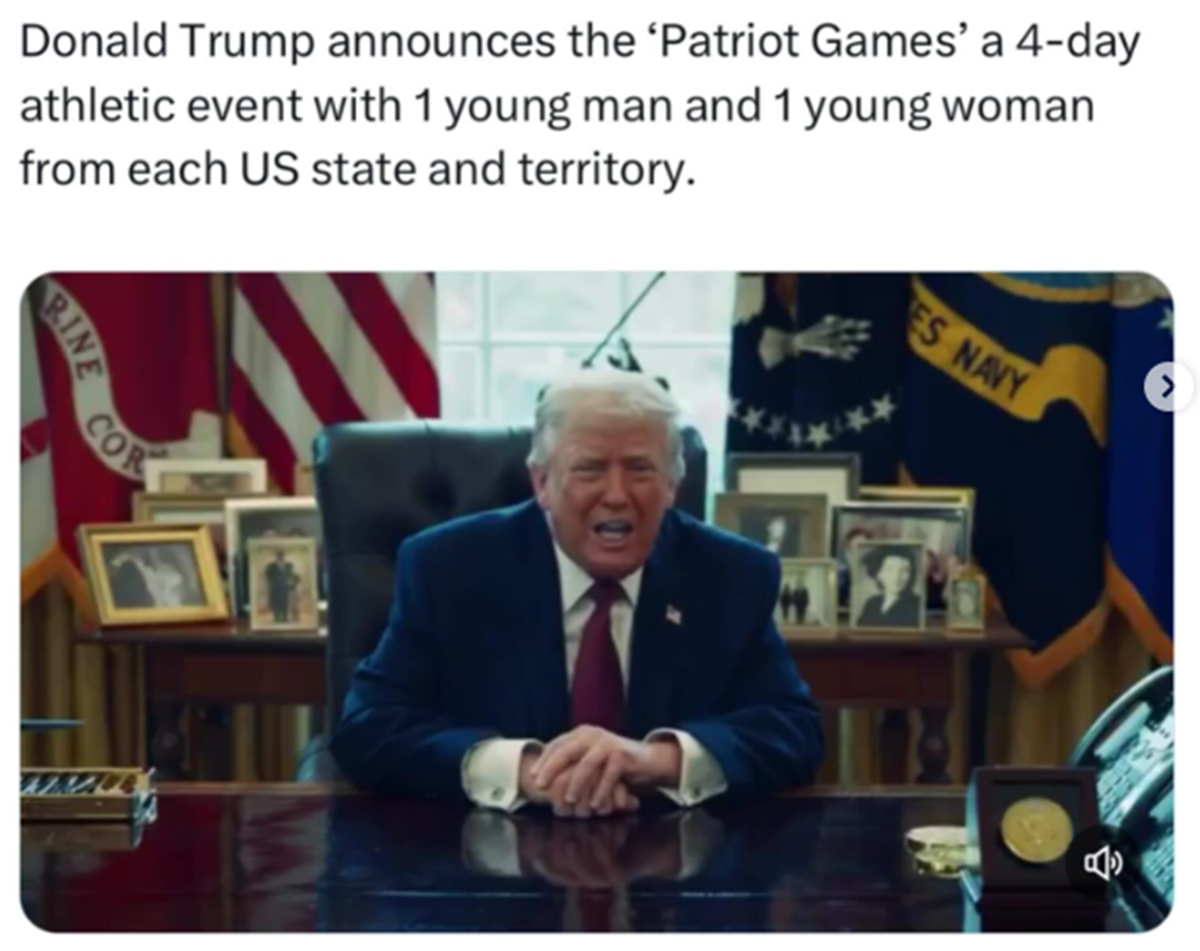
Donald Trump’s political career can be understood not merely as a conventional struggle for electoral power, but as a dramatic contest shaped by loyalty, spectacle, and survival. Two metaphors help decode this phenomenon: “Patriot Games” and “Hunger Games.” Together, they describe how Trump reshaped American politics into an arena where nationalism is tested, institutions are challenged, and political actors compete under constant pressure for relevance and allegiance.
The Meaning of “Patriot Games”
The phrase Patriot Games refers to Trump’s redefinition of patriotism as personal loyalty to his vision of America. Under Trump, patriotism was no longer limited to respect for the Constitution, democratic norms, or long-standing institutions. Instead, it became a political litmus test: those who supported Trump were “true patriots,” while critics—whether Democrats, Republicans, journalists, judges, or bureaucrats—were portrayed as enemies of the nation.
This framing proved politically powerful. By casting himself as the sole defender of “real America,” Trump positioned dissent as betrayal. Institutions such as the FBI, intelligence agencies, election bodies, and even courts were publicly questioned when they contradicted him. This constant challenge to authority was not accidental—it was a strategy to shift trust away from systems and toward a single leader.
In this game, loyalty mattered more than expertise. Officials who upheld institutional independence were sidelined, while those who echoed Trump’s language and grievances were elevated. The result was a political environment where patriotism became performative, measured by public displays of support rather than commitment to democratic principles.
Nationalism as a Political Weapon
Trump’s version of nationalism was emotional and confrontational. Slogans like “America First” simplified complex global relationships into zero-sum conflicts. Immigration, trade, NATO, climate agreements, and international organizations were framed as threats rather than cooperative frameworks.
This approach energized large segments of the electorate who felt ignored by globalization and cultural change. However, it also deepened divisions. Opponents were not just wrong—they were portrayed as anti-American. In this way, Patriot Games became a constant test of allegiance, played daily through rallies, social media posts, and media confrontations.
Enter the “Hunger Games” of Politics
If Patriot Games defines loyalty, Hunger Games describes survival. Borrowing from the dystopian fiction, this metaphor captures how Trump turned politics into a competitive arena, where allies, rivals, and institutions constantly fought to avoid elimination.
Trump governed—and continues to campaign—by rewarding loyalty and punishing dissent. Cabinet members, advisors, party leaders, and even long-time allies were publicly praised one moment and discarded the next. Turnover became normal, reinforcing the idea that no position was secure unless absolute loyalty was maintained.
Within the Republican Party, this created an internal Hunger Games. Politicians faced a stark choice: align with Trump and survive politically, or oppose him and risk primary challenges, public ridicule, or political irrelevance. Many adapted, reshaping their positions to fit Trump’s narrative rather than traditional conservative ideology.
Media as the Arena
In the Hunger Games analogy, media platforms functioned as the arena itself. Trump’s mastery of television and social media allowed him to dominate attention. Conflict was not a side effect—it was the fuel. Every controversy kept him at the center of the conversation, forcing opponents to react on his terms.
This constant visibility made Trump politically resilient. Legal troubles, impeachment proceedings, and scandals often strengthened his bond with supporters, who interpreted criticism as proof that powerful forces were targeting their champion. In Hunger Games terms, attacks from elites only reinforced his status as a survivor fighting the system.
Institutions Under Pressure
Perhaps the most lasting impact of Trump’s Patriot and Hunger Games is the strain placed on democratic institutions. Elections, judicial independence, and civil service neutrality faced unprecedented skepticism. Claims of election fraud, especially after the 2020 election, pushed the boundaries of democratic acceptance.
While American institutions ultimately held, the damage was not insignificant. Trust declined, polarization intensified, and the idea of shared democratic rules weakened. In the Hunger Games framework, institutions became obstacles to be overcome rather than foundations to be protected.
Supporters vs. Opponents: Two Realities
Trump’s supporters often view him as a disruptor who exposed corruption, challenged hypocrisy, and fought for forgotten Americans. To them, Patriot Games represent a necessary struggle to reclaim national pride, and Hunger Games symbolize survival against entrenched elites.
Critics, however, see something more troubling: erosion of democratic norms, normalization of misinformation, and the personalization of power. From this perspective, Trump’s games replace rule-based governance with emotional mobilization, making democracy dependent on loyalty rather than law.
The Broader Legacy
Regardless of one’s political stance, Trump has permanently altered the American political landscape. He proved that politics in the digital age is less about policy detail and more about narrative control, identity, and spectacle. Patriotism can be reframed, and political survival can depend on visibility rather than competence.
Even after his presidency, Trump’s influence continues to shape elections, party strategies, and public discourse. Future leaders—both in the U.S. and globally—are studying this model, recognizing how quickly democratic systems can be transformed into arenas of constant competition.
Conclusion
Trump’s Patriot Games and Hunger Games are not just metaphors—they are frameworks for understanding a new style of politics. One game tests loyalty through nationalism; the other demands survival through conflict. Together, they reveal how power can be maintained by redefining patriotism and turning governance into spectacle.
Whether this era is remembered as a corrective disruption or a dangerous precedent will depend on how societies respond—by reinforcing democratic norms or by continuing to play the games.
FAQs
What is meant by “Trump’s Patriot Games”?
“Trump’s Patriot Games” is a phrase often used by political commentators and media outlets to describe Donald Trump’s strategy of appealing to nationalism, patriotism, and “America First” sentiments. It generally refers to his political messaging, campaign tactics, and public positioning aimed at energising his core voter base.
Is “Trump’s Patriot Games” a book or a political concept?
In most contexts, it is used as a political concept or headline phrase, not an official policy name. However, the phrase may also appear as a book title, opinion column, or documentary theme, depending on the publication using it.
Why is patriotism central to Donald Trump’s politics?
Patriotism plays a key role in Trump’s politics because it helps him connect emotionally with voters who value national sovereignty, military strength, border security, and traditional American identity. His speeches often frame political issues as battles between “patriots” and the “establishment.”
How does Trump use patriotism during election campaigns?
Trump frequently uses:
-
National symbols like the flag and military imagery
-
Rhetoric focused on national pride and sovereignty
-
Strong opposition to globalism and illegal immigration
-
Messaging that portrays elections as a fight to “save America”
These elements together are often described as part of his “patriot games.”
Is “Patriot Games” linked to Trump’s foreign policy?
Indirectly, yes. Trump’s foreign policy positions—such as reducing U.S. involvement in foreign wars, pressuring NATO allies, and prioritising American economic interests—are often presented as patriotic decisions that put the U.S. first.
Why do critics use the term “Patriot Games”?
Critics use the term to suggest that Trump strategically deploys patriotism for political gain, sometimes accusing him of oversimplifying complex issues or using divisive rhetoric to mobilise supporters.
How do supporters view Trump’s “Patriot Games”?
Supporters generally see it positively, viewing Trump as:
-
A defender of national interests
-
A leader who challenges political elites
-
Someone who prioritises American workers and security
For them, patriotism is seen as genuine rather than performative.
Does “Trump’s Patriot Games” affect U.S. democracy?
Opinions vary widely. Supporters argue it strengthens democracy by engaging voters who feel ignored. Critics argue it can polarise society and undermine trust in institutions by framing political opposition as unpatriotic.
Is the phrase still relevant after Trump’s presidency?
Yes. The phrase remains relevant as Trump continues to influence U.S. politics, election campaigns, and the Republican Party. His style of patriotic messaging continues to shape political discourse in the U.S.
Why does the media frequently use phrases like “Patriot Games” for Trump?
Media outlets often use such phrases to:
-
Summarise complex political strategies
-
Create impactful headlines
-
Highlight the emotional and symbolic aspects of Trump’s politics